

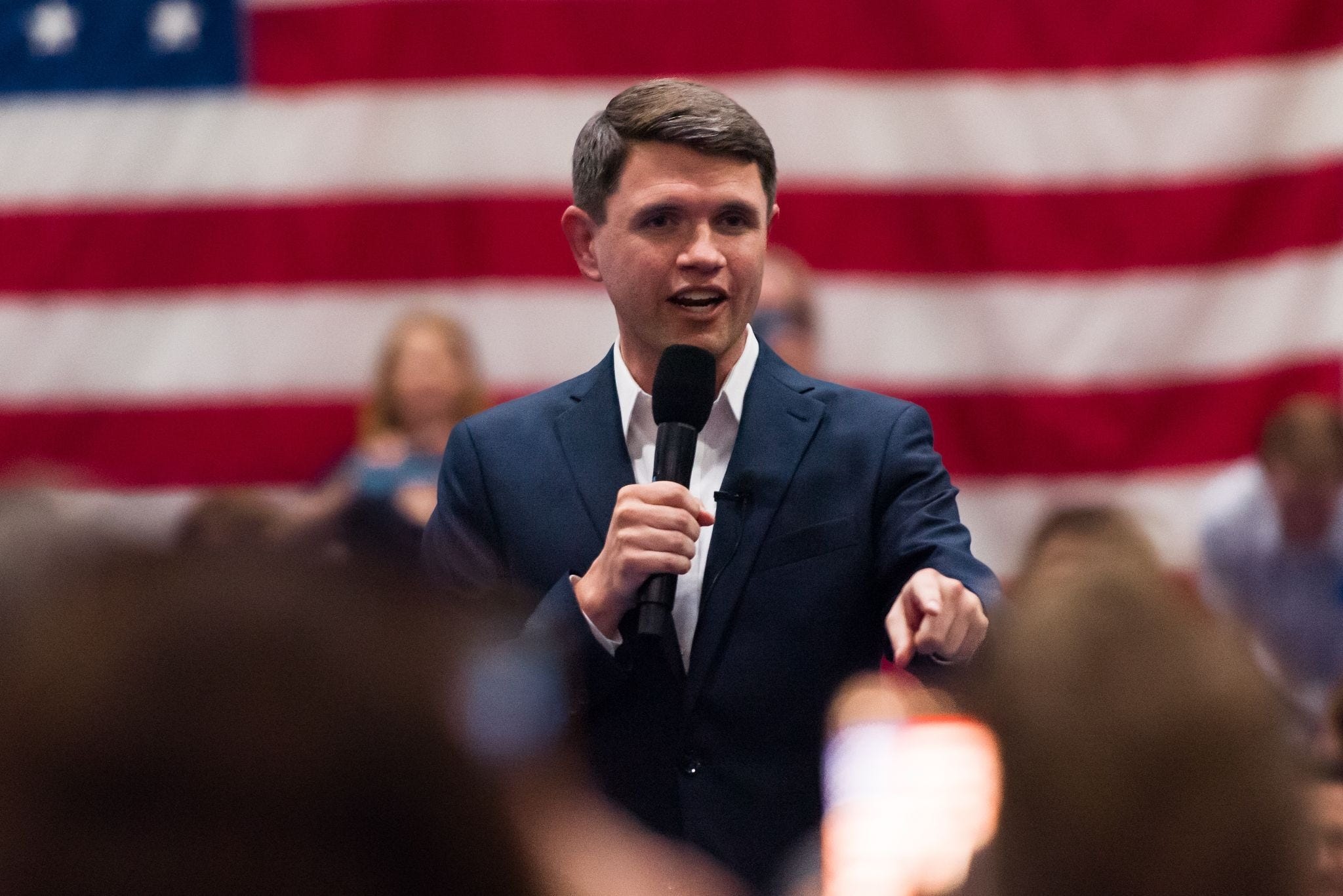
James Talarico is the Democratic Party’s greatest Rorschach test. To some, he’s proof that the progressive brand, one defined by tough rhetoric against big corporations and billionaires, can win a state exclusively governed by country-club Republicans.
To others, he’s evidence that issue moderation works. After all, how can you get elected in Texas without telling voters that you won’t decimate the fossil fuel industry or back policies that create chaos at the border?
Everyone loves a winner, but the fact that many camps claim Talarico proves that the Democratic Party’s factional debate has entered a new era. And (some) contentious arguments of the past can be put to rest.
The left no longer argues that Hispanic voters want a less restrictive border policy or that young people are uniquely motivated by a political message that centers on climate change. By the same token, red-state Democrats do not need to directly ape the economic sensibilities of a politician like Joe Manchin.
Instead, it’s clear that all factions can play a constructive role in the future of the Democratic Party. As the New York Times editorial board wrote today, “Even as the factional battles between the party’s left and center will no doubt continue, the Democrats who won difficult races this year largely borrowed the strongest messages from each side.”
If Democrats want to keep expanding the map, then this synthesis must be taken to heart. To those invested in making the party more electorally competitive, it’s time to acknowledge that the old factional war is over.
What the moderates got right
The argument in favor of issue-moderation emerged in response to a well-funded and widely accepted view inside the Democratic Party: the path to a bigger governing majority must involve moving sharply to the left on key issues that were not connected to the economy.
This reached a fever pitch during the 2020 presidential primary, when interest groups and candidates pushed the party hard to the left on immigration policy. The idea wasn’t just that this was good policy, but that it was critical to winning Hispanic voters. As Rogé Karma reported in The Atlantic, “These groups convinced party leaders that shifting to the left on immigration would win Latino support. Their influence can be seen in the focus of Hillary Clinton’s campaign on immigration and diversity in 2016, the party’s near-universal embrace of border decriminalization in 2020, and the Biden administration’s hesitance to crack down on the border until late in his presidency.”
At the same time, climate groups were ascendant. The case, which was led by the Sunrise Movement, was that young voters couldn’t be mobilized if politicians didn’t talk about climate. This argument, and the groups leading it, became gospel on the Left and carried influence in the Biden administration.
Yet last Tuesday in Texas, young and Hispanic voters turned out in droves for candidates who campaigned on policies that were basically the inverse of the ones I laid out above: a pledge to protect the oil and gas industry and a promise to work with Donald Trump on securing the border (though not on the administration’s brutal and lawless internal deportation policies).
Talarico wasn’t alone. As Robinson Meyer wrote in Heatmap, “This new class of congressional Democrats sought to embrace every kind of energy source except for coal.” And just like Texas, those states turned blue on the back of historic youth turnout.
Even the left’s most favored candidate engaged in textbook issue moderation. In the week before election day, Abdul El-Sayed criticized the Biden administration’s handling of border security, going as far as to say that “The politics at the time were complicated by a lot of advocacy. And I think we’ve learned a lesson.” On climate, he told a reporter he didn’t get caught up on “one and a half degrees or two degrees” of warming, and that he preferred to talk about how Americans “shouldn’t have to breathe unclean air.”
El-Sayed also did not adopt the maximalist Medicare for All policy that defined Bernie Sanders’ presidential campaign. Instead, his plan says “Medicare for All does not have to ban additional private insurance through unions or employers.” Searchlight polling has found that 70 percent of Americans would prefer to keep their coverage than enroll in single-payer; El-Sayed simply adopted a more popular policy than the one that used to define the left.
What the left got right
The moderation camp’s theory of candidate electability was too mechanical: directly emulate the politicians who used to win red states in the 2000s. Or, nominate the candidate with a demonstrated history of winning over coveted swing voters.
A candidate like Josh Turek benefited from his experience winning and representing a red state Senate seat, but the theory doesn’t extend to everyone. Gina Hinojosa beat the seemingly invincible Greg Abbott, despite representing a deep-blue Austin district — in part, because she distanced herself from cultural progressivism.
But she was also one of the many Democratic candidates who racked up big margins in red states by embracing economic populism — a message that is distinct from many of the Democrats who used to anchor the party’s majorities. On the campaign trail, she would often say, “Does Texas belong to the people, or is this the billionaires’ world and we just live here?”
In South Carolina, Annie Andrew’s agenda blamed corrupt politicians and big corporations “for raising the cost of … well just about everything.” Jeff Stein, a reporter who is currently writing a book on Bernie Sanders, compared Talarico’s basic diagnosis of American politics to the socialist senator’s.


While economic populism isn’t exactly a new force in Democratic politics, the “billionaires” and the “big corporations” have reached historic levels of boogeyman status among this new class of politicians; notably, that rhetoric is not turning off red-state voters. Bernie Sanders, especially the one who ran in 2016, can say I told you so.
An issue that rhymes with economic populism is a general and bipartisan antipathy toward data centers. Data center moratoriums were on 44 ballots on Tuesday, and they won in 43 of them. The first national politician on the anti-data-center wave was Bernie Sanders.
There’s also Israel.
One should not overstate the electoral salience of this particular country in the Middle East, but the insurgent left had the right political argument, and they had it first. America should not be sending money overseas to an “ally” that destabilizes the region and commits widespread atrocities in Gaza; the voting public agrees, and Israel’s favorability continues to plummet. The party’s pro-Israel consensus, which was driven by many moderates, will certainly not exist in the next Democratic administration.
It’s worth mentioning that some on the left have simply developed better political instincts. That means running on an agenda that is relatively simple and popular: enacting universal health care, taking money out of politics, and regulating or stopping the rapid data center buildout.
The Democratic Party at its best
In many ways, this synthesis between the left and the moderates represents an updated version of the most successful template for Democratic success.
The barnstorming blend of economic populism and cultural moderation practiced by Talarico, Ossoff, and Adam Hamilton in Kansas was core to the campaign strategies of our last two-term Democratic presidents. The campaign manifesto from Bill Clinton and Al Gore was titled “Putting People First,” and included sweeping health care reform and massive infrastructure investments.
During a rally kicking off his second presidential campaign, Obama derided Mitt Romney for saying “Corporations are people.” No, he told the raucous crowd, “People are people.” Obama later ran a campaign ad highlighting a paper factory worker in Marion, Indiana, who saw his plant shutter after a corporate restructuring plan that was overseen by Mitt Romney and Bain Capital.
Of course, both Obama and Clinton paired economic populism with efforts to ensure they didn’t get portrayed as liberals who were out-of-touch on cultural values — attacks that their opponents lobbed at them incessantly.
Make no mistake, this isn’t a call to go back to the politics of that time. Notably, our country has moved in a much more progressive direction on many cultural issues such as LGBTQ rights. On material issues, there’s a bigger appetite for sweeping health care reform and an increasingly bipartisan agreement among voters that wealthy Americans and big corporations need to pay more in taxes.
The new synthesis does not need to revolve around the fights of the past. But one overarching principle we should carry forward into the new debates ahead is that enforcing an orthodox ideology on the party is a losing strategy. Searchlight’s Supermajority polling project found that “Only 14% of the electorate is completely ideologically conservative and 10% is completely ideologically liberal.”
Tuesday night marked a new era in American politics. If Democrats want to lead it, then they need to remember why they won. The party is at its best when it is a big tent, when it runs heterodox candidates who match the dynamism and maverick nature of the American people.
I would add in the Bulwarkers as the third leg of the stool.
It’s significant that very little of the social moderation of 2026 involved “hippie punching”- candidates didn’t go out of their way to pick fights with progressive activists in order to burnish their centrist credentials.