

Earlier this month, Representative Alexandria Ocasio-Cortez dropped a political grenade when she remarked that “Woke 1.0 was crazy.”
Now, what exactly does this mean? The comment came in response to a question about abolishing prisons and defunding the police. So it’s been taken as a renunciation of the Left’s COVID-era anti-police politics and excessive cultural progressivism. But what has been left unsaid, yet still functionally admitted by many other Left politicians, is that they dropped several other toxic policy positions as well.
Sure, AOC no longer uses pronouns in her social media bio. But this was also the first session of Congress when she did not introduce a resolution supporting the Green New Deal. Abdul El-Sayed and Peggy Flanagan, two of the Left’s favored Senate candidates, aren’t using the word Latinx. But they also don’t advocate for decriminalizing border crossings — which was once a defining left-wing immigration position. Climate policy was the central organizing issue on the Left in 2020, but it is largely absent inside the faction today — even the DSA House candidates running in deep blue districts hardly mention it.
The rallying issues for the Left today are cost-of-living and concentrated wealth. The void left by climate has been filled by dogmatic positions on data centers and restricting aid to Israel — two stances that are more popular with the voting public. And their defining immigration issue is Abolish ICE, which is not the sort of message that will appeal to a conservative voter, but has less downside than an issue like border decriminalization.
Not coincidentally, this pivot is coming at the peak of the Left’s electoral prominence. They’re winning big-city mayoral offices (in part because they’re less combative towards the police), earning swing state primary nominations, and unseating incumbents across the country.
To be clear, there is absolutely more the Left needs to do to expand their political appeal to red states. Campaigning with influencers like Hasan Piker or refusing to adopt even a single moderate cultural position will always hold the movement back.
But it’s important to recognize that the Left sounds a lot different than it did in 2020. This is both integral to their expanding influence and a reminder that running on popular issues does, in fact, translate to political success.
The Medicare-for-all pivot
The most important position change is over healthcare. As crazy as it might seem to those who suffered through the tedious Medicare-for-all debate that defined the 2020 presidential primary, a candidate can now be in good standing on the Left and still advocate for maintaining a private health insurance market.
In fact, a candidate can navigate a contentious Senate primary, moderate his Medicare-for-all plan to allow 160 million Americans to stay on their private employer health insurance, and Bernie Sanders, the biggest M4All purist in American politics, will call that win “the most extraordinary and impressive political victory in the modern history of the United States of America.”
Of course, I’m talking about Abdul El-Sayed’s campaign in Michigan. Rachel Cohen recently covered El-Sayed’s policy shift for Vox, but it is still perhaps the most underdiscussed story of this election cycle. That’s because, as Cohen noted in her reporting, his Medicare-for-all plan is quite similar to the one Pete Buttigieg proposed in 2020. And as some might recall, Buttigieg was slammed by the Left for his “Medicare-for-all who want it” plan. Justice Democrats, one of the most influential progressive PACs in American politics, accused Buttigieg of abandoning a purer form of Medicare-for-all because of corporate influence.
Now, El-Sayed is one of the most important political figures on the factional Left, and his healthcare plan says “Medicare for All does not have to ban additional private insurance through unions or employers.” He also recently told The Bulwark that “as long as it reduces the power of the health care corporations, expands health care, and does so publicly, I’m for it, and would be glad to work with like-minded partners on that path.”
Those are very similar to the guiding principles of Searchlight’s healthcare plan.
This is also just good politics. Abolishing private health insurance is a position that is both unpopular and not what Americans expect when they hear the slogan Medicare-for-all. A polling collaboration last month between Searchlight and Zeteo found that 61 percent of Americans expected Medicare-for-all to allow people to keep their private health insurance, and that 70 percent of Americans would prefer to keep their coverage than enroll in single-payer.
El-Sayed won his primary by a percentage point. That means it’s not an exaggeration to say that if he held tight to the Left’s old line on phasing out private health insurance, Haley Stevens might be Michigan’s Senate nominee.
They barely say climate
In addition to running on an uncompromising Medicare-for-all plan, Bernie Sanders, the Left’s favored 2020 presidential candidate, had an aggressive $16 trillion climate agenda. Time magazine called him the Green New Deal candidate, and emphasized that he “finds ways to incorporate climate into seemingly unrelated questions.”
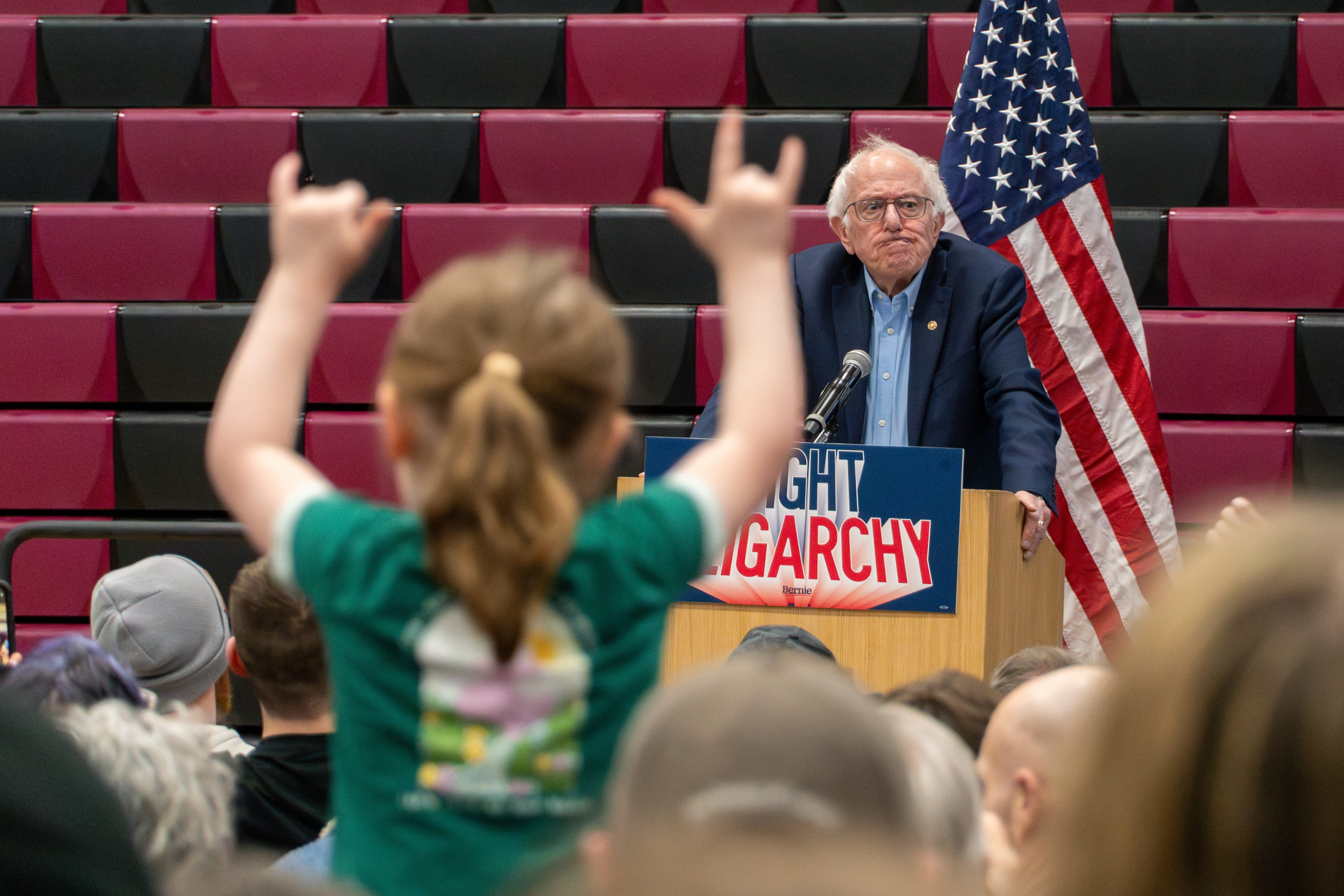
But listen to Sanders speak at a Fight the Oligarchy rally, and climate is barely mentioned; the message is almost exclusively focused on concentrated wealth and Trump’s corruption.
This political strategy extends to many insurgent Left candidates as well. Writing in The Nation, Ilhana Cohen warned climate activists that their issue was missing from New York’s progressive primary wave, and that “even when candidates had robust climate platforms, climate change didn’t generally feature prominently in candidate forums, rallies, or media coverage.”
One might argue that this is because the climate movement culminated in the Inflation Reduction Act, which included hundreds of billions in clean energy spending. But Republicans repealed many of those tax credits. And none of the insurgent candidates on the Left have prioritized bringing them back in their campaign messaging.
On his website, Abdul El-Sayed’s campaign includes the words “climate crisis,” but it is buried in a section on Environment and Natural Resources, which is itself buried in a tab titled “Money out of Politics.” In terms of actual policy, El-Sayed doesn’t explicitly call for a fracking ban or any classic keep-it-in-the-ground policies.
His campaign also keeps a database where voters can type in an issue and watch a clip of El-Sayed speaking about it. ‘Climate change’ yields absolutely no results.

Again, this omission is not restricted to a single candidate. In a NYT editorial from May of this year, Matthew Huber identified left-wing candidates like Trey Martin in Oklahoma and Chris Reichard in Missouri, who omitted climate from their campaign messaging. As Huber noted further in his reporting, Sam Forstag, a Bernie-endorsed, union worker running for Congress in Montana, doesn’t mention the issue in his platform, and did not even say climate change when he was asked about wildfires in the state.
Candidates like Forstag or Rebecca Cooke in Wisconsin are oddities because they’re endorsed by both the moderate Blue Dog caucus and Bernie Sanders. The fact that such a combination exists is proof that the Sanders left is evolving, or even returning to the faction’s pre-2020 economic populist roots.
What Mamdani taught the Left
El-Sayed is heralded as a potential successor to Bernie Sanders and a future presidential candidate. But compared to the Left’s previous presidential candidates, his agenda is far simpler and more legible to a more disengaged voter.
Elizabeth Warren’s presidential run was defined by extensive and ambitious policy plans. She wanted to cancel student debt, end the opioid crisis, invest trillions in clean energy, break up big tech companies, and the list went on. This lack of focus was a problem for Bernie Sanders too; just read this quote from the beginning of his 2020 presidential campaign announcement where he describes the goal of his political movement.
“It will not be racism, sexism, xenophobia, homophobia and religious bigotry. That is going to end. The principles of our government will be based on justice: economic justice, social justice, racial justice and environmental justice.”
Listen to El-Sayed’s victory speech in the Michigan Senate primary, and you don’t hear any of those words. Instead of economic justice, it’s “the price of gas and the price of groceries.” There isn’t a laundry list of goals. It’s simply “Money out of Politics, Money in Your Pocket, Medicare-for-all.”
Senate campaigns are focused, by definition, on a more limited set of issues than a presidential campaign, but the difference in scope and framing is still quite stark. So what’s the impetus behind the change?
Let’s start with the most surprising campaign of the decade: Zohran Mamdani’s mayoral win in New York. After he shocked the political world, numerous pundits and strategists wrote strategy documents and op-eds identifying what the Left could learn from the campaign.
The central point was to just keep the message simple and laser-focus on economic issues. Jared Abbott, a researcher at the Center for Working-Class Politics, wrote in Jacobin: “Unlike many other progressive candidates over the last five years, that’s exactly what Mamdani did. His campaign was highly disciplined, with a tight focus on housing, transportation, wages, and the everyday cost of living.”
So if you listen to El-Sayed or even Melat Kiros in deep-blue Denver, the rhetoric is simple and the top-lines are concentrated wealth and cost-of-living. Even Palestine, which, as many have argued, has replaced climate change as the Left’s rallying issue, is best framed in economic terms. El-Sayed says Israel’s military aid should be spent on communities in America.
There are certainly still examples of Left candidates clinging to COVID-era cultural progressivism and anti-police politics. And again, this is not a movement that holds the keys to winning a red state like Iowa or Texas. But the Left is leaner and more focused on kitchen-table issues. It’s no wonder why they’re more popular with voters. They took on a more popular set of issues.
Forgot about Latinx! Good times.
All good changes. Not running on climate change doesn't mean not promoting climate change initiatives once elected. Ossoff's hits on Trump's corruption also seems like it's getting traction, in part because it has some authenticity behind it rather than simply following the political winds on such themes as affordability, scaled down progressive left themes, and simpler messaging.