


Recently, the election discourse was set ablaze when Rebecca Traister dropped a reported story in New York Magazine about Troy Jackson’s campaign against Maine Senator Susan Collins.
Embedded inside the piece was a thesis that, for many, summarizes exactly what’s wrong with the Democratic Party: Troy Jackson’s populist politics have been watered down by a nefarious class of DC consultants. The socialist commentator Nathan Robinson put it bluntly in a widely shared piece: “The Consultants Will Kill You.”
Campaign consultants make the best boogeyman. They’re portrayed as faceless, gutless, poll-waving buzzkills. In the 1972 film The Candidate, Robert Redford plays a firebrand Senate candidate in California who is convinced by consultants to moderate in order to appeal to more voters. He wins, but the movie ends with Redford ideologically adrift and seemingly regretful. The viewer is left with a negative impression of campaign consultants. And Traister’s story leaves the reader with a similar impression of Troy Jackson’s campaign in Maine.
Now, is this true? Are consultants really as bad as they say?
As in any profession, some consultants are just bad at their jobs; this piece shouldn’t be read as a defense of the industry as a whole. But I’ve never bought into the theory that DC-based Democratic consultants are sabotaging left-wing politicians in races against Republicans. For one, a consultant’s primary goal is to win the campaign; this yields them status and financial reward and, because they’re partisan Democrats, it satisfies their urge to beat Republicans.
More broadly, the theory doesn’t account for one of the biggest problems in Democratic politics over the last decade, which is that a variety of left-wing advocacy organizations and their campaign advisors issued polling and election analysis that misled the party about what voters actually want.
Bad political advice can come from all over the factional spectrum. This isn’t an establishment conspiracy.
The consultants come to Maine
But is Troy Jackson the victim of an establishment conspiracy?
Let’s investigate. When Graham Platner was forced from the race, Maine Democrats scrambled to replace him. Despite finishing third in the gubernatorial primary, Jackson quickly consolidated support for the Senate nomination. He wasn’t the most charismatic or energetic campaigner, but he was backed by Platner’s consultants and grassroots supporters because he shared Platner’s hard-left politics.
According to Traister, as well as additional reporting from Drop Site, establishment consultants who recently worked for candidates like Dan Goldman and Mallory McMorrow are now advising Jackson. Former Chuck Schumer aide B.J. McCollister is running his media, and Jackson’s old campaign staff have been sidelined.
The charge from the journalists at Drop Site is that Jackson has dropped his harder-left positions. In the American Prospect, Robert Kuttner made a similar claim in a piece titled “Chuck Schumer Neuters Troy Jackson.”
Drop Site says Jackson has been advised to stop using the word “genocide” to describe Israel’s actions in Gaza, instead calling for a block on “offensive weapons” and an end to “horrific, senseless violence.” Kuttner focuses on the consultants’ decision to cancel local grassroots events in favor of out-of-state meetings with donors. Traister reports Jackson occasionally swapped out “Medicare for All” for “universal healthcare” and qualified his call to abolish ICE with a mumbled pledge to stop sex traffickers. Campaign staff has also limited his interaction with voters.
There’s merit to the criticism that the campaign is being too cautious about Jackson’s voter and media interactions. Consultants can be overly risk-averse and avoid putting their candidates in tricky public positions; this was a problem during the Harris campaign, and it usually backfires.
But it’s also worth noting that Jackson’s campaign held nearly 50 events between August 1 and mid-September, some of which have been town-hall style. This isn’t some sort of dormant campaign.
On the actual issues, if Jackson thinks what’s happening in Gaza is a genocide, it’s reasonable and politically fine for him to use that word. If he believes in Medicare for All, he should continue saying that too. But he should also let voters know that he won’t forcibly remove them from their private insurance, which is what Abdul El-Sayed promised in Michigan. Abolishing ICE is trickier because, while it fires up the base, it is also divisive with swing voters. But beyond his tepid qualification, Jackson hasn’t even explicitly moderated, so it’s unclear what the problem actually is here.
It’s really all about what fits your narrative. If you think DC campaign consultants are the scourge of the party, then you’re going to pick up on a few anecdotes and campaign gossip and write a story confirming that idea. But if you look at Jackson’s substantive positions or the fact that Bernie Sanders is planning to hold three rallies with Jackson this month, it’s clear that this campaign has not been “neutered” by moderate DC consultants.
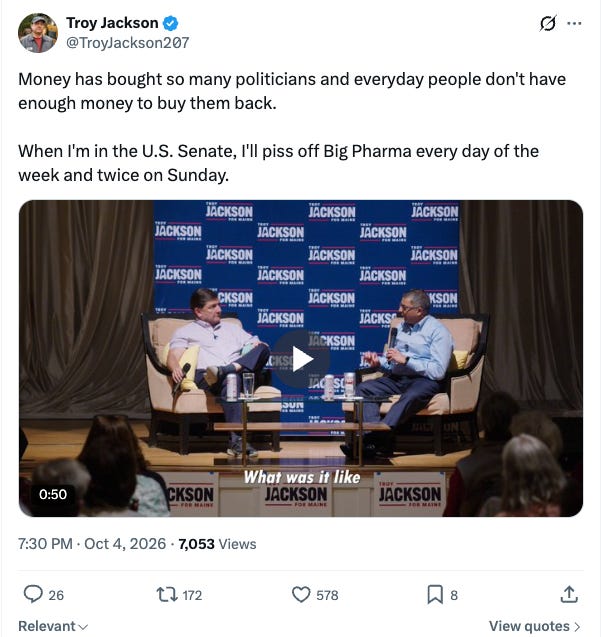
In fact, this was a post on the campaign X account just two days ago.
What this debate is really about
The consultant question is basically a stand-in for the never-ending debate over how to win elections. In this case, the left is convinced that Jackson has abandoned his unapologetic brand of leftist politics and consequently lost support among Maine voters.
I don’t think there’s any evidence for that thesis at all. First, there’s the fact that Jackson’s stances on ICE, Gaza, and Medicare for All have not substantively changed. More importantly, there’s no proof that orthodox left politics are even the best way to win a state like Maine.
Some left-wing pundits have recently expressed their regret over Graham Platner’s exit, believing his politics would have resonated more in a general election campaign against Susan Collins. Setting aside the disturbing dismissal of the sexual assault allegation, this idea doesn’t make sense on the merits. That’s because before the biggest scandal broke and he was forced out of the race, Platner was nearly tied with Collins and notably trailing with working-class voters.
Most revealing is a recent New York Times poll, which found that Maine voters preferred a Democratic-controlled Senate by twelve points, while still supporting Collins by a three-point margin (subsequent polls show the race closer).


This confounded many people, since a Democratic Senate might hinge on Collins losing. But I think it laid bare the political realities of Maine. A strong majority of voters don’t like Trump or the national Republican Party, which is why Kamala Harris won the state by seven points in 2024 and why voters currently favor a Democratic Senate by twelve points. They’re still not ready to drop Collins because they (wrongly) think she’s a moderate bulwark against Trump.
So how do you win Maine? You talk to the voters who supported Susan Collins in 2020 and Kamala Harris in 2024, want Democrats to control the Senate in 2026, but still aren’t persuaded to move away from their longtime senator.
My guess is that these voters are not secretly burn-it-down populists. They just need the permission structure to move from a moderate-coded Republican to a Democrat. There are plenty of candidates around the country who are currently winning over those sorts of voters, from Roy Cooper in North Carolina to Mary Peltola in Alaska. And Jackson still has a month left to be one of them.
Consultants vs. The Groups
Some of this reporting reads as a preemptive excuse for the left if Jackson loses. Sure, he was their hand-picked candidate, but then the consultants ruined the campaign.
Here, I’d encourage some self-reflection. The Democratic Party can certainly benefit from a robust debate about the policies and political style that win elections, but that conversation is not enhanced by the conspiratorial charge that the establishment is always trying to sabotage the left. If anything, the causal story is backward. Left-wing interest groups have actually had tremendous influence on the establishment, especially since Obama departed the political scene and left the party rudderless.
These organizations and their pollsters and policy advisors are not “campaign consultants” in the traditional sense, but in many ways they have had more influence on the party’s national policy agenda and governing choices. That’s because while consultants are merely trying to get the candidate elected, these interest groups prioritize raising the salience of their cause.
When virtually every Democratic candidate raised their hand during the 2020 presidential debate and pledged to decriminalize border crossings, that was because the Sunrise Movement and the Working Families Party advised them to. When the Biden administration waited too long to act on the border crisis, it was because left-wing immigration groups pressured them not to. The same story can be told about the Democrats’ position on energy or hot-button cultural issues. Interest groups published misleading polls showing that centering climate policy in their messaging wins young voters, that running to the left on immigration wins Hispanic voters, or that race-class narrative language wins working-class voters. And the Democratic Party listened.
The problem isn’t as bad this election cycle, although many environmental groups are lining up against the bipartisan permitting reform bill. But when the 2028 presidential nomination begins in earnest, expect many of these groups to flex their influence over the Democratic Party.
Again, this isn’t to dismiss the fact that establishment consultants are sometimes bad. It’s to show that the Democratic political class, taken as a whole, is usually not a moderating force on the party. After all, this is a group of highly-educated, politically engaged city-dwellers. A 2022 study from Data for Progress found that political elites, who include campaign consultants, lobbyists, and think tankers, are more supportive of progressive policy than the average voter. Notably, this applies to economic policies such as Medicare for All, paid family leave, and a wealth tax.
That’s why the typical campaign consultant or staffer is more liberal than the candidate they work for, especially if the candidate represents an ideologically diverse electorate. But the job of the consultant isn’t to incept their views into the candidate. It’s to help her win.
In The Candidate, Robert Redford’s campaign consultant did exactly that; he crafted a message that resonated with a majority of Californians and helped unseat a popular Republican incumbent. A cynical interpretation is that Redford betrayed his ideals, but those same ideals are certainly better served with him in office than on the sidelines.