

Two years ago, I heard about the strategists who eventually became known for recruiting Graham Platner to the Senate. Before they became synonymous with political scandal, before they had even gone to Maine, they had a political theory that I thought — if adopted by more Democratic strategists — was going to usher in a supermajority.
The premise was this: the Democratic brand was simply too tarnished to win deep red races. Whether it was Amy McGrath in Kentucky or Jaime Harrison in South Carolina, prototypical Democrats would lose no matter how much attention they received or money they raised. To even have a slight chance at beating Republicans in these races, Democrats needed higher-variance candidates — political outsiders whose heterodox beliefs would not pass every party litmus test, but would be a substantial improvement over their MAGA opponent. Some of them wouldn’t even need to run as Democrats.
Dan Moraff, the mastermind behind the strategy, was driving around states like Iowa and Nebraska in search of blue-collar workers who fit this archetype. Importantly, he wasn’t just looking for bearded candidates in plaid shirts; he wanted someone who could authentically fuse economically populist and culturally moderate politics.
Today, Moraff is known for his failure to properly vet Platner, insistence that his brand of left factionalist politics would overcome the campaign’s numerous scandals, and most recently, his own sexual misconduct allegations. Altogether, he doesn’t seem like a particularly wise political operator or really all that good of a person.
But the original theory had merit. The problem in Maine, before the sexual assault allegations, was that Platner’s advisors let themselves be seduced into thinking a blue-collar aesthetic was sufficient to win over working-class swing voters. They forgot about the second part of the formula: taking on the right set of issues.
The ideal candidate
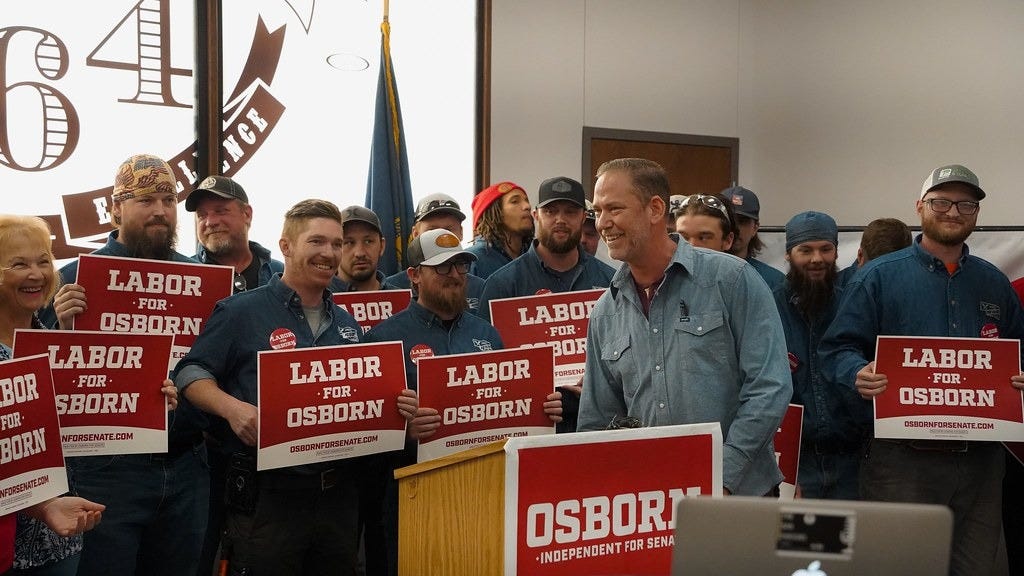
In 2024, Moraff recruited Dan Osborn, a union mechanic who was known for organizing the Kellogg strike, to run for Senate in Nebraska. Osborn eventually lost his Independent bid against Republican Senator Deb Fischer. But according to the election modeling firm Split Ticket, he fared 17.7 points better than a typical Democrat would have. That made Dan Osborn the single-best electoral overperformer in the country; no other candidate won such a large proportion of crossover voters.
Inside the Democratic Party, Osborn is a sort of Rorschach test. He’s proof that a Bernie Sanders-style populism can win over Trump supporters. Or, he’s an example of how shedding Democrats’ unpopular cultural positions can win over Trump supporters.
Both interpretations have important insights. Osborn did talk a lot about the corrupting influence of money in politics, the rich cheating on their taxes, and corporations ripping off consumers. What often goes overlooked when left political commentators write about Osborn isn’t just that he moderated hard on issues like immigration, but rather that his actual economic policies are not standard leftist fare.
This cycle, Osborn is running for Senate again (Moraff is not behind his campaign) on an economic agenda that is virtually identical to his platform in 2024.


Instead of wealth taxes and Medicare for All, it’s a middle-class tax cut and a pledge to protect Medicare and break up health care monopolies. There are anti-corporate consumer protection laws as well as an entirely separate plan to “balance the budget.” How does one describe this agenda? The rhetoric is certainly populist, but the policies are, as the strategist David Shor says, “popularist”; virtually all of them would command supermajority support among voters in both parties.
Of course, Osborn also courted the many Nebraska voters who hold right-wing beliefs on immigration. In one of the most attention-grabbing ads of the election cycle, Osborn wielded a blowtorch and promised to help Trump build the wall. This was a perfect example of how blue-collar identity politics can be leveraged to highlight an issue that appeals to more conservative voters. If Osborn wore his mechanic attire and called for a Green New Deal, it just wouldn’t have the same effect.
And if there were any remaining doubts about the sort of message Osborn was trying to convey, his Super PAC ran an ad during the final week of the campaign calling him “the only real conservative in the race.”
Campaign finance reform, economic populism (“popularism”), and conservative immigration were Osborn’s entire platform. Israel was a very salient issue for certain voters in 2024, but the campaign did not mention it because the priority was winning over Trump voters in Nebraska.
Looking back on the campaign today, it’s crazy to think that Graham Platner’s strategists were the ones behind this messaging. Dan Moraff had previously organized for the DSA and voted for Jill Stein. And here he was backing a candidate who wanted to balance the budget and didn’t talk about Israel and Palestine.
This means Moraff understood one of Searchlight’s fundamental theories of politics: the Democratic Party is a big tent, and it stretches from DSA candidates in Brooklyn to heterodox candidates in Nebraska.
What went wrong in Maine (aside from the obvious)
When evaluating Platner’s political appeal, it’s hard to separate his troubled past from his actual politics. But before the sexual assault allegation that took down his campaign, he was a case study of what happens when strategists overrate the appeal of blue-collar, ultra-masculine identity politics.
Maine is more liberal than Nebraska. So when Moraff began scouting the state, he could afford to find someone who better matched his own leftist politics. Still, winning Maine means courting the tens of thousands of voters who split their ballot between Susan Collins and Joe Biden. Perhaps Platner’s brand of uncompromising left populism could have won some of those voters, but aside from moderating somewhat on gun control, the campaign never really made any Osborn-style attempts to appeal to voters who had sent Susan Collins to the Senate for the past five election cycles.
They filmed an ad in which Platner said: “The only thing the DC establishment can agree on is a love of Jeffrey Epstein — and a hatred of me.” Sixty percent of his fundraising emails mentioned Israel — more than any other Democratic candidate in the country. He was a vocal advocate of abolishing ICE.
There’s nothing wrong with taking a strong moral stand on Israel’s conduct in Gaza. As Searchlight President Adam Jentleson wrote last month, Democrats that ape the most maximalist pro-Israel positions are out of step with the electorate. It’s just that his stump speech, ads, and the vast majority of his policies defined him as a hard-left factionalist. What was the appeal to crossover voters? When asked about Platner’s scandalous personal history in his infamous Wall Street Journal interview, Moraff argued that it was an integral part of Platner’s case: “Part of our thesis here is that people do not want their candidates grown in vats.”
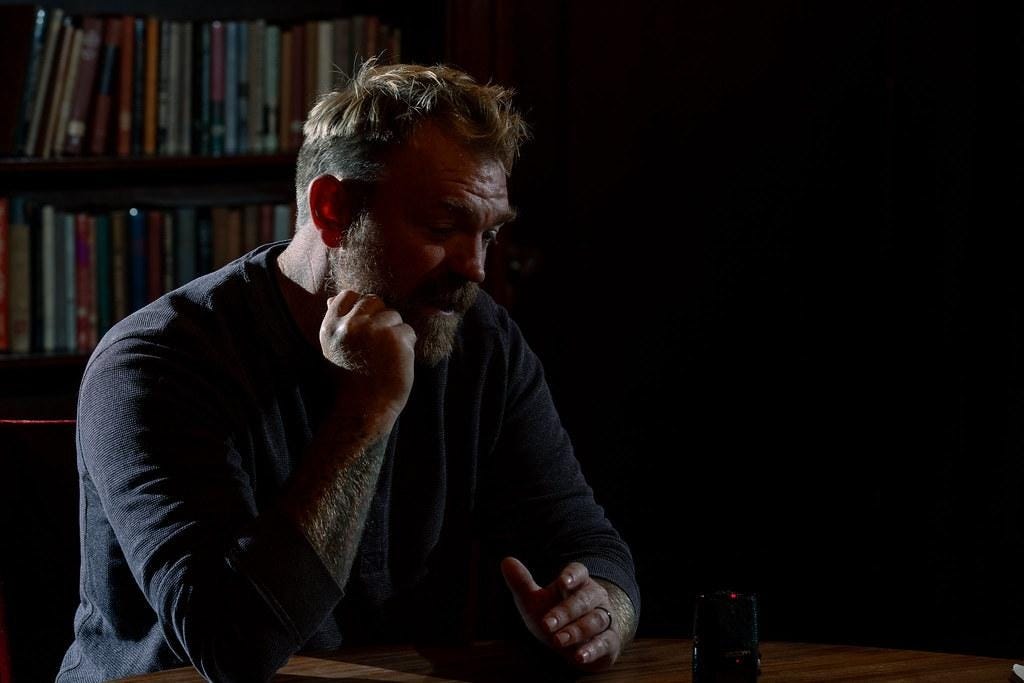
The polling never bore that argument out. Platner did maintain a narrow lead over Collins, but the previous Democratic challenger, Sara Gideon, consistently ran even further ahead in the polls until she was eventually trounced. Collins also maintained a substantial polling advantage over Platner among working-class voters — the exact sort of people who were supposed to support this blend of uncompromising left politics and blue-collar identity.
Again, we’ll never know how he would have done in the general election. But Moraff and his strategists didn’t just imagine Platner squeaking out a narrow victory against Susan Collins in a favorable Democratic electoral environment. They were privately telling people that Platner was a future 2028 presidential candidate. By all accounts, this infatuation started immediately. Morris Katz, another strategist behind the Platner campaign, said, “Within, like, five minutes [of meeting Platner] I was thinking, Holy shit, this guy can help save the Democratic Party.”
Five minutes isn’t enough to understand someone’s worldview. It isn’t enough to know if he would run on the sort of issues that could win over Trump voters in states like Ohio or Iowa. It’s an admission that you were overly seduced by the political appeal of Platner’s gruff voice and blue-collar aesthetic. And it’s proof that you forget the core lesson of why Osborn was able to appeal to so many Trump supporters — issues matter even more than identity.
Identity is never enough
I’ve never made the ill-advised decision to recruit a sketchy candidate, imperil the Democrats’ hopes of securing a Senate majority, and create a national scandal for myself in the process — but I have made a similar version of this mistake.
Last year, I wrote an article evaluating the merits of economic populism, and I questioned Chris Murphy’s populist appeal on the grounds that he didn’t have the right background: “Chris Murphy will likely run for president in 2028 on a platform of ‘big tent’ populism. But it’s worth asking if the lawyer and two-term senator from Connecticut has the profile to authentically deploy the populist message that can win back the working-class.”
It’s a bad argument. Who knows if Chris Murphy will run for president? If he runs, wins the Democratic nomination, and loses in the general election, it won’t be because he’s a lawyer from Connecticut. It will be because he failed to take on the heterodox set of issues necessary to win over the sort of swing voters who previously supported Trump. His lack of an authentic blue-collar identity will not be a liability or an asset.
How do we know this? Well, look at the two biggest political figures of the 21st century. Barack Obama, the Harvard lawyer with a funny name, won the support of millions of working-class voters in states like Iowa, Ohio, and Michigan. He didn’t do it by adopting some sort of blue-collar aesthetic; he simply moderated on certain issues: increasing penalties for hiring illegal immigrants and promoting America’s fossil fuel industry.
Those same Midwestern voters then switched their votes from the Harvard lawyer to the crooked real estate magnate from New York. Again, issues mattered here more than identity. Trump railed against NAFTA, moved even further right on immigration, and moderated on Social Security and Medicare — the albatross that had undermined Republican support for decades.
I want to make this clear: Moraff’s blue-collar outsider recruitment strategy had important insights. Democrats have been getting steamrolled in red states for over a decade now. Finding and properly vetting candidates at union shops or established small businesses is exactly the sort of low-risk, high-reward strategy the party should be trying. The key is to remember that issues matter too. Blue-collar identity politics might sound good to the sort of cosmopolitan folks who pontificate about politics online. It just isn’t sufficient to win over voters who decide elections.
My takeaway from this is that the messenger is very important but having the correct message and delivering it well is much more important than the costume he's wearing.
Another excellent and insightful piece Ben. I'm really enjoying these Searchlight posts.
I appreciate that you acknowledged your part about Chris Murphy because A LOT of the centrists here ripping Platner were big believers in identity politics and how “Tim Walz wasn’t manly enough”