


The American electorate is more complicated than Democrat and Republican, liberal or conservative. Over the past eight months, we spoke to over 9,000 voters in a series of quantitative and qualitative surveys. We asked questions ranging from Social Security funding and birthright citizenship to more value-based questions on topics such as the government’s role in the economy, gender roles, and preference for order or openness.
Our most important finding, the statistic that we want to drill into the brains of every politician, pundit, and strategist in America, is this: Only 14% of the electorate can be classified as completely ideologically conservative and 10% as ideologically liberal. These are also the two voter groups that are the most likely to not know anybody who thinks differently than them.
This doesn’t mean the rest of the electorate doesn’t care about the issues. Quite the opposite. It’s just that the vast majority of voters hold a heterodox collection of beliefs that range across the ideological spectrum.
To better classify these voters, we turned our mountain of survey data into nine distinct ideological groups; these segments all have partisan leanings and general demographic traits, but they’re built from the 16 policy and values questions that we found to be most correlated with voter attitudes. We believe this gives us a much better understanding of the American electorate than simple ideological labels such as liberal and conservative.
For example, Lawn Sign Liberals are conventionally progressive on all issues, except they’re more friendly towards a market-based economy than the ideologically homogeneous Liberal Arts Left. On the right, Sticker-Shocked Skeptics support sweeping policy change and gender equality, but voted for Trump because of inflation (a choice they now regret). In contrast, No Trespassing Populists strongly back aggressive deportation policy, but they differ from some of their fellow Trump supporters because they support economic populist policies. In fact, they go further left than Lawn Sign Liberals (a more Democratic aligned group) because they support wealth caps. The American electorate is wild!
In their exclusive editorial of our massive polling project, German Lopez of the New York Times summed up the problem well:
American politics is often described as a battle between liberals and conservatives, but most voters have much messier views than those partisan labels suggest. They aren’t reliably liberal. They aren’t reliably conservative. They have a mix of opinions that are almost impossible to find in any one politician.
As two seasoned pollsters, this problem — breaking through the idea that most voters are liberal and conservative — is one we know well.
Typically, when polls are interpreted by campaigns and shared widely around the internet, the insinuation is that voters are ideologically consistent.
For example, currently only 37% of Americans approve of Trump’s immigration policy. But does this now mean that 63% of Americans support progressive immigration policies? Does this correlate with support for other progressive policies on taxes, policing, or healthcare?
Our data and the NYT’s graphical interpretation of them say no. Just because a voter holds one liberal belief that doesn’t mean they are ideologically homogeneous.
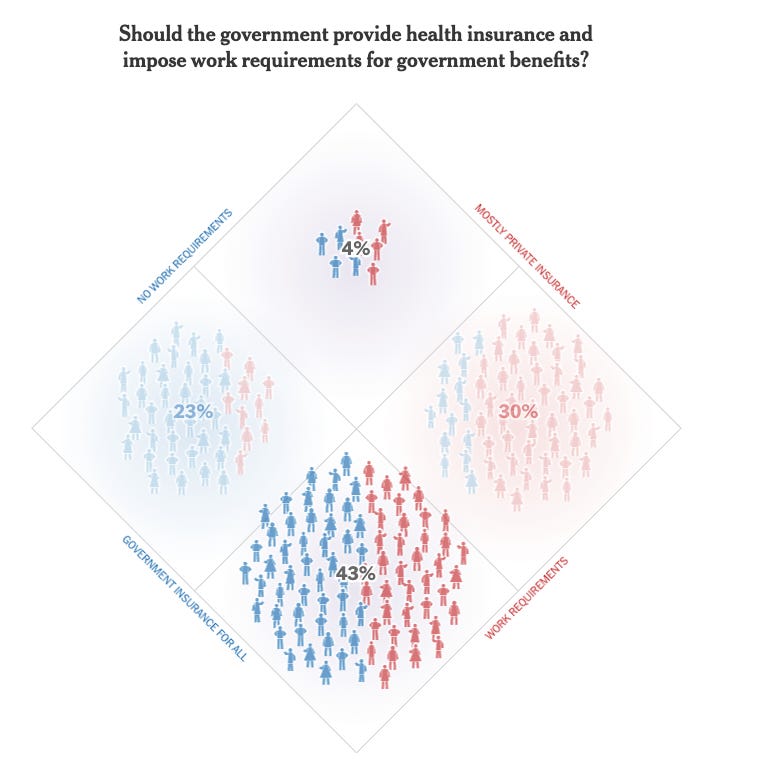
For example, 66% of respondents supported the liberal idea that the government should provide health care to all Americans, regardless of age or income. Whereas 72% of respondents agreed with the conservative idea that able-bodied adults should have to work or look for work in order to receive government benefits. And 47% of voters, by far the biggest coalition, agreed with the conservative position on one issue and liberal on the other.
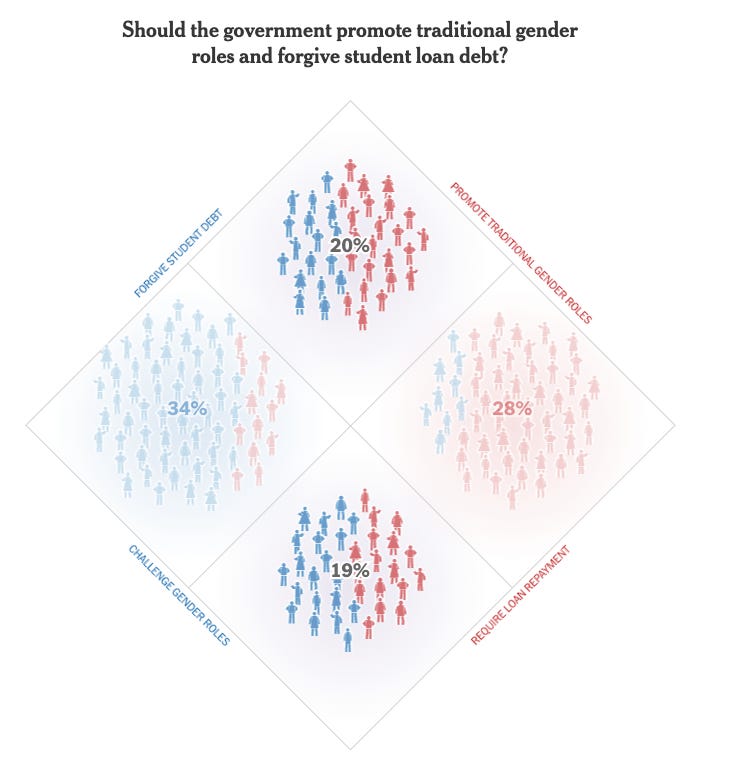
Another example is student debt and gender roles. One would assume that someone who wants to challenge gender roles also supports forgiving student debt; after all, these are two liberal coded positions. But nearly 40% of voters’ positions are classified as heterodox; 20% support forgiving student debt and promoting traditional gender roles. And 19% want to challenge gender roles and require students to repay their loans.
What should campaigns and politicians do with this information?
The good news for candidates, especially the ones running in narrow swing districts, is that specific policy proposals can theoretically draw support from across the political spectrum. For example, taxing the rich and expanding government involvement in health care is popular across every single segment, except the most down-the-line conservative one. In our data, we also found that issues can impact vote choice over and above partisanship. This means there’s room for a candidate to appeal to voters outside of their political party. Instead of attempting to win over a very narrow majority of the electorate, politicians can make the choice to represent more Americans.
But here’s the important caveat: Since less than a quarter of the electorate is ideologically rigid, politicians need to make space in the coalition for voters who strongly agree with some, but not all, of their policy ideas. This means rejecting issue litmus tests, especially the ones that are massively out of step with the voting public.
There’s no obvious issue set that will lead a certain candidate or political party to command a supermajority. But as campaigns gear up for 2028, it will be vital for them to understand that the American electorate, even their own voting base, is more heterodox than many realize. This fact is hard for many people working in politics to properly grasp, especially because these are exactly the sort of people who are the most ideologically homogeneous, but it is the skeleton key that will free us from this era of hyper-polarization and narrow governing majorities.
The American electorate is messy, ideologically inconsistent, and impossible to neatly categorize. It’s time our politicians were too.
P.S. Click here to take our Political Neighborhood’s Quiz to find out your segment!
The natural question is how do we, the ones in the middle, vote when most choices are politician's motivated by campaign financing that only favor the more extreme right and left agendas?