


Ideological litmus tests often backfire among Republicans and Democrats alike. On the Democratic side, politicians are constantly forced to satisfy the demands of some outside interest group — whether it’s banning fracking or withholding criticism of Israel — even when it’s clearly bad policy and bad politics. The result is a party that can’t build a governing supermajority.
As an equal opportunity hater of litmus tests, I’d be remiss if I didn’t highlight the most absurd one in all of American politics: the lie that the 2020 election was stolen. This Republican Party litmus test isn’t being pushed by a group at all; it’s one man: President Donald Trump.
It was on full display during a prime-time address Thursday night, when Trump repeated many of his old grievances about election interference and accused China of buying, hacking, or stealing voter data in 18 states. These are all provable falsehoods. There’s also no reason to think this will improve the GOP’s electoral prospects in November — in fact, during the 2021 special elections in Georgia, there was evidence that Trump’s election denialism contributed to the party losing two Senate seats.
This is an obsession for Trump, and it’s potentially a politically damaging litmus test for the rest of the Republican Party. Still, over the coming days, expect many in the party to contort themselves into absurd positions to back Trump’s claims of election denial.
Democrats will be rightfully outraged when this happens, especially because it will be clear that Republicans are only doing it to appease their interest group of one.
But that also presents an opportunity for reflection. Democrats have their own electorally damaging litmus tests. They undermine the party’s ability to compete in red states, which consequently empowers the very politicians pushing Trump’s election denialism.
We know how embarrassing this is for them
Earlier this week, Senator Jon Ossoff asked DNI nominee Jay Clayton a very simple question during his nomination hearing: Who won the 2020 election? And Clayton, a man who is attempting to oversee the U.S. intelligence community, simply refused to answer it.

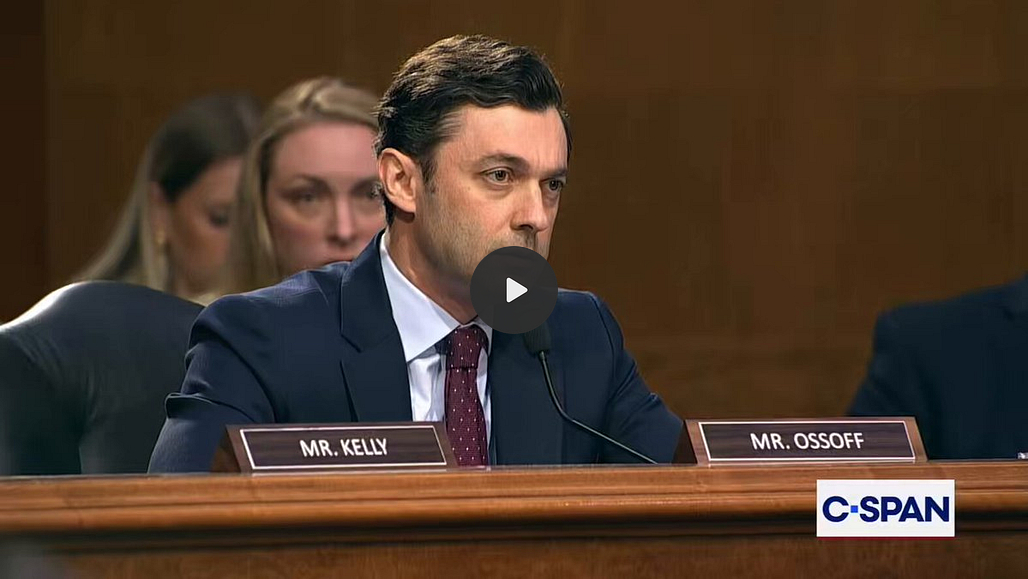
Why did Clayton subject himself to such public debasement? Because he was trapped: either admit to an obvious truth or pass Trump’s litmus test. So he took the second option, and the future Director of National Intelligence looked like an obstinate child on national television.
This is the state of politics in America today.
To the Democrats who bemoan this situation, I sympathize. I also ask them to use this as an opportunity for some self-reflection. It’s easy to notice when a politician you disagree with adopts an extreme position that puts them out of step with public opinion. It’s harder when that politician is someone you support, and that litmus test is something you find to be broadly agreeable.
Democrats must look inward at their own litmus tests
I don’t want to imply an equivalency between Trump’s election denialism and fracking bans; one is just a bad policy, and the other is a complete fabrication that serves to rot our American political system. But the mechanism by which these litmus tests are imposed reveals important truths about how our two political parties operate.
The GOP is ruled by Trump — a delusional, mad king, who generally gets his way unless he’s trying to create a $1.8 billion slush fund for his supporters. The Democrats are ruled, in part, by a network of interest groups, many of which advocate for well-meaning causes, but force Democratic politicians into electorally compromising situations that are also usually bad policy.
Eliminating private health insurance, border decriminalization, and halting the expansion of fossil fuel projects — these are all examples of litmus tests that have been advocated for inside the Democratic Party. There’s nothing wrong with certain Democrats agreeing to these positions; the problem comes when they become a litmus test for Democrats to remain in good standing or receive endorsements during a presidential primary. The result is an election like 2024, where, despite Kamala Harris’ attempt to disavow her old litmus test positions, swing voters still saw her as too left-wing.
It’s also worth noting that these litmus tests don’t always come from the Left; this election cycle, AIPAC is forcing Democrats out of step with public opinion on Israel.
It’s bad for democracy when politicians are forced to adopt positions to satisfy interest groups. We all know how strained and exasperated Republicans look when they’re forced to answer or obfuscate questions about Trump’s election denialism. And Democrats come across the same way when they’re forced to talk about their past extremist positions.
Admittedly, the party is getting better about this. The League of Conservation Voters watered down its candidate questionnaire after it was criticized for being too ideologically rigid. More ideologically diverse candidates are also running in Iowa and Texas.
But the tyranny of litmus tests is not completely over.
Can you care about protecting immigrants while refusing to abolish ICE? Can you support decarbonization and environmental justice and still vote for a bipartisan permitting reform bill? Many immigration groups and environmental groups are still saying no. That’s bad policy, and that’s bad for Democrats who want to be more electorally competitive in red states.
We should all be equal opportunity litmus test haters
This is likely a familiar argument to most readers. The problem is that it is still not shared widely enough by engaged Democratic primary voters — the exact sort of people who find the 2020 election lie litmus test to be completely abhorrent.
The election analyst Nate Silver recently outlined the three main factions inside the Democratic Party: the Left, Abundance Libs, and Resistance Libs. As Silver explains, that latter group, the people whose primary goal in American politics is kicking Trump and MAGA Republicans out of office, has still not been sufficiently convinced about the need for a more ideologically diverse and explicitly populist Democratic party.
They watch Trump’s election denialism with rightful horror. They desperately want to beat Trump and all of his loyal supporters. But then they refuse to adopt the right strategic politics that would actually reduce the power these politicians have in our country. Fighting Trump is about suing him in court and calling him names on social media — two strategies that are certainly fair game for Democrats. But if it’s the entire political message, then the strategy becomes more expressive than strategic.
The right path is thinking critically about how Democrats can expand their electoral appeal to voters who support Trump, but do not share his obsession with the 2020 election.
The election denial litmus test Trump has imposed upon the Republican Party is without equal. It serves to undermine trust in our election system and deepen polarization at a time when America desperately needs to unite and restore faith in its institutions. But that will only happen if Republicans lose power, not just narrowly, but become a minority party in the country.
That means the only way to beat the election denial litmus test is for Democrats to drop litmus tests of their own.
I think being anti-Israel in specific ways (as opposed to simply declining to pass AIPAC's litmus test) is quickly becoming a left litmus test in Democratic politics.
Should Democrats ignore some of their values and prioritize “expand(ing) their electoral appeal to voters who support Trump, but do not share his obsession with the 2020 election?” Or, should they prioritize engaging disaffected and non-voters who share progressive values to create durable majorities?