

When I attended the DNC in 2024, I witnessed my fair share of pandering to the left. A land acknowledgment kicked off the DNC’s Council on the Climate Crisis. There were also some silly identity focused groups like “White Dudes for Harris.” In my attempt to be a good-faith critic, I wrote up some of those criticisms, but emphasized that the bulk of the messaging I saw seemed intended to win over swing voters. A Texas border county sheriff was given a key speaking slot and Harris was hyped up as a career prosecutor; a dogmatically left convention it was not.
Evan Barker, the Democratic behind-the-scenes fundraiser turned party critic, saw it a very different way. After a few days hanging around the convention, becoming increasingly enraged by her fellow out-of-touch staffers and their excessive cultural progressivism, she eventually stormed out. The instigating event was a speech from Oprah Winfrey, which in her mind epitomized the party’s obsession with cosmopolitan elites. A few days later, she voiced that critique in a viral TikTok. A few months later, she voted for Trump.
Two years after that, she wrote a book: Nothing Left: Confessions of a Former Democratic Operative, cementing herself as a pundit dedicated to criticizing the Democratic Party for being too woke and out-of-touch with the working class.
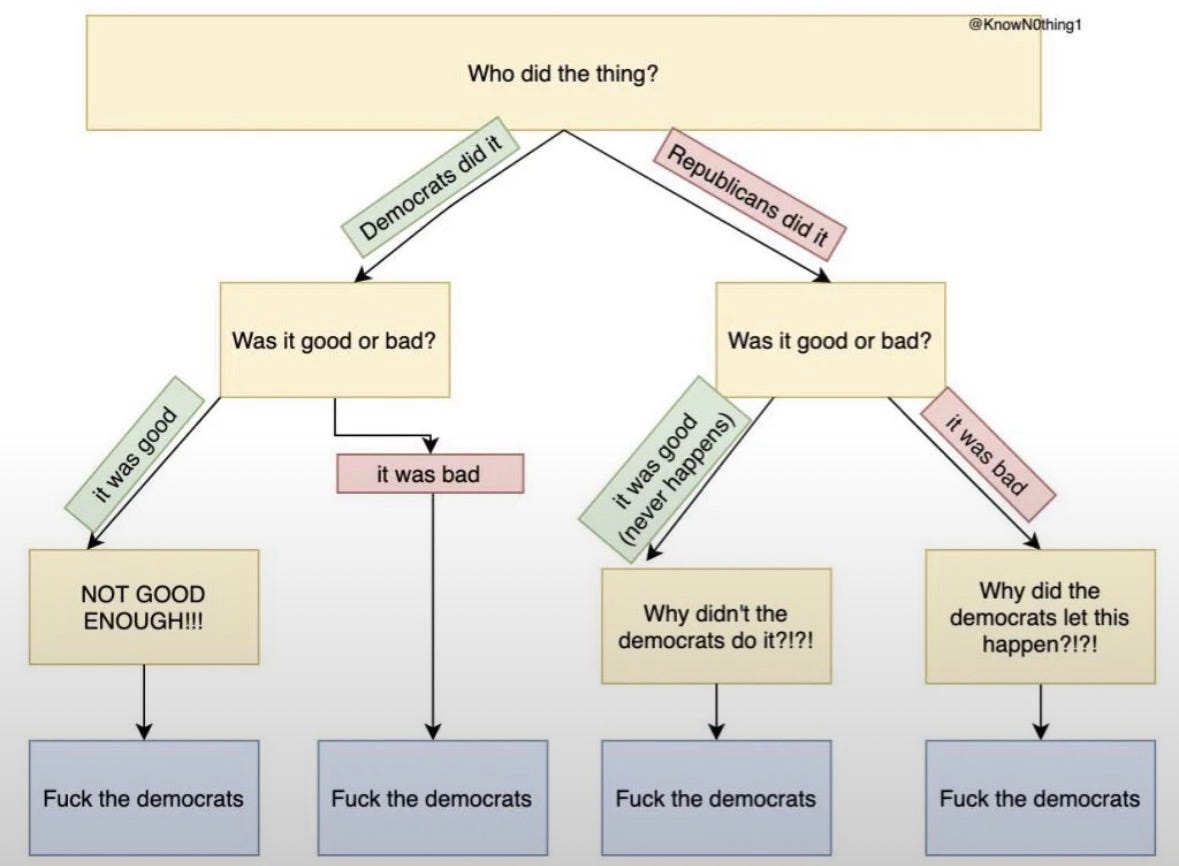
There’s nothing wrong with moving from party operative to critic. And as someone who works for a think tank that was founded, in part, on criticisms of the Democratic Party, I see the virtue in voicing concerns about the party in public. But in order to actually be effective, one must also be willing to call balls and strikes and give credit to the party when it’s due. That means not being the living embodiment of this meme.
It’d be tempting to dismiss Evan Barker as just another “reformed” Democratic op, pivoting to the right for attention and cash. But the book and her rising public profile are now being discussed in some Democratic staffer-class circles. She’s on the New York Times Best Sellers list. She’s podcasting with well-known journalists. And recently she landed an opinion column at a mid-sized publication. This Democratic critic has been handed a megaphone.
And to be fair, Barker is animated by what are, on their face, valid criticisms. When she describes her experience fundraising at Left Rising, the firm that provided the financial plumbing for the Bernie Sanders left, she persuasively argues that the movement was not doing anything to build a broad governing coalition. She’s correct that the Democratic Party is staffed by people who are overwhelmingly to the left of the median voter. And she rightly points out that many Democrats backed away from sensible border policy and embraced bad political messages like race-class narrative.
The good news is that in the years since, new institutions (such as Searchlight) as well as many new candidates have emerged to attempt to reset the direction of the party.
A good-faith critic would, at the very least, acknowledge this fact. They’d look at the candidates who are attempting to expand the Senate map, such as Mary Peltola in Alaska and Josh Turek in Iowa, and see that the Democratic Party isn’t just tolerating ideological diversity, but actively supporting it. Both were top Senate recruits from party leadership, and both have the full support of the Democratic Senatorial Campaign Committee. The same goes for James Talarico in Texas or Roy Cooper in North Carolina. Each candidate has been vocal in breaking with the party’s 2020 stances on immigration, fossil fuel production, and culture. And each is being rewarded for it by the party and the voters.
Even factional left candidates, such as Abdul El-Sayed in Michigan, while not explicitly moderating, are now running on a narrow economically populist message. Look to the congressional races, and one will find a whole crop of culturally moderate and economically progressive “Berniedog” candidates popping up around the country, such as Bob Brooks in Pennsylvania or Rebecca Cooke in Wisconsin; the name is derived from the fact that both have been endorsed by Bernie Sanders and the moderate Blue Dog PAC.
It’d be one thing to say this isn’t sufficient, but Barker still levels the same critique that the Democratic Party is structurally broken. In a recent column, she rips into Nebraska independent Senate candidate Dan Osborn for a hypocritical leaked comment about border policy, and then ends by declaring, “Neither wing of the Democratic Party is giving working-class voters what they really want.” Missing is any mention of the candidates who are giving her what she wants, which is progressive economics and social moderation.
Barker is far from the only offender here. In a recent Wall Street Journal review of Supermajority, Ruy Teixeira writes about the current crop of Democratic politicians: “None seems prepared to challenge Democratic orthodoxy on issues such as climate, trans rights, immigration enforcement, diversity mandates and affirmative action.” He continues, “Today’s Democrats would seemingly rather lose an election than adopt any position deemed conservative—the horror!—even if that position is popular and correct on the merits.”
Just like Barker, Teixeira completely misses the fact that numerous Democratic candidates competing in red-leaning districts or states are challenging Democratic orthodoxy.
There’s another implicit problem in these critiques: they treat the Democratic Party like a centralized, monolithic authority. Any bad action is automatically attributed to the Democrats rather than just to the singular person. That is at best a misunderstanding, and at worst a willful misrepresentation of how the party operates. Fundamentally, the Democratic Party is a coalitional institution shaped by millions of dedicated party base voters, as well as a collection of interest groups, candidates, and strategists who jockey for influence. Ultimately, there’s no disciplining actor in all of this. The party, as Daniel Schlozman and Sam Rosenfeld persuasively argue, is hollow.
That means one can always find a candidate or an interest group to be angry about, and one can also find someone to praise; that’s just the nature of commenting on an entity characterized by diffuse and competing factions. Hopefully a strong party leader emerges in 2028, but until then this is the reality that Democratic critics must reckon with.
To be clear, moderates are not the only ones who are unwilling to see any positive narratives inside the party. Many on the left denounce elected Democrats as dominated by corporate and special interests, despite the fact that the party moved significantly to the left on economics under the Biden presidency. Most Democratic members of Congress also agree on issues like raising taxes for the wealthy and dramatically expanding the government’s role in healthcare.
When it comes to elections, while some on the left complain that the establishment is undermining El-Sayed’s Senate run, the truth is that the party establishment swiftly and unequivocally backed his candidacy after the primary. This is for the incredibly obvious and boring reason that the party wants to control the Senate.
Again, there’s plenty to criticize the Democratic Party about, across all ideological factions. But those criticisms need to be informed by the reality of what’s actually happening on the ground. This election season, both moderates and leftists are seeing some of their ideas being absorbed and promoted by the party they love to hate. I urge them to at least acknowledge it.
Critics like Barker and Teixeira should be seen as what they are. They have brands to promote (self-loathing Democrats), narratives to tell (Democrats are bad) and right-wing audiences to please. They're not ever going to acknowledge any improvement because they'd lose their audience and relevance. I hadn't heard of Barker until recently, but Teixeira has been doing his bit for years. Neither of them are arguing in good faith and both should be ignored.
You're doing great work at Searchlight just like you did for Matt. I subscribed to Searchlight the second I found out what it was and have been a fan of what it puts out. Keep fighting the good fight.
This is what I want in a candidate How to be a “We the People” politician in 5 easy steps:
1. Get out and talk to the people (grassroots boots on the ground), listen and find out what their
needs are.
(Include: working and middle class in rural, suburban and urban communities.)
2. Shape policy around the people’s needs
3. Avoid billionaire and corporate donations.
(You report to the people; therefore you will not be owned by the billionaires/corporations)
4. Activate a vast number of volunteers all year long - every year
(We the People want to be involved. Find & organize things we can to do)
5. Repeat - all year long - every year. An ongoing process