

Americans notoriously rack up a lot of debt. Some of this debt is driven by people who are too young to even know what the word means.
This starts in the lunchroom. While most kids are happily munching away with their friends, some are quietly racking up debt for themselves and their families. In total, there are around 1.54 million children in the US who can’t afford school meals. And if they aren’t covered by a free meal program, they might be going into debt simply for the act of eating with their friends at school.
The total estimate for student meal debt places the number at over $200 million nationally. Meanwhile, surveys of school nutrition directors indicate that debt levels have steadily grown, from $2,700 per district in 2014, accounting for inflation, to $6,900 in 2024. Importantly, this debt is heavily concentrated in schools that do not exclusively serve free school meals.
The school food authorities overseeing paid meal programs report a debt 3.5 times larger than those that administer a universally free meal program. The vast majority of schools that do not serve exclusively free meals say meal debt is a challenge. Counterintuitively, this meal debt is not exclusively concentrated in high poverty areas. Schools with lower poverty rates have a meal debt that is three times larger than schools with a higher poverty rate.
This is, in part, because the eligibility determination for the Community Eligibility Provision — the federal policy used to deliver universal free meals in schools — is measured by poverty composition; the lowest-income districts are more likely to qualify. Wealthier school districts can still have poor students, some of whom fall through the cracks of free lunch eligibility.
This cost hangs over the head of these children and their families. By federal law, school meal operations must break even, and federal revenue cannot be deployed to recoup the costs.
That’s when the debt collectors come in.
A school district in Iowa sent almost $80,000 of school meal debt to a collections agency. In Arkansas, a school district with nearly $500,000 in school meal debt began sending families with over $100 in debt to collectors. In Nebraska, a collections agency even sued a family over a $53 meal debt, won, and then garnished their wages.
Some school districts have statutes that provide guidance on how to report parents to state child welfare services for school meal debt. A Guardian investigation found that districts across 10 states had language referencing a referral to social services or to police following excessive school meal debt accrual. While the investigation explains that schools typically do not report parents to social services for neglect due to meal debt, we know that it creates a chilling effect on low-income parents and their hungry kids.
Keyna Franklin of Rise, a New York-based welfare advocacy group, explained that “The kids aren’t going to say they’re hungry because they don’t want to get their parents in trouble.”
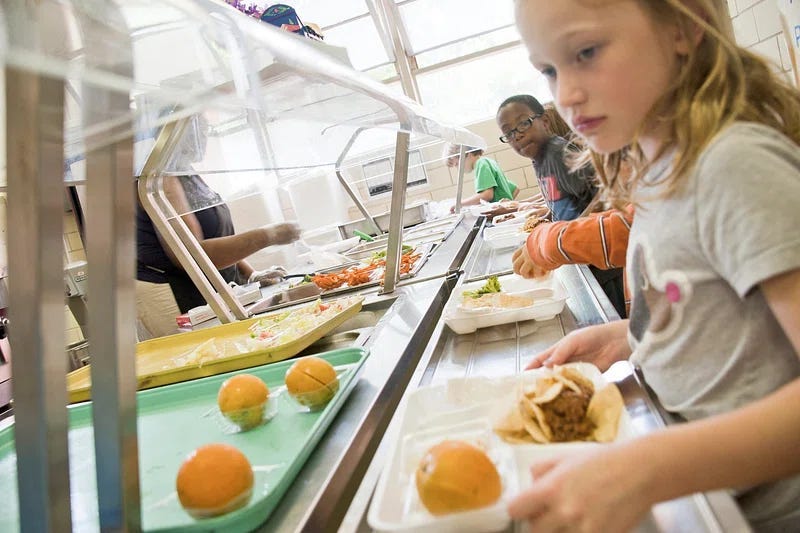
During the pandemic, families got a momentary reprieve when USDA waivers were created to feed every child for free. In the subsequent years, a two-tiered system has emerged, in which some states have built on the success of pandemic waivers to create universal school lunch programs, while the states relying on the typical paid lunch system have seen students plunge deeper into debt.
And food inflation is making this even worse. The free lunch reimbursement rates have not necessarily kept pace with rising costs, which means districts either have to increase prices for students or make up the difference themselves through cuts in quality.
Moreover, SNAP eligibility is one of the primary mechanisms to determine eligibility for free meal programs. And the recent cuts under the One Big Beautiful Bill will almost certainly have the downstream effect of reducing access to free lunch in schools. The full impact hasn’t yet shown up in the statistical data, but so far SNAP enrollment has fallen 12 percent in the past year; this includes 1.2 million children.
The impact of this even goes beyond just those individual children potentially losing their direct certification for free meals. Under the Community Eligibility Provision for free meals, participating schools are reimbursed at more generous rates according to a sliding scale that is based on their percentage of students receiving certain means-tested benefits programs. So, if more children are cut from SNAP rolls, entire schools may be forced to consider the financial viability of running universal school meals programs.
What can we do to fix this?
A Democratic Congress will certainly attempt to restore these regressive welfare cuts. But I implore lawmakers to go a step further. Even before inflation and the SNAP cuts, the status quo was not delivering for children who rely on the school cafeteria to access a regular meal. In some cases, students and their families had to fill out an application in order to receive free lunch eligibility. Or they simply fall through the cracks.
Jennifer Gaddis, a professor and food policy expert at the University of Wisconsin told the Bulwark that “a lot of people don’t realize that you can actually apply for free or reduced meals at any time during the school year.”
The first step should be passing the School Lunch Debt Cancellation Act to make the school meal accounts whole.
But the silver bullet to school meal debt is a universal program. In my recent paper, I explored how Congress can do this by reforming the existing policy levers. The primary mechanism is expanding the Community Eligibility Provision, which currently covers more than 70% of eligible schools.
We should simply make all schools eligible. We should raise the reimbursement levels, so more meals are reimbursed at a higher rate. And we should enhance reimbursements so schools can deliver higher-quality meals to every student. Using the Community Eligibility Provision is a financial decision at the end of the day. This program is incredibly popular, but schools will only switch from their paid program if they have the financial means to cover what the government cannot. Congress should make the math work so the program is undeniably beneficial financially for these schools.
There’s so much evidence that when universal school meal programs are implemented at the school level, families become less food insecure, student performance improves, and surrounding grocery prices can actually fall.
In a fiscally constrained environment, Congress needs to spend its money wisely. But investing in children’s health and education and abolishing student lunch debt is just common sense. Kids should eat free. It’s that simple.