

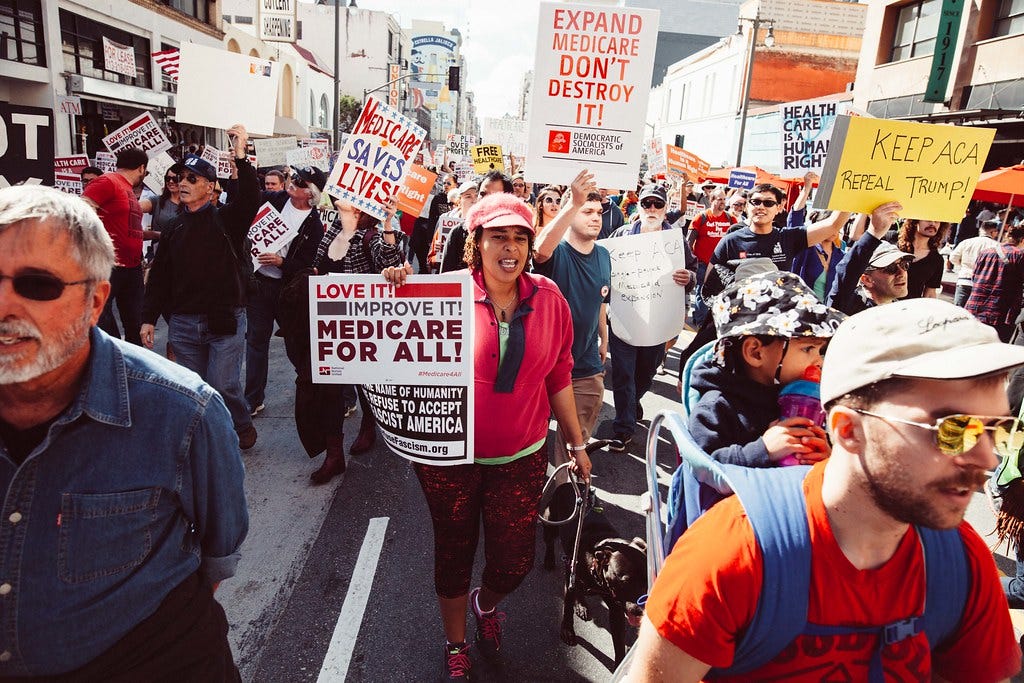
I have news for both sides of the Medicare for All war — you’re right. (Sort of)
If you think voters strongly support something called Medicare for All, then you’re correct. Searchlight polling has consistently found that Medicare for All commands broad and durable support — at least in the abstract. The term also has high “name ID,” a valuable asset in politics, as virtually every voter has heard of it.
On the other hand, if you think Americans do not trust the government to implement a single-payer system that abolishes private health insurance, then you’re also correct. In a polling collaboration with the progressive media outlet Zeteo, we found that voters overwhelmingly do not want to opt out of their private insurance and enroll in a government plan.
These seemingly contradictory facts make the Medicare for All debate frustratingly circular: Americans support the brand but not necessarily what it represents. Whether it’s in our own polling or others’ work, a consistent rule about Medicare for All across virtually all polls is that the more voters learn about the specifics of the policy — at least as it has been defined over the past few years — the less they like it.
The numbers vary from poll to poll. As supporters rightly point out, some polls show support remaining above water even after voters learn more. But in many other polls, as voters learn details — such as the fact that most people would be forced off their private health plans and onto a government plan or that they would have to pay more in taxes — support veers into negative territory. And across nearly every poll, the overall pattern is the same: as voters learn details of Medicare for All, support declines.
Notably, this is the opposite of the pattern we saw with Obamacare, where the brand was less popular than the underlying policy. As someone who worked to help pass the Affordable Care Act, this was an extraordinarily frustrating dynamic. We believed that once the policy went into practice, voters would like it, even as they told pollsters they hated the brand — and this turned out to be true. With Medicare for All, I fear the opposite is the case: voters will tell pollsters they like it based on a hazy notion of what it means — then when they find out the specifics, Democrats who supported it will reap the whirlwind.
The question of whether voters like the brand or the actual policy — whether they are endorsing specific legislation or merely advocating for a broader goal — hinges on what voters think Medicare for All means. By definition, polls that seek to test support for various aspects of Medicare for All feed respondents a description of the specifics. This is important for testing support of the bill’s provisions, but preempts the chance to test what voters think the brand means when they encounter it in the wild.
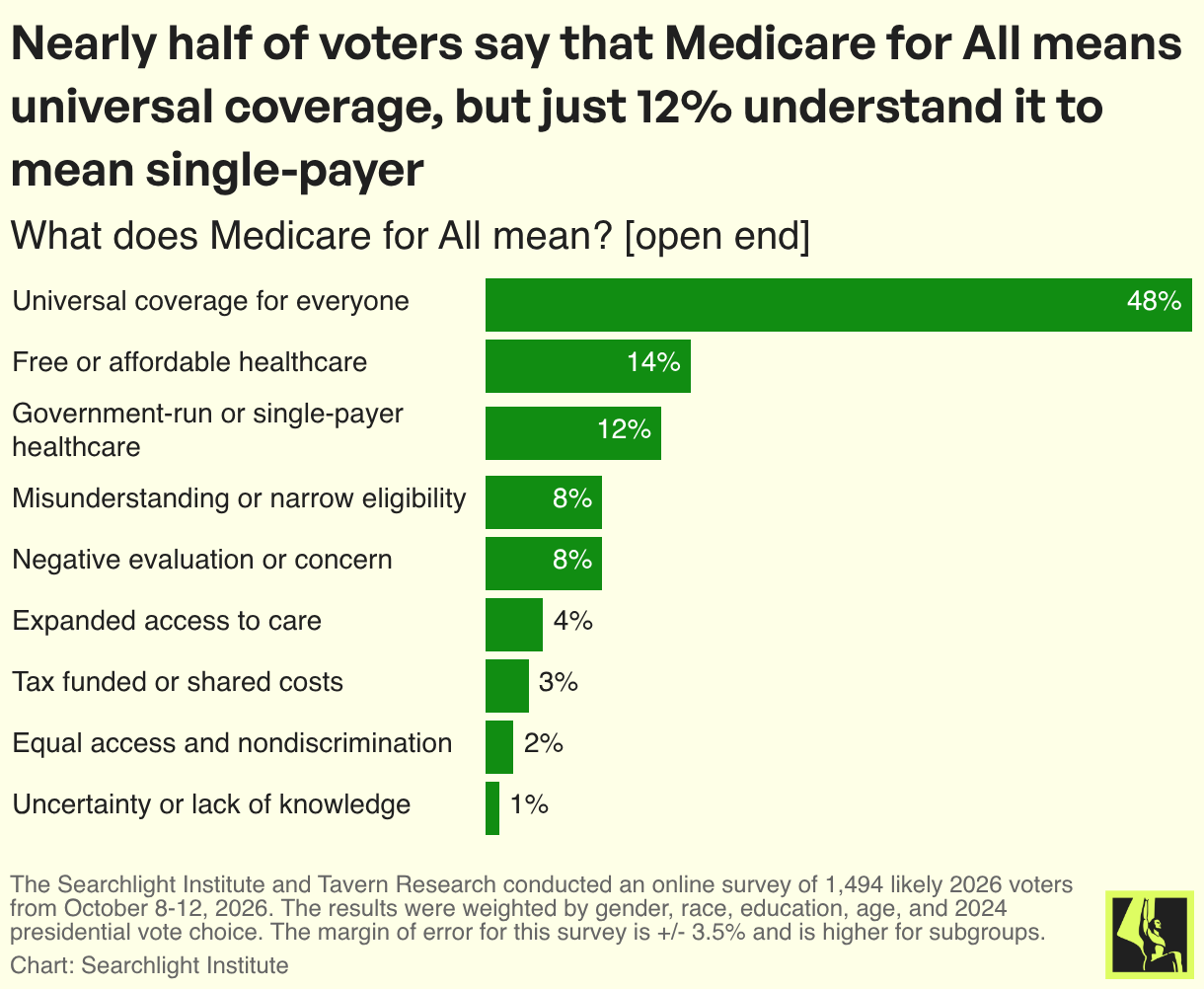
To get at this, we asked voters a simple, open-ended question, with no prompting: What does Medicare for All mean? The results were fascinating: nearly half of all respondents, by far the largest plurality, said that Medicare for All means “universal coverage for everyone.” The margin between this and the next-highest option, “Free or affordable health care,” was 34 points. Notably, only 12% of respondents said Medicare for All meant government-run or single-payer health care.
As Democrats chart their agenda for the next Congress, the takeaway here is important: Medicare for All is a brand — and a popular one at that. But support for the brand does not constitute a mandate for passing single-payer. Rather, it’s proof that voters want their representatives to fight for universal, affordable health care coverage.
This is good news, since that is a goal all Democrats share — one that can unite all factions of the party and point the way out of the Medicare for All war that has divided the party in recent years.
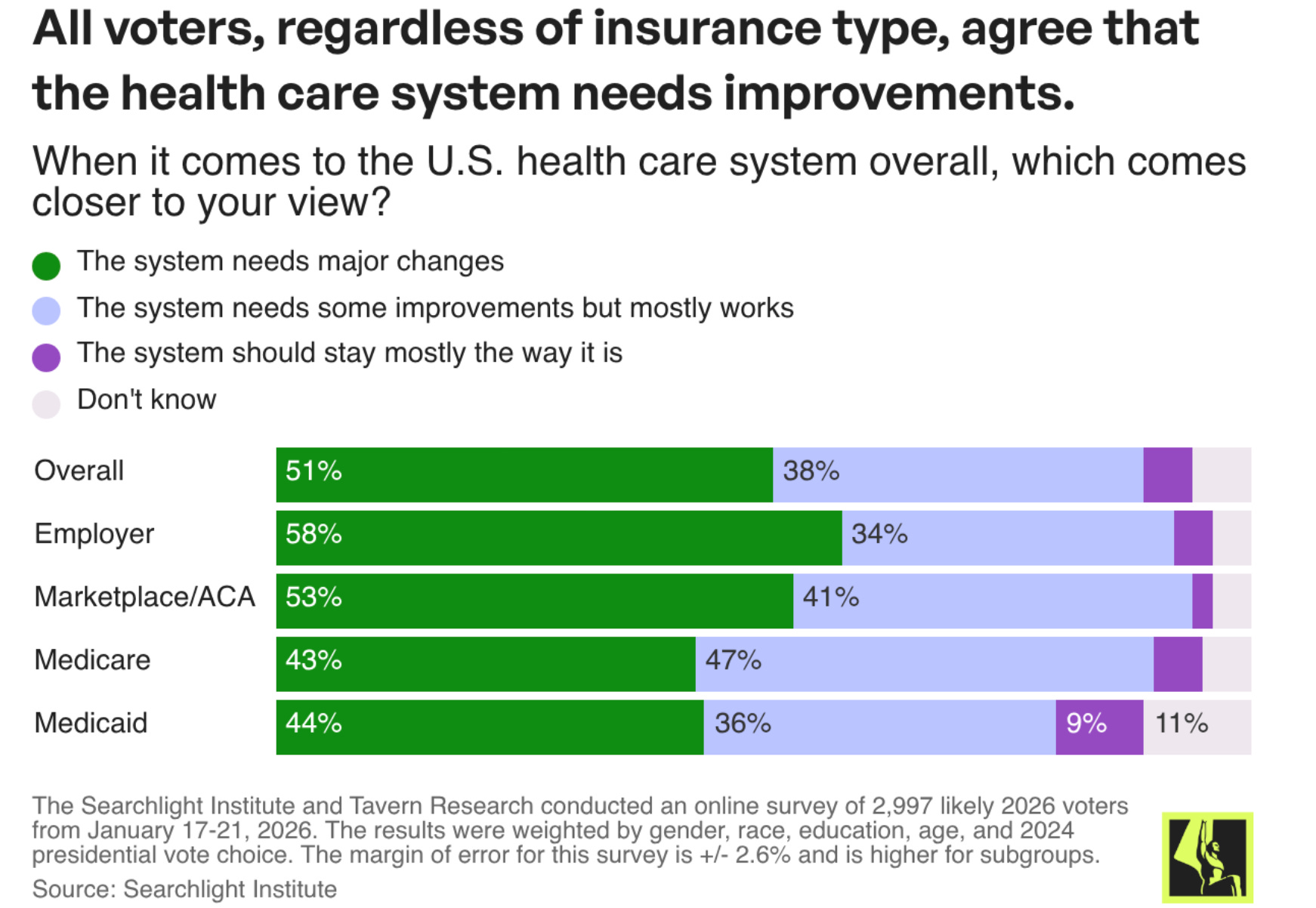
This does not mean we should be content with tinkering around the edges. In a survey from earlier this year, almost every respondent told us the health care system needs improvements, and a majority of voters said they want major changes.
What I find energizing is that Democrats appear increasingly unified on this goal.
Senator-elect Abdul El-Sayed, who wrote the book on Medicare for All, endorses the idea of allowing private health insurance to remain alongside a government plan. While the specifics remain hazy, this is clearly a concession to the reality that Americans do not want to be forced off their private plans and onto a government plan. In a recent interview, he elaborated, saying the essence of his Medicare for All plan is the “guaranteed public health insurance”— a goal that can be achieved through various means, including a robust public option, lowering the Medicare eligibility age, and policies to expand coverage for children such as Senator Andy Kim’s Medikids proposal. Senator Adam Schiff released a video calling for Medicare for All, yet clarified that this did not mean a strict single-payer model: “If you want to participate in Medicare, you can do that. If you want to stay on private insurance, you can stay on private insurance.”
This newfound flexibility on Medicare for All from the left has been met with a more aggressive posture from Democratic leadership. Previously, their agenda seemed limited to reversing Trump’s Medicaid cuts and restoring Affordable Care Act subsidies. Now, Speaker-elect Jeffries has announced a more ambitious agenda, committing Democrats to pursuing more sweeping expansions of public health insurance.
Senator Sanders called this the first year of his Medicare for All. Most likely, we are not on a pathway to completely eliminate the private insurance marketplace, but embarking on a multistep process to guarantee universal and affordable health care.
But what this article presupposes is that it is a feature, not a bug. Let’s unleash the full force and creative energy of these big, diverse Democratic majorities that Americans elected. Let’s invite everyone to bring their talents to the collective goal of achieving universal, affordable health care for all. Doing so would be a generational achievement that would stand for all time with the greatest advances of the New Deal or the Great Society. If we achieve that goal and call it Medicare for All — while giving ourselves flexibility about what, exactly, that brand means — then more power to us.
The point of public service is to deliver concrete benefits for hardworking Americans and the most vulnerable among us. When it comes to the goal of achieving universal health care, Americans are firmly on our side and want us to fight hard for it. That there are multiple pathways to get there is a good thing. By embracing this reality, we can unify our big tent and achieve a goal that Democrats have been chasing since FDR. The opportunity before us is historic, and we should seize it.
I'm all for having this debate and achieving universal coverage. At the same time, it falls short of truly making healthcare accessible. It only deals with the demand side of the equation. The supply side is every bit as important. For example, large parts of the country have a shortage of medical providers. We have to expand the supply not just of providers, but of medicine, too. Solutions to that aren't as exciting as arguing over how far to expand Medicare, but they matter a lot. Without an adequate number of providers, health insurance won't go nearly as far as it should.
I hope to see some ideas from Democratic-aligned groups, including Searchlight, on how best to expand the supply of providers and medicine. Some of the ways to do it could have bipartisan support.
The thing that “M4A” as a brand has going for it is that it coherently denotes an outcome - something like “everybody has coverage”. Obamacare by necessity and design couldn’t really do that, so the complication of its costs and benefits in turn I think came into fuller view.