

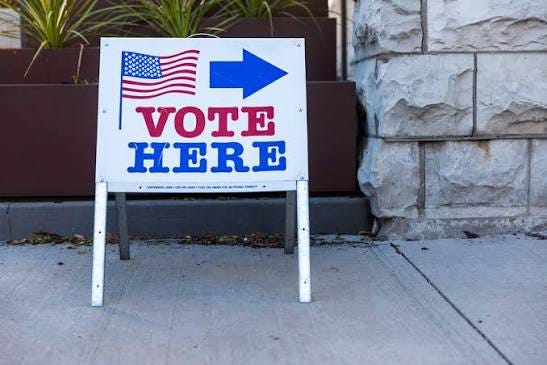
In the days and weeks after Election Day, takes will start flying around the internet — many of them will be ill-informed, designed to flatter a particular political bias, and detrimental to the epistemics of our election discourse.
As a veteran pollster, I’ve watched this cycle play out across numerous elections, and it seems to get worse every time. The truth is that we’ll learn a lot when voters head to the polls on Tuesday, but it takes time and patience to ascertain the right facts and form the right opinions.
Don’t let yourself be fooled into buying a B.S. narrative based on incomplete data or motivated reasoning. I’ve compiled a list of the most common ill-conceived post-election takes below. If you see them, please ignore them.
Take 1: “This electoral performance can be repeated next election cycle.”
This election is shaping up to be very favorable towards Democrats. That means that every Democratic candidate is benefiting from a voter base that is both more motivated to vote blue and incredibly unmotivated to vote red.
In these circumstances, the baseline expectation is that Democrats gain seats. While candidate quality and issue selection matter, I worry people will discount the simple fact that it’s a bad year to be a Republican. It’s boring to write “people are unhappy with Trump” for the 100th time, but they really are very unhappy with Trump.
It’s important to remember that Democrats will not be running against a desperately unpopular Republican president forever. That means an election performance in 2026 is not necessarily an indicator of being able to win in 2028 or 2030; the electorate simply will not be the same. That’s why I always look at relative performance between candidates and do not overvalue what are ultimately structural factors that will change between election cycles.
Take 2: “Everything this losing candidate did was wrong/everything this winning candidate did was right.”
Campaigns are complicated. And winning or losing is a single binary metric. It is entirely possible for a candidate to do many things right and still lose, or vice versa, which is one of the reasons we study metrics like overperformance. For example, Dan Osborn lost his Nebraska Senate race in 2024, but he was the single biggest overperformer of the election cycle.
It’s genuinely very hard to figure out what parts of a campaign went well or poorly. While I’m very happy to talk tactics on X dot com, I feel bad for the folks who have run solid campaigns that couldn’t quite get over the line to victory. Just take a deep breath and remember that one viral clip or embarrassing social media post you saw likely did not decide an entire election.
Take 3: “The margin of victory is equal to this thing we did; therefore, we caused the win.”
This is my personal pet peeve. Margin of victory means the difference in votes between the winning and losing candidate, and in races that get a lot of attention it is often small, as low as a few thousand votes.
This leads people to use the margin as a way to stress how large the impact of their demographic or issue of choice is. For example, an issue-advocacy group might say “We knocked more doors than the margin of victory.” However, anyone vaguely familiar with statistics should know that just because two numbers are similar does not mean they are related.
An especially egregious instance of this false comparison showed up in a recent paper on the political effects of the Inflation Reduction Act — the researcher compared the number of voters potentially influenced by the economic effects of the IRA to Trump’s margin of victory, implying that a bigger clean energy package could have potentially won the presidential election.
The margin of victory in a marquee Senate race could be equal to the number of doors knocked by a particular organization, the number of people who went to see You Can See Everything last weekend, and the number of people who say that McDonald’s is their second-favorite burger, all at once, and still not be evidence that any of those things mattered.
Take 4: “Democrats didn’t do as well as expected”... before the count is finished.
Some states count faster than others; I’m looking at you, California. This means that even the day after an election, popular-vote totals can seriously underrate the number of Democratic votes nationwide. Alaska is also a bit slow, since they need to run its ranked-choice voting system. So while I’d love to see reforms to speed up vote counting, the best way to handle it is simply to wait… and not form any takes based on incomplete national ballot totals!
On election night, there are often minor panics during the ballot counting process. This year, we don’t quite know how this will play out, but usually, Democrats are more likely to vote early or use provisional ballots, which can mean their votes are not tabulated until the end of the night or the next day. If you’re watching raw totals, this could look like “red mirage” followed by a late blue shift. It’s important to remember that there are no new votes being cast after the polls close on election night. It’s just that counting takes a while.
There’s a lot we’re going to learn about American politics after tens of millions of Americans cast their ballot Tuesday: what issues mattered to voters, how leftist candidates compare to moderates, and how lame a duck Trump will be over the next two years. Jumping to sweeping and inaccurate takes before the data comes in will only undermine the important truths we must glean from election night.
This is a rare opportunity to get real data about voter behavior; let’s make it count.