

David Pomerantz is the executive director of the Energy and Policy Institute, a utility watchdog organization.
The biggest congressional victory in 50 years was powered by one particular issue: voters’ cost of living — including their skyrocketing utility bills.
Tomorrow, the Senate will vote on the Bipartisan American Affordability and Jobs Act (BAAJA), a bill that would dramatically reform how the country plans, permits, and builds lines that transmit electricity. For millions of Americans, those transmission reforms could lead to lower energy bills.
Under the status quo, utility monopolies regularly obstruct the construction of long-distance transmission lines because they threaten their profit margins; the utilities’ opposition makes electricity more expensive and less reliable, and jeopardizes the grid’s ability to absorb clean energy and accommodate new electrified vehicles or factories.
Other sections of the BAAJA package would make it easier to permit both fossil and clean forms of energy infrastructure, which has sparked controversy among climate advocates. Reasonable people can disagree about those trade-offs based on their values and the constituencies they represent.1
But all stakeholders, from environmentalists to industry, Democrats and Republicans, seem to love the bill’s transmission reforms.
Only one group has disagreed: the electric utilities that build most of our transmission lines.
Utilities prefer local transmission to regional transmission
Why have the companies that build transmission lines tried to weaken or kill the parts of BAAJA that would make that process much easier and faster?
As someone who has studied utility companies for over a decade, I think the answer lies in the conflict between local and regional transmission.
To use roads as an analogy, BAAJA is trying to spur development of the interstate highways, not the local through-roads.
Regional lines are so valuable because they can bring electricity from where it’s abundant, which will often mean bringing cheap electricity to a place where it’s more expensive, lowering everyone’s bills.
But cheaper electricity imports create a threat for the company that’s selling the expensive electricity: it undercuts the value of their own transmission lines and power plants. Specifically, it often boils down to the fact that any given utility doesn’t have a monopoly right to build regional transmission, or the generation at the other end of a line. And how could they? Regional lines, by definition, extend outside of any one utility’s territory!
In other words, a new transmission line might benefit one utility while threatening the profitability of another.
The economist Catherine Hausman modeled how better transmission integration in MISO, the grid operator for a big stripe of states down the middle of the country, would affect the revenues of Entergy, a utility that operates in Arkansas, Louisiana, Mississippi, and East Texas.
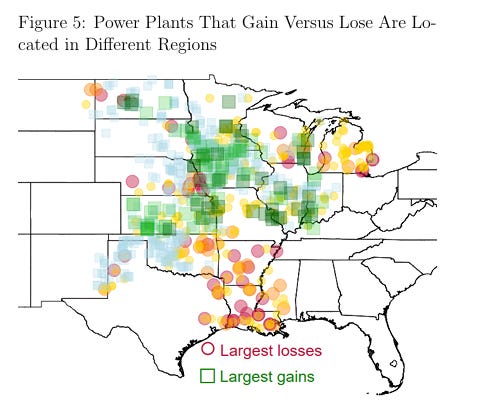
She found that those southern states served by Entergy would benefit if they could access the cheap, surplus wind energy produced in the northern states. But it’s simply not in Entergy’s interest for them to do so: Hausman found that building more transmission to better integrate MISO North and South would have cost Entergy’s subsidiaries $850 million in net revenue in 2022.
Unsurprisingly, given those dynamics, Entergy has worked to thwart MISO’s regional transmission planning and development. EPI has documented how Entergy used an undercover operative at MISO stakeholder meetings, and how it co-opted and coordinated with its Mississippi regulator to thwart MISO’s transmission planning.
All of this obstruction gummed up the works in the grid region: after Entergy joined MISO, the number of hours that it spent annually on transmission planning skyrocketed.
When MISO finally approved a landmark tranche of $21.8 billion in regional transmission lines, they all went to the northern parts of its region, and none went to the South, where they might have outcompeted Entergy’s plants.
It’s not that utilities like Entergy don’t want to build any kind of transmission lines. They just want to block the ones that cross utility service territories and threaten the profitability of their own assets. Within their own monopoly fiefdoms, utilities have been very happy to invest more and more money into local transmission lines.
The result is that Americans are not getting the new transmission super-highways that we need because they threaten monopoly utilities’ profits. Instead, we’re paying more than ever for overpriced local transmission inside those monopolies, which does little to lower bills, make the grid more reliable, or integrate clean energy.
BAAJA aims to make it easier to build and constrain monopoly power
A few years ago, Jennifer Harris wrote about the future of Democratic economic policy using a framework of two animating theories: one was a “Build” wing, which seeks to make it easier to build more desperately needed assets like housing or energy infrastructure; the other was a “Balance” wing, which seeks to break up concentrated market power that imposes scarcity and extracts wealth without providing value.
BAAJA’s transmission sections marry these “build” and “balance” philosophies.
When it comes to building more transmission, BAAJA would clear out a bunch of bureaucratic processes that make permitting, planning, and paying for transmission nearly impossible:
Regional transmission operators (RTOs) have their own exquisitely bureaucratic ways of planning transmission lines. That has made building any lines that cross between the different grid regions impossible. BAAJA would enshrine basic planning standards for every RTO. (Sections 2103 and 2106)
Similarly, BAAJA would require regions to plan alongside their neighbors, and require FERC to create standards for how each region should allocate the costs of new transmission lines, currently a thorny endeavor that they all undertake differently. (Section 2103)
Interstate transmission lines currently have to be permitted by each state they cross, creating a permitting gauntlet. After a year, BAAJA gives federal regulators at FERC the authority to step in and approve a line if the state is taking too long or saying no to a project that will benefit the public. (Section 2101)
The backstop authority plays a critical role in making the planning work. It provides an incentive check against predatory delay in the planning process, so that if utilities let real need for new infrastructure accumulate over time, another utility or developer can go straight to the states and then FERC to propose a solution.
BAAJA also recognizes that it’s not just barriers to building that are thwarting transmission development. Concentrated market power, held in this case by utilities, is a problem too. So BAAJA seeks to balance utilities’ gatekeeping power over the system:
If a state believes that a utility’s local transmission projects are not cost-effective, or if the utility is obstructing regional transmission planning, then the state could refer that utility to a joint FERC-state team for investigation, which would be empowered to cut the utility’s profit rate or issue a fine. (Section 2104)
BAAJA would also prohibit any new federal “right of first refusal” that would allow utilities to have first dibs on building new regional transmission lines, ensuring competitive bidding to keep costs down. (Section 2105)
Ultimately, BAAJA would strike at the heart of the utilities’ monopoly power over transmission, to the benefit of customers.
Utilities are lobbying to defang these reforms
As one might expect, utilities hate these reforms.
As EPI reported last month, Oklahoma Gas & Electric has lobbied to make “substantial revisions” to the bills, including objecting to FERC’s joint investigation team and the reforms that would make transmission bidding more competitive.
Given how popular the transmission reforms are with both Democratic and Republican BAAJA negotiators, OG&E’s more aggressive asks may fall on deaf ears. But other utilities are lobbying too, and I suspect some are trying a less ham-handed approach.
Instead of trying to kill these provisions, utilities may be trying to weaken them with subtle poison pills.
Or maybe they’ll just try to find one senator who can slow this debate down until the next Congress, or try to build resistance in the House.
They certainly don’t suffer from a lack of political resources to try.
Southern Company, which owns utilities in Georgia, Alabama and Mississippi and has been a major opponent of past efforts to spur regional transmission development, spent $3.2 million lobbying Congress in the last quarter. The Edison Electric Institute, the investor-owned utilities’ D.C. trade association, which is funded out of captive ratepayers’ monthly electric bills, spent $1.6 million last quarter on lobbying. Both employ Democratic and Republican lobbyists, and both listed transmission-related terms in their lobbying reports.
Transmission reforms have a chance because utilities have never been weaker
No matter how much utilities are able to spend on Beltway lobbyists, the BAAJA transmission reforms have a chance of passing because the industry is at a generational nadir in its political power.
Poll after poll has found that Americans are furious about their skyrocketing electricity bills, and that they primarily lay the blame at their utility companies’ feet.
Politicians are responding. Throughout 2026, governors running for office in red, blue, and purple states campaigned aggressively against monopoly utilities, promising to appoint tougher regulators who will deny more rate increases and cut their profits.
Adam Hamilton, who shocked the political world by winning a Senate seat in Kansas, actually campaigned on a criticism of utilities’ monopolization of transmission lines.
Indeed, it’s unlikely that the senators who negotiated BAAJA would have even sought the ambitious transmission reforms in the bill, which far outpace prior efforts, if utilities weren’t so politically weak at the moment.
Still, no one should underestimate utilities’ political power on the Hill, even if they’re going to be on fewer politicians’ Christmas card lists this year. These companies spend massively on politics, and typically get what they want.
On Monday, we will see whether Congress is ready, for the first time in a generation, to start standing up to them.
My organization, EPI, does not have a formal position on the bill.

This must be the fifth puff piece Searchlight has published on BAAJA and I am really starting to question its motivations. As in my previous comments, this bill must be rejected. It eviscerates a number of bedrock environmental regulations including the National Environmental Policy Act (NEPA), the ESA, the Clean Water Act (CWA), the National Historic Preservation Act (NHPA), and Title IV (concerning permit certainty). Despite Searchlight's claim in other articles, it will not meaningfully address climate change, and locks in place the federal energy permitting policies of the last ten years, which will make it even more difficult for future administrations to effectively reduce GHG emissions. Much of this comes from the limitations BAAJA places on public participation and consideration of scientific and technical information. There are literally dozens of sites that detail the environmental harms BAAJA would unleash and the lack of progress on climate change. Tellingly, AI tech bros are all-in on BAAJA (see https://therevolvingdoorproject.org/how-baaja-would-benefit-ai-data-centers-according-to-the-ai-industry-and-its-friends/). The fact that this bill is being pushed through during the last gasps of the maga congress should also be revealing.