

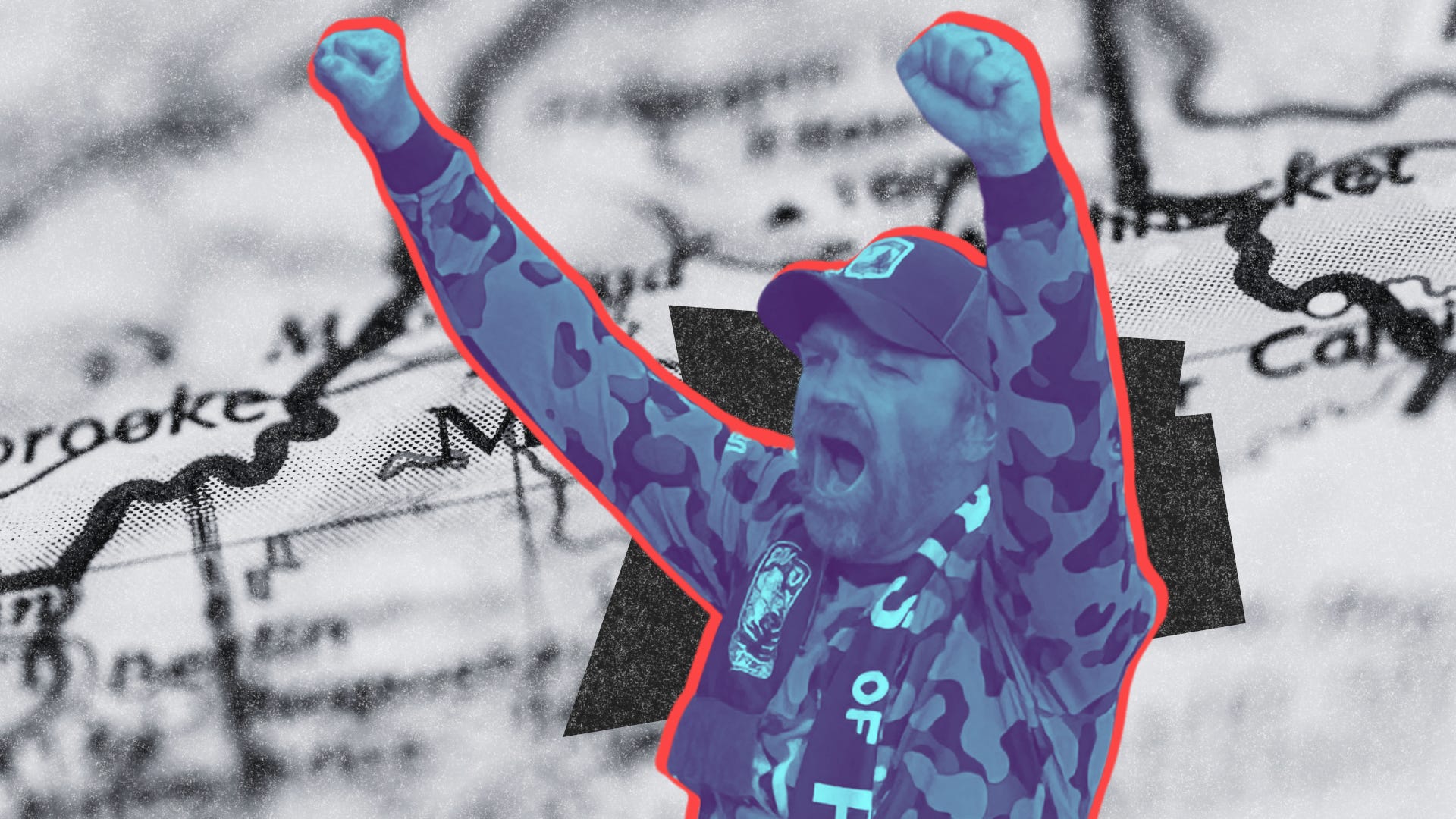
Graham Platner is almost certainly about to drop out of the Maine Senate race. After months of controversy and factional disputes, the candidate who has attracted the most attention this election cycle will soon be leaving it because of a very credible sexual assault allegation.
In The Argument this morning, Jerusalem Demsas reflected on Platner’s demise in a piece titled “What Graham Platner’s defenders refused to see.” In the article, she persuasively argues that Platner’s defenders blinded themselves to his numerous defects because he was a member of their team.
Here’s the relevant point:
“The problem, of course, is that Platner’s defenders have done some bad practical reasoning. They have decided that the world is sorted cleanly into friends and enemies, which means evaluating claims is a matter of figuring out which team you’re on, not whether the argument has merit. That’s why every time people raised concerns with Platner’s behavior, it was shot down as an attack on a friend by an obvious enemy.”
This failure to see clearly that someone with Platner’s track record was probably a rotten guy was rooted in another impulse. Platner’s most fervent supporters incessantly defended him because the stakes for what he stood for transcended any sort of character flaw.
In a system where every political and policy problem is directly downstream of the billionaire class, where the only reason Medicare for All does not exist is malign political influence, and each and every politician outside of their narrow tent only serves special interests, there are only a few candidates ideologically pure enough to support.
Simply put, Graham Platner could not fall. If he did, who else would be left? A tribe, after all, must protect its chief.
That’s what I found to be so dispiriting and revealing about the whole Platner debacle. There are other Democratic candidates running this election cycle who also espouse righteous critiques of the establishment, billionaire donors, and political corruption. But they were never beloved by the same political commentators and strategists who obsessively defended Platner until the most damning revelation of all.
Why? It’s because they didn’t pass every litmus test imposed by that political coalition.
Consider James Talarico in Texas, the Presbyterian seminarian who is running for Senate on a mission to reclaim Christianity for the left. He calls out “billionaire mega-donors and puppet politicians.” His platform also proposes profoundly progressive improvements to our healthcare system. But he doesn’t dogmatically back Medicare for All, receives money from more moderate Democratic groups, and speaks favorably about Texas’s oil and gas industry. As a result, he doesn’t attract the same type of zealous support.
In Iowa, Josh Turek is running for Senate as a “prairie populist.” His platform is also progressive, certainly dramatically more so than his Republican opponent, but like Talarico, he doesn’t box himself in with Medicare for All. He’s also viewed with suspicion because he was the favored candidate of Chuck Schumer. So, unlike Platner, who held all the right positions and had all the right enemies, he never gained much favor either.
Jon Ossoff is running for reelection in Georgia and creating buzz for a presidential run because of his viral videos exposing Trump’s corruption. He also calls the political system (which includes his political party) “coin-operated.” On the other hand, he supported a crypto regulation bill that has been labeled as “pro industry,” voted for a conservative immigration bill, and has all sorts of heterodox positions. That means he’s out too.
To be clear, these politicians are not actively opposed in their campaigns by the left populists who loved Graham Platner. But they just don’t attract the same ideological fervor. And if they ever faced the same barrage of credible accusations that Platner did, they certainly would never receive the same sort of scathing defenses.
I’m not arguing that they would be worthy of defense. Nobody is. But I do think left factionalists should be more interested in these politicians. They might not be ideologically pure enough, but they make many of the same arguments as Platner. And more importantly, they are running competitively in states more ideologically conservative than Maine.
On a less sexy note, everyone should take a closer look at Roy Cooper, too — the former North Carolina governor who is on track to blow out his Republican opponent in a state Trump has won three times. He doesn’t dogmatically toe the line of economic populism, but he wins votes.
Ultimately, it all comes down to this: If there is ever going to be a vote to reverse Trump’s regressive tax cuts, much less pass a progressive health reform like a public option, Democrats are going to need the votes of candidates who reflect the politics of redder states. They’re going to need a tent that is much bigger than Graham Platner.
So my call to all the die-hard Platner supporters isn’t just to reflect on the cognitive dissonance that got them here. Rather, it’s to think in politically practical terms. Open your minds to candidates who might not share every ounce of your worldview, but still get pretty close.
I like the article and I appreciate the points of all 7 comments before mine. Problem is that "protecting their chief" is exactly what happened with the Dem establishment and Biden in 2024, no? Mainstream Dems were protecting their chief even when he couldn't communicate and it became obvious to the entire country it was a cover-up and we were all being lied to.
I think the Dems' coalition problem, which is being described so clearly by everyone above, is actually bigger than the United States; it's a structural problem for liberal democracy and constitutionalism everywhere. It's a problem that never goes away and, thus, it's a fatal weakness for a liberal democracy when a far right populist movement arises. The remaining political liberals in the country are too divided to form a coalition strong enough to fight a protracted battle against illiberalism. We see this happening in Hungary and the UK very clearly right now. Carney's solution to it in Canada is to just default back to neoliberalism while ignoring the populists on both sides. He's doing what mainstream Dems have tried to do for twenty years in the US: just wait and hope the populism on both sides eventually goes away.
There's illiberalism on the far left too, but the illiberal right is far bigger. Which means that when they form an authoritarian movement the center left is structurally too divided and weak to fight back much. There are potential solutions to this situation but I'd have to write a book on it all. We actually need a new theory of radical centrism and a civic paradigm for liberal democracies, what academics call "deliberative democracy."
So, centrists cannot get out of the mess they are in without radically improving the functioning of liberal democracy and strengthening the center-left coalition beyond anything done before. And yet, asking centrists to be radical is a tall order. They think they already know what "radical centrism" is but they don't.
Platner is the perfect ‘wedge candidate’ for the same reason Israel is (right now) the perfect ‘wedge issue’ - the downsides and counterpoints are so legible that full-throated support becomes an unassailable ‘costly signal’ to commitment to The Cause. The difference is that Israel might prove to be a winning issue, whereas Platner (as across the arc of his life) is destined to take the L.