

Need to argue for onshoring semiconductor manufacturing? China. What about next-gen energy technology? Also China. How about naval construction or AI or cars? Once again, China. You need to sell the American people on your governing priorities? Just point to what our rival across the Pacific is doing. Right?
Maybe it’s just carryover from Cold War-era politics, but for whatever reason, lawmakers on both sides of the aisle love to say “China Bad” whenever they need to make the case for a piece of legislation. Just take your pick from a potpourri of committee hearings if you’re looking for evidence.
That strife-based salesmanship tends to work on other members of Congress. Competition with China has proven to be a powerful propellant for bipartisan cooperation on the Hill. But it’s not as salient to the American people as many lawmakers may think.
Searchlight just published the results of a whole slew of questions where we asked voters about how they think America should move on the world stage. As it turns out, even though a majority of voters view China as a threat, a majority also favor cooperation with China over antagonism. That sentiment is especially strong among voters under 35, which suggests that an anti-China posture will become less and less convincing to the public in the coming years.
Our polling doesn’t indicate exactly what’s driving this mindset among Americans. Some people may say it’s related to Trump’s tariffs, some might even say that the generational divide could be proof of online CCP influence operations are working (that’s for the spooks to decide).
Perhaps younger voters see issues that are important to them, like climate change, as needing an all-hands-on-deck approach. Or maybe it’s just a case of good-old American bravado: 55% of voters think that the US military is stronger than China’s, while 44% say the same thing about our economy. But whatever the cause may be, Searchlight’s findings fly in the face of longstanding conventional wisdom on the Hill.
To be clear, this piece is not arguing that Congress should deprioritize outcompeting China. What lawmakers should do however, is examine their assumptions about how Americans might respond to anti-China rhetoric and try out some new arguments in favor of the critical work that’s happening in Congress to strengthen our national security and supply chains.
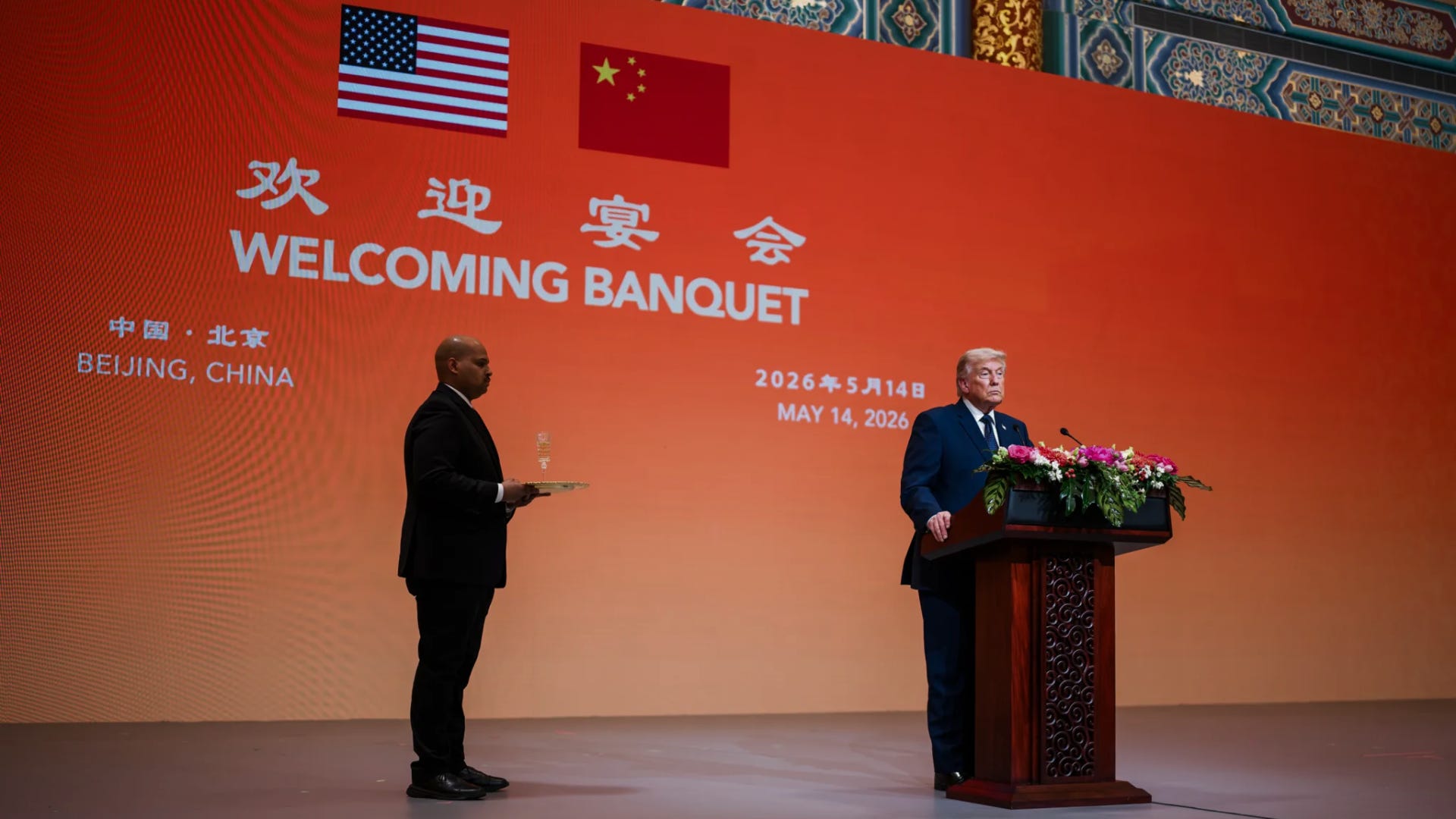
President Trump’s visit to China earlier this month only further cements this shift. Flanked by both his cabinet and members of the White House press corps, he and the rest of the delegation stepped onto Chinese soil with a new tone toward the nation’s leadership and its insurgent place in a multipolar world.
Consider these findings in the broader conversation regarding the new, shifting consensus among young people and their view of America’s role in the world — a consensus which seems to reject intervention, aggression, and the hawkishness that has long fueled skepticism of China in international affairs.
Put simply, younger voters today have become less interested in the United States serving as some sort of arbiter of American values abroad. The old way of doing things might not work for much longer.
So essentially this article argues that the U.S. should adopt some other position regarding China than the current one. But it doesn't offer one, with the only suggestion that it should be something younger voters find appealing. This is not particularly helpful. There are in fact many areas in which the U.S. and China can cooperate toward a mutual benefit: climate change and clean energy, nuclear nonproliferation, improved trade, space technology, and finance are some examples, none of which are currently being pursued. What should be obvious to Americans but isn't, is that China does not in fact have a technological edge in most areas—it has a manufacturing edge, largely due to Chinese subsidies and other non-capitalistic approaches. Furthermore, most of the manufacturing expertise China exhibits is based on original technologies developed by the west (and mostly the U.S.). Some notable exceptions being battery technology, and drone technology. Therefore, any bilateral trade negotiations must acknowledge this and preserve and extend U.S. manufacturing in key strategic areas. However, pursuing the above noted areas of potential cooperation can be done while doing just that.
Its been 20 some years since I spent time {6 months) time in China, at night when bored I would turn on the hotel room TV. In the Chinese featured shows with subtitles the USA was always depicted as the villain, while the Germans or French were the "Good guys". Its been 20 years, but I doubt the state run media has changed that much. We all need to come together for the common good of the global population. China has hawks like USA has hawks that like to strut around and blame "Those Guys".