

Recently, the president was asked a hypothetical: If he found himself standing before the judgment throne of God and was asked to forgive his political enemies, could he find it in his heart to do so?
Trump, ever characteristically, was blunt: “No, I think they were very bad people, and I dislike… I can use the word hate, I do hate some of my enemies.”
It’s an exchange that perfectly encapsulates the vibe that has swallowed our political discourse: hate, distrust, and a permission structure to dismiss anyone who disagrees with you as not just an opponent, but an enemy. Trump is clearly the worst offender, but some Democrats have borrowed the style as well. Gavin Newsom is the Democratic Party’s pugilistic attack dog. Jasmine Crockett built her reputation with vicious anti-Republican takedowns, in one instance calling all MAGA supporters “unpatriotic people.”
Some of this is fair; there are elements of MAGA that are antithetical to the American political project. Still, the concept of good-faith political agreement often feels lost in our politics. The days of Barack Obama declaring, “There is not a liberal America and a conservative America — there is the United States of America,” are a hazy memory.
The White House might still sit under the dark and divisive cloud of Trump, but I see a renewed commitment to political pluralism on the horizon.
This election cycle, several red-state Democrats successfully campaigned on traditional liberal values, not just in the progressive sense, but in their enthusiastic embrace of diverse political thought. In Iowa, Rob Sand began town halls by asking attendees to applaud for those who might belong to a different political party. He would end them by encouraging his supporters to seek dialogue with those they might disagree with.
James Talarico painted Texas blue while preaching what The Nation called a “Gospel of Pluralism.” In a CNN town hall, he told a Republican voter that debate and disagreement are inherent to the Bible and “something that we should be comfortable with Christians.”
I never expected Sand or Talarico to win their races by double digits, but I had a feeling that their commitment to political tolerance would resonate with voters. That’s because Searchlight research has found that Americans share these values. While Trump has destroyed much in our public sphere, we are not burdened by the same level of blinding political hate.
In a survey taken in the weeks before the election, we asked Americans a series of values-based questions:
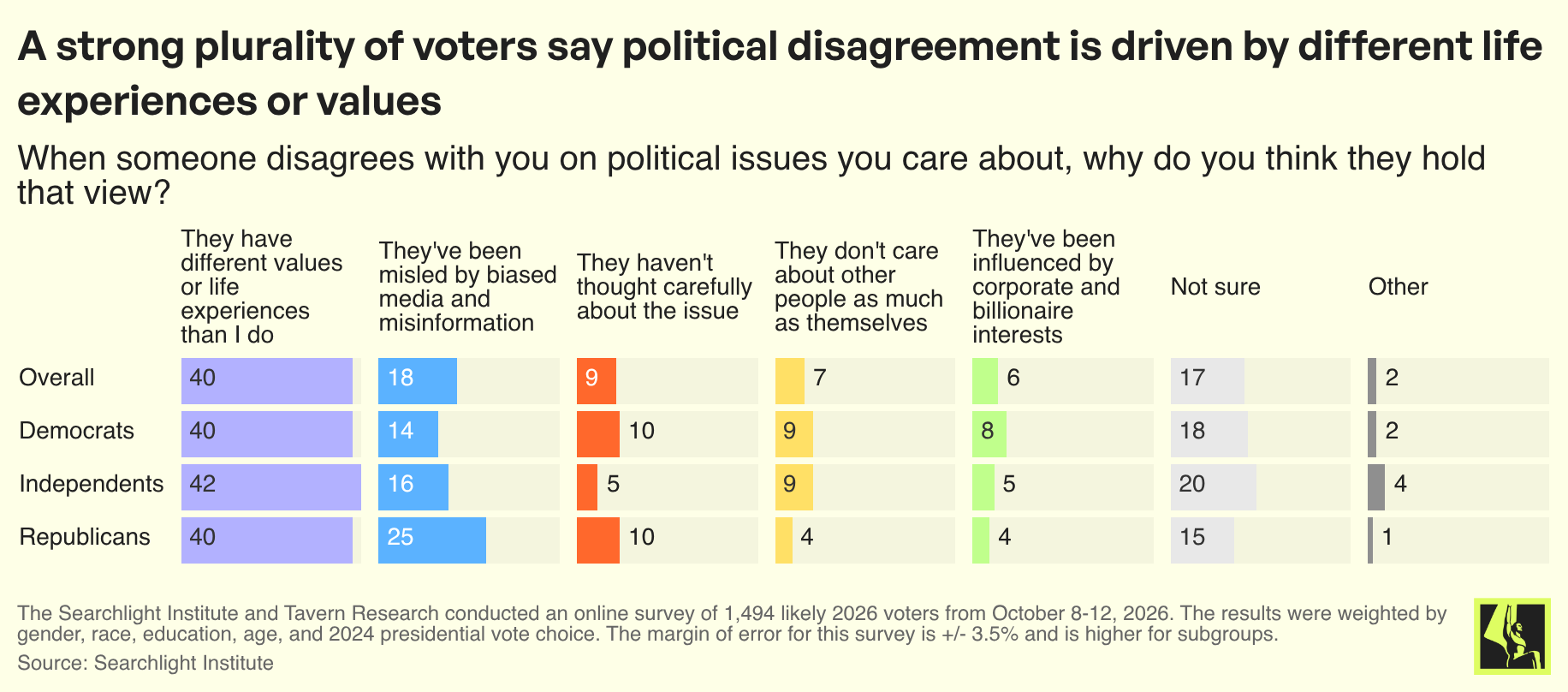
The first was about political disagreement. When someone disagrees with you on political issues you care about, why do you think they hold that view? Overwhelmingly, the top choice was the most tolerant one: “They have different values or life experiences than I do.”
The second question got at the heart of a troubling phenomenon that has broken out both on the right, with the rise of moral authoritarianism, and in some segments on the left, which has its own issues policing dissent.
In our poll, a strong majority of voters, across the political spectrum, said that political discourse is better when it includes a range of opinions. Only 14% of voters said our debates would be better if the people they disagreed with had less political influence.
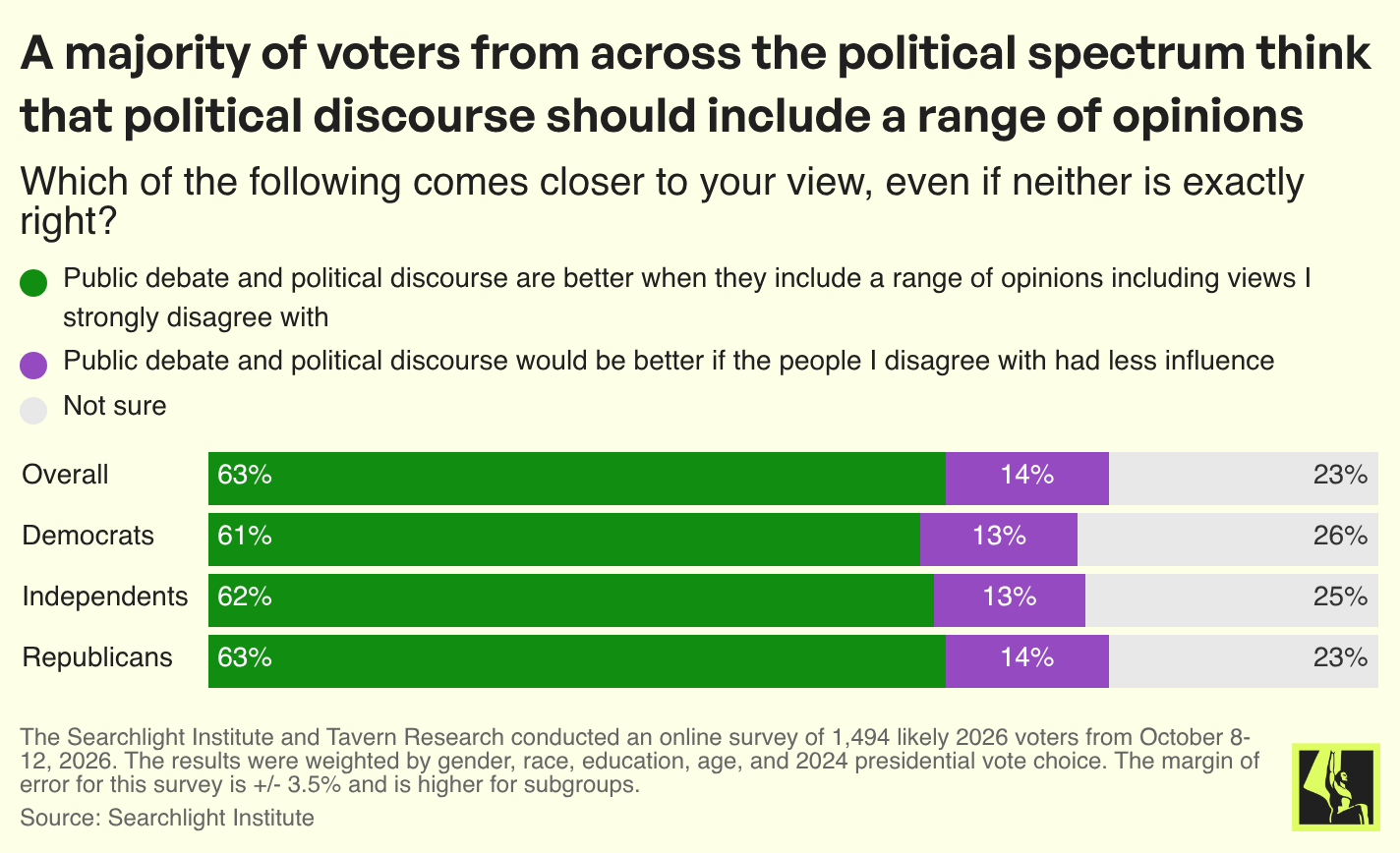
This shows that American voters hold a liberal approach to political discourse. They might have common ground with the great philosopher John Stuart Mill, who famously said, “He who knows only his own side of the case knows little of that.”
But American voters aren’t fully ready to hold hands and sing kumbaya. Our last question asked voters whether their political opponents prioritized winning over what is best for the country; a plurality of respondents (45%) said yes.
This reflects a real sense of polarization and mutual distrust in the electorate, but it’s also an understandable reaction to the zero-sum nature of our politics — where elections are regularly called “stolen,” and politicians and partisan media figures frequently demonize their opponents.
But perhaps this may change if politicians stop feeding into it. In a Carnegie report on polarization and its potential solutions, Rachel Kleinfeld argued that “Altering the sense of threat also requires changing political incentives that allow politicians to use hatred, othering, and claims that the other side is immoral as a winning political strategy.”
American politics will always be high-stakes. This is a massive country governed by two ideologically distinct parties; politicians should be clear-eyed about their political differences, but understand that this is compatible with a commitment to pluralistic thought.
James Talarico spoke with righteous anger about the rising price of health care. Rob Sand was outraged by his opponent’s opposition to mRNA cancer drugs. At the same time, both preached the value of political tolerance.
And the voters rewarded them for it.
You are like our “watchdog our press, you normalize people who CHOOSE to be cult followers and then you want us to become pro-actively bipartisan. These are unprecedented, critical times.
It's all well and good (really) for Dems to take the attitude suggested by the author. However, what Dems must do now is to cultivate and exercise the political will to carry out the reforms that our Democracy cries out for. That includes impeachment, and in some cases prosecution, of those members of the trump administration that have been raping and pillaging America. Regarding that, there is little room for compromise.