

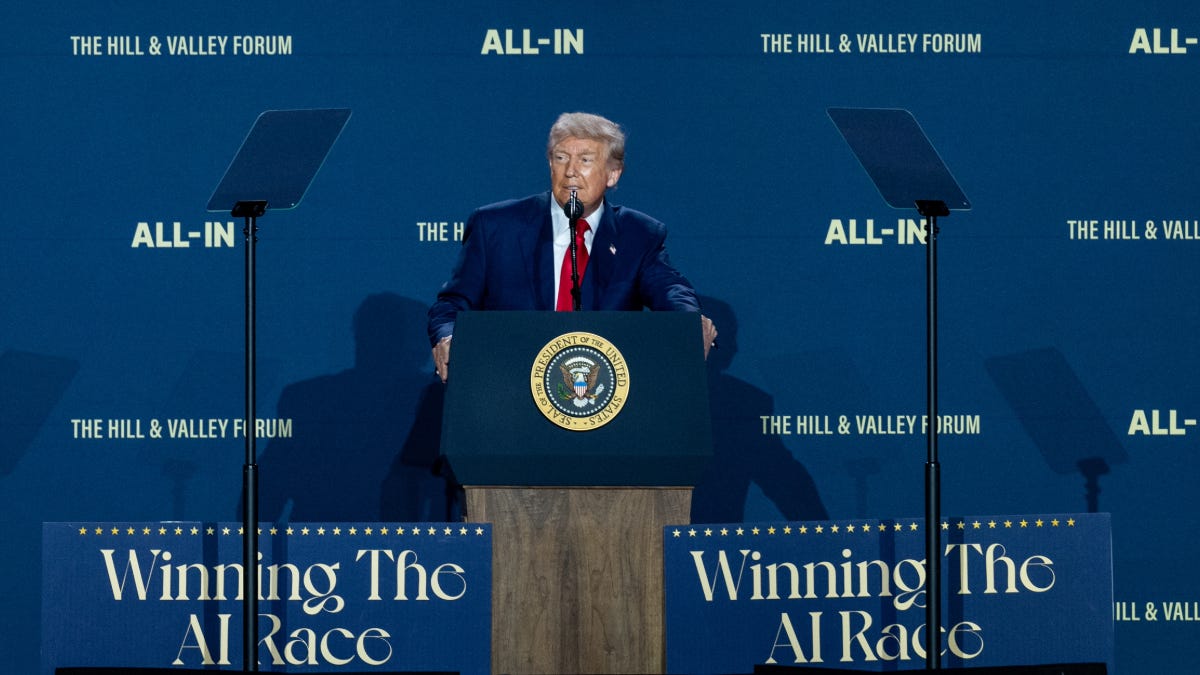
At the end of March, the Trump Administration released a National AI Legislative Framework that lays out half a dozen objectives for Congress.
Notably, the framework fails to mention the word “agent.”
Any sensible legislative framework will require Congress to understand and address the expansive new capabilities agentic AI brings to the table.
As a New Yorker who can’t drive, I have no business making traffic analogies. But, for the sake of my argument, I’ll say this: attempting to regulate AI while discounting autonomous agents is like writing rules of the road for horses in a world that runs on cars.
Agentic AI, as described by this helpful backgrounder from MIT Sloan, is a “new breed of AI systems that are semi- or fully autonomous and thus able to perceive, reason, and act on their own.” Unlike AI chatbots, which require a human to prompt each new output, AI agents can complete tasks without constant back-and-forth communication. Working with other software systems, agents independently break down complex tasks into subtasks — making decisions and acting across multiple steps to achieve a given goal, often from a single human prompt.
AI agents can be useful and fun! (I have a friend, for instance, who uses one to notify her in real time when price drops occur on fashion resale sites). But they can also complete tasks that are far more serious — and sinister — than flagging vintage handbag deals: probing and exploiting software vulnerabilities; operating spearphishing campaigns that can adapt in real time according to a target’s responses; coordinating disinformation at scale; or acquiring accounts and resources while evading human oversight.
Think about it this way: Agentic AI can do anything a human can — but unlike humans, AI agents can act around the clock in thousands of parallel instances. And they aren’t constrained by fatigue, cost, or conscience.
The Trump Administration’s framework does not mandate (or preclude) any specific policy on agents. It’s a set of non-committal, vague objectives. Even organizations that have expressed approval broadly for Trump’s framework have put forward criticisms regarding its failure to include calls for transparency or safety testing requirements on frontier AI companies.
Congress is also behind the ball on agentic AI. The National Institute of Standards and Technology — the executive agency lawmakers rely on as their technical authority on AI — recently issued a formal Request for Information (RFI) on the security of AI agents in January 2026. Information gathering through an RFI is the first step in an ongoing, but long process that should end, eventually, in the creation of guidelines for Congress. But this timeline assumes that lawmakers know what they’re waiting for in the first place.
The deeper problem here is conceptual. The lawmakers that still picture AI through the chatbot lens are operating under a mental model that’s already obsolete. Regulations built around that context would be fundamentally ill-equipped to handle ‘AI as an autonomous actor.’
The following sets of hypothetical regulatory questions demonstrate what this blindspot looks like in practice. The first question in each pairing raises a regulatory issue from the ‘AI as a chatbot’ perspective. The second question does so from that of the ‘AI as an agent.’
How do we keep minors away from harmful or inappropriate AI-generated content? → How do we identify and govern agents that can autonomously build ongoing relationships with children, learn their vulnerabilities, and act on them over time?
Who should be liable when chatbots deliver harmful physical and mental health advice? → Who is liable when an AI agent takes action in the world (like scheduling a procedure or ordering a medication) that causes someone harm?
Should we require platforms to disclose when content was AI-generated? → Should we disclose (if we can even detect) when an AI agent autonomously drafts, sends, or negotiates on someone’s behalf?
What types of outputs should require human review before they’re acted on? → In a reality where AI agents are executing thousands of decisions per minute, what does “human review” actually mean in practice?
How should we regulate AI-generated disinformation or predatory advertising? → How do we detect and regulate AI agents that can autonomously identify persuadable voters, craft hyper-individualized messages, or run deepfake campaigns at scale?
The window for getting this right is narrowing. AI agents are already transforming the world. In the meantime, Congress is still writing rules of the road for horses — while cars zoom past them at 80 miles an hour.
When I call my marketplace insurance, Ambetter, it only connects me to an AI agent that talks. I have, while walking around in public like a lunatic, accused it of being a robot, to which it responds, "I am not a robot, I am an agent."
I hate that robot agent. They programmed it to sound like a person-- little verbal tics and all. But it's not a person. If I ask it certain questions, it doesn't understand.