

Democrats are the party of government. Republicans are the party of free enterprise.
That may not seem entirely true on the merits, at least given the way the Trump administration is inserting itself in the private economy through punitive tariffs, prescriptive DEI policies, and outright demands for government equity in Intel and other corporations. (Perhaps you’d prefer a splash of socialism in your populism, MAGA?) Nevertheless, the average voter still associates more government with Democrats, and less with the Republicans. Which means, for Democrats, that government needs to work. But do people think that it does?
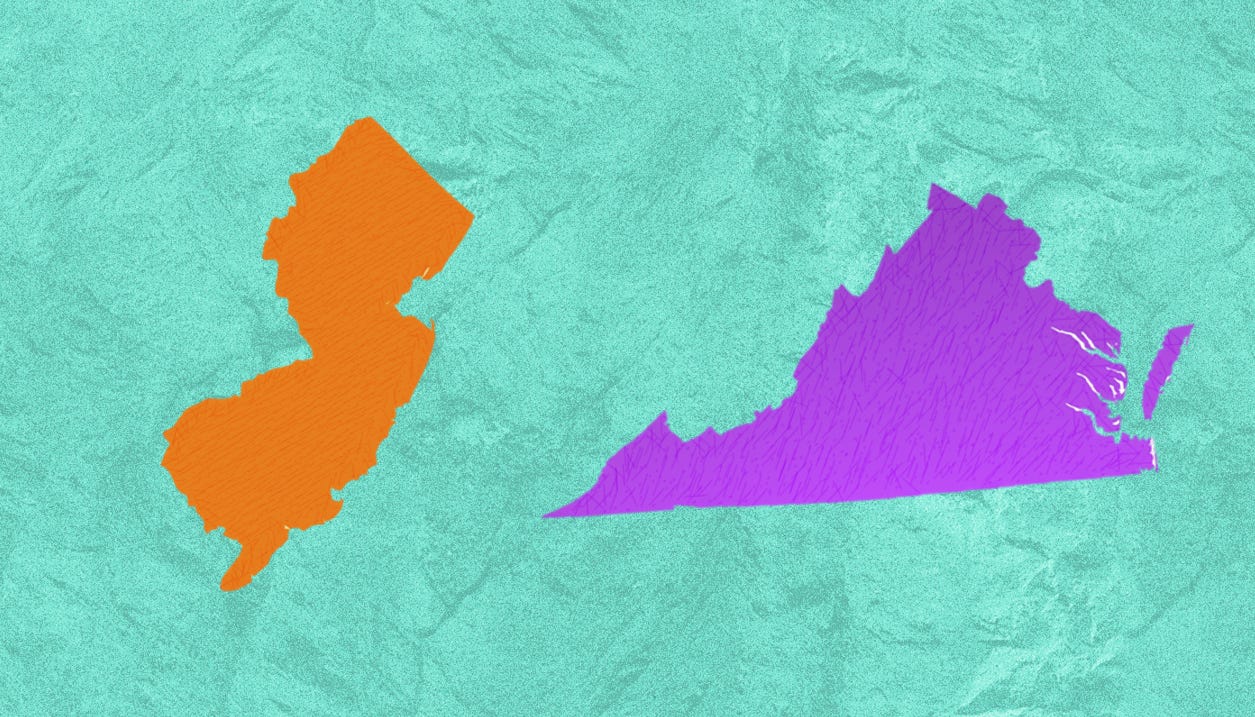
In the two states with newly elected Democratic governors, the answer is quite decidedly no. Polling recently released by the Searchlight Institute reveals that only about a third of New Jersey and Virginia voters say they trust their state government to do what’s right most of the time or always. Worse, less than 20 percent of voters trust Washington to do what is right. Why? The top two reasons cited: government “wastes tax money on things that aren’t needed” and is “too slow.”
Note that these answers reflect government’s brand as much as it does the reality of what government delivers. Residents of New Jersey and Virginia who visit state parks, or apply for business licenses, or even register their cars say overwhelmingly that the service should get four or five stars (out of five). But that’s not the point—nor is it something that Democrats should use to push back against public opinion.
Whether or not you’re able to quickly and reliably renew your driver’s license online won’t necessarily change your overall impression of government. And, for Democrats, that’s the key: If yours is the “party of government”—if voters believe that it’s in your charter to have government do more—then it’s terrible politics to leave things at the notion that a couple of its bureaucracies actually work well. Put another way: Democrats shouldn’t hang their hats on the pretty park down the street, let alone the popularity of a newly retooled DMV.
Here’s a case where, even if Democrats aren’t able to fix government in one fell swoop, they need to get caught trying. Too frequently, they’re left flat-footed on the wrong side of an argument where Republicans are lighting into some bureaucracy that’s done the wrong thing, and Democrats are left to defend the indefensible. In other cases, Democrats bang a drum for asking government to do more at the same time voters don’t think government is doing a particularly good job with the tasks it’s already been assigned.
To be sure, that doesn’t mean that Democrats need to turn against government. But they do need to acknowledge that its failures are, in large part, due to design rather than personnel. We haven’t constructed enough housing in this country to make homes affordable, not because there aren’t people clamoring to build more housing, but because we’ve built a system that makes it too hard to get shovels in the ground. We’ve been unable to take advantage of the clean energy revolution for the same reason—and as a result we’re seeing utility bills skyrocket. Our infrastructure is poor compared to what you see when you visit other developed countries.
The list of failures goes on and on, and while certainly some blame should be laid at the GOP’s feet, or at the role of private capital, Democrats need to acknowledge that, in too many cases, checks on government have rendered it ineffective. More importantly, as the polling out of New Jersey and Virginia makes plain, voters understand and believe that.
The implications are profound. Rather than trying to convince voters that, actually, government works well—rather than trying to convince them to task government with doing more—Democrats need to convince them that they share their common frustration and, moreover, that they’re uniquely equipped to turn things around.
Democrats need to demonstrate to voters that when they are handed the reins, government gets better at solving real problems.
Governors-elect Spanberger and Sherrill have a tremendous opportunity: The public’s lack of faith in the public sector is kryptonite for Democrats. To restore their strength, they need to begin racking up little wins that prove, in the public’s mind, that government can be trusted to do the right thing.
Marc J. Dunkelman is a Senior Fellow at the Searchlight Institute.

How much of complaints or perception of government failure isn’t about the operation of a government bureaucracy, but rather by the kind of environment which laws and regulations create for businesses and organizations? That is, it could be that the bureaucracy itself is very efficient whenever anyone has to deal with it, but a business has to fill out a ton of forms, and that makes it frustrating for sole proprietors and people running small businesses or non-profits. Or that there are onerous rules about getting a license to be a barber or hairdresser, or for other professions.
I agree with the overall premise of this article: Democrats must acknowledge that government doesn't always work as well as it could, and that they have good ideas for improving it. However, the examples are poorly constructed. For instance, the author claims that the reason housing is unaffordable is due to bureaucracy making the process (presumably permitting) too complicated. This is incomplete. Housing is unaffordable because of a supply shortage (which is in part due to permitting issues), but is also due to much higher construction costs, economic pressure (stagnating wages and higher interest rates), and institutional investing (investors own the majority of homes in may cities). Also, one of the reasons why the permitting process does take longer than it used to is because (1) society now places a higher value on limiting environmental disturbance and (2) water supply is now scarce in many regions. The author's second example: Clean energy is also bogged down by bureaucracy is closer to the mark. The National Environmental Policy Act (NEPA) has delayed many wind and solar projects for years, especially under the Trump administration(s). Again, the intent is that these projects, like any large construction project (e.g., pipelines, highways, etc.) properly consider environmental impacts. However, the reality is that a major factor is politics. The lead entity for NEPA is the president's Council on Environmental Quality (CEQ), with various agencies leading or contributing depending on their expertise. Obviously, these entities are all under the executive branch, which exerts pressure depending on its own ideology. Thus, permitting bureaucracy is often blamed for delaying housing and wind and solar projects, but the reality is more complex and must be dealt with through examination of the fundamentals. Also, consideration of the environment is a common factor in many Republican-Democrat debates, and were the Democrats to cave on that issue, they would lose many voters and do us all a great disservice. So yes, "Democrats need to demonstrate to voters that when they are handed the reins, government gets better at solving real problems." But in doing so, simply blaming bureaucracy is not the answer. Democrats must cite to specific causes and offer specific solutions.