

As Democrats celebrate what is starting to look like a victory in a mid-decade redistricting war that they did not start, a less sunny future is just over the horizon: another potential gutting of the Voting Rights Act by the Supreme Court.
In Louisiana v. Callais, the Court seems poised to strike a pretty decisive blow against a key provision of the law. Section 2 of the Voting Rights Act prohibits racial or ethnic discrimination in elections. From subsection (a) of the statute:
No voting qualification or prerequisite to voting or standard, practice, or procedure shall be imposed or applied by any State or political subdivision in a manner which results in a denial or abridgement of the right of any citizen of the United States to vote on account of race or color.
The section goes on to spell out what constitutes a violation:
A violation is established if, based on the totality of circumstances, it is shown that the political processes leading to nomination or election in the State or political subdivision are not equally open to participation by members of a class of citizens protected by subsection (a) in that its members have less opportunity than other members of the electorate to participate in the political process and to elect representatives of their choice.
In layman’s terms, Section 2 has both prevented discrimination and provided a pathway for racial and ethnic minorities to have a reasonable opportunity to get elected. It has inarguably changed the composition of the U.S. House of Representatives by affording people long denied it seats at the table of power. In short, it has been very effective at doing the thing its architects intended.
Which brings us to today
The facts of Louisiana are a bit complex but they go like this: After the 2020 census and subsequent decennial reapportionment, lawmakers in Louisiana enacted a new congressional district map that included only one majority minority (or “opportunity”) district. Plaintiffs in a separate case alleged that the new map was in violation of Section 2. A federal district court and circuit court affirmed this.
Subsequently, lawmakers redrew their maps again ahead of the 2024 elections and created a second opportunity district. This new map was then challenged by a dozen white Louisiana voters who alleged the new maps were a violation of the 14th Amendment’s Equal Protection Clause. This case eventually made its way to the Supreme Court in March 2025. After initial oral arguments, the Court ordered that the case be reargued with a specific focus on whether the use of race as a factor in redrawing district maps is unconstitutional. A ruling on the case is due any day now.
The ruling most voting rights activists fear is an effective neutering of Section 2 entirely. One need not wonder why that ruling would be troublesome:
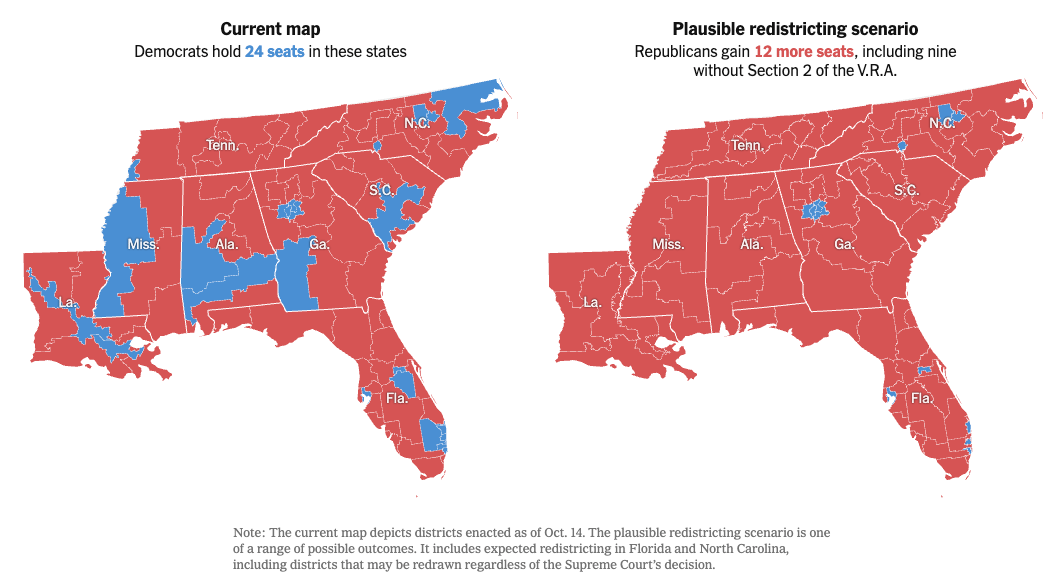
If the Supreme Court severely weakens Section 2, Republican state legislators across the south would likely be able to pursue aggressive gerrymandering to gain as many as 12 seats in the House. In addition to nuking minority representation and eroding the voting potency of non-white voters, this could easily lock Democrats out of a majority in the lower chamber for a generation or more.
This is scary stuff to be sure and advocates are right to sound the alarm. But a question I keep pondering aloud is what’s the plan if the worst comes to pass? This Supreme Court warring against the Voting Rights Act is not new. Chief Justice John Roberts has been cutting away at the law with almost surgical-like precision since he was a baby lawyer in Ronald Reagan’s Department of Justice. It appears that, should the bottom fall out from the Voting Rights Act, the plan is just to decry an adverse decision and hope a future Democratic trifecta (if one can even be achieved) does something about this.
For the sake of multiracial democracy, liberals had better find another way.
I understand how uncomfortable this moment is. Donald Trump, many Republicans, and their allies are weaponizing the statutes long used to help guarantee a pluralistic society to further their brand of grievance politics. It can be paralyzing, but I’m reminded that it was during the height of institutional segregation that leaders and advocates pressed their case to achieve the bedrock civil rights protections we know today.
I believe now is the opportune time to think proactively about how we move forward on fair and free elections—without the spectre of Trump being the main focus. Something will come after him. Liberals need to be ready.
American democracy does look differently than it did when the Voting Rights Act was passed. The racial animus that necessitated its creation is not the voting rights challenge we face today. While we must remain vigilant against all the efforts to restrict access to the ballot or fair representation, we need to update our priors. The Voting Rights Act was the first measure that meaningfully established multiracial democracy in this country, but it need not be the last.
Where do we go from here?
In short, liberals need a plan, both for if the worst comes to pass and even if it doesn’t. This Supreme Court clearly sees the Voting Rights Act as an anachronism. Even and especially if you don’t agree, it’s incumbent on those of us who believe in the sanctity of the vote to plan for the reality we inhabit and not just curse the wind.
What does this look like in practice? Other countries have managed to adopt redistricting schemes that seek to ensure communities of interest can elect representatives of their choosing while avoiding considerations that can scan as biased or even prejudicial to onlookers. There is also no shortage of fresh thinking on changing the way we elect Members of Congress to promote more demographic diversity overall—from multi-member districts to ranked choice voting and a smattering of other proposals.
The problem is solvable, but is there actually the will to do so?
I suspect there’s reticence to engage fully on what a redistricting process that is more race-neutral could look like in part because of the multiracial coalition that powers Democrats’ electoral victories. The backbone of this coalition is indisputably black voters. If you’re the Democratic Party, how do you look the staunchest part of your base in the face, during the height of the second Trump troubles, and say “we need to move on from maximizing the chance of your community having representation this way?”
The sign of any healthy organization is recognizing when something you’ve been doing the same way forever is no longer working. We are quickly approaching—both by judicial erosion and natural evolution—the end of the functional utility of many statutes that pushed our country forward to this moment. It’s possible that in the not too distant future, liberals will be in a position to do long overdue renovations to our democracy’s infrastructure. Now is the time to have the hard conversations necessary to make that moment as productive and effective as possible when it arrives.
The business of democracy is not fixed, and we’d be foolish to believe that a statute enacted six decades ago would be sufficient for all purposes for all time. The people who fought and marched and died for voting rights had faith that future generations would keep up the fight—even as it moved to a new phase. Let’s prove them right.
Any response has to include repeating what just happened in Virginia. There are many states bluer than it that have self-imposed limits on gerrymandering. New York, Washington and Colorado could offset the gains Republicans make from southern states. I have no doubt the efforts by southern states to redraw districts will light a fire under Democrats in blue states.
There is in fact a plan that has been discussed in a number of quarters: stack SCOTUS once a Democrat becomes POTUS again. Republicans have proven time and time again that they will support anyone, regardless of ethical, moral, or criminal malfeasance. They have already gone scorched earth. Like the recent VA gerrymander, you don't bring a stick to a knife fight.