


Primary season is thankfully almost over. That means in many states, it’s time for candidates to make the critical pivot to the general election. For a Democrat to win voters in states like Michigan, Texas, or Iowa, they need to expand their ideological appeal and focus on the occasionally uncomfortable politics of persuasion.
Profiles in Heterodoxy is a regular Searchlight column identifying candidates who make clear choices to appeal to voters who, otherwise, might not vote for a Democrat. Importantly, we’re interested in highlighting figures from all across the Big Tent — moderate, establishment, or Left. The only criterion is whether that candidate is attempting to match the heterodox set of opinions that define the sort of voters that swing elections.
Today’s profile is Rob Sand in Iowa.
Anybody who follows politics knows that deer-in-the-headlights look a politician gets when they’re asked about a tricky issue. For Democrats, it’s usually about trans sports or immigration enforcement. For Republicans, it’s healthcare or Trump’s absurd corruption scandals.
There’s no getting around answering these questions if you want to win a race where the majority of voters do not normally support your political party. Evading an issue does not make it go away. Answering it head-on is the best way to demonstrate independence and broaden your political appeal.
This brings us to this week’s Profile in Heterodoxy: Rob Sand, the Iowa State Auditor who is running for governor. In an interview with Politico’s Jonathan Martin, Sand was asked a question that has plagued other Democrats on the campaign trail: “Would you want to have Joe Biden campaigning for you?”
Sand answered, “No.”
The next question was whether he’d welcome Kamala Harris on the campaign trail. Again, a simple “No, thanks” sufficed. He quickly followed it with, “We need new leadership.” And said he didn’t want Harris to run in 2028.


Distancing yourself from a politician who lost your home state by 14 points should be an obvious political move, but Martin later confirmed that Sand was the first high-profile candidate to answer his question directly.
It’s understandable that Democratic politicians don’t want to throw leaders like Biden and Harris under the bus. The impulse is to be a good Democrat, especially because candidates can be rewarded (or punished) for disloyal behavior. But we’re in the midst of a wave of anti-establishment politics, and if the audience is Democrat-skeptical swing voters, distancing yourself from unpopular party leaders is 100% upside. Voters expect politicians to be loyal to their party; breaking from that expectation is pure political heterodoxy.
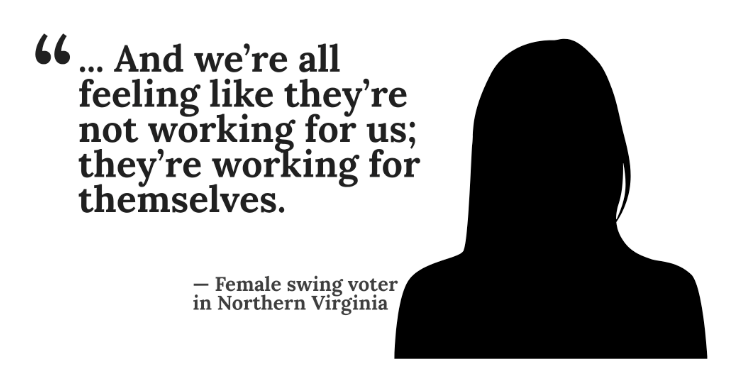
I could imagine Sand’s comments resonating with the sort of swing voter I watched in a Virginia focus group last June. They universally believed the political establishment was corrupt and desperately wanted new leadership.
Beyond the good politics of distancing himself from an unpopular establishment, Sand was able to effectively pivot back to a message that is more relevant to his campaign — mRNA cancer vaccines in Iowa and his opponent’s attempt to ban them.
And that’s ultimately what matters here. Every candidate, just through association with their political party, is going to have a host of issues where they automatically have a disadvantage. In this case, the issue is literally about Sand’s political party establishment, which is not particularly popular in the state of Iowa.
Even if that issue is not highly salient to the majority of voters, it’s still important to directly answer the question and be as broadly appealing as possible. That’s how you shut down issues that might drag down your campaign and pivot back to more important topics like affordability.
Sand has had a long-standing track record of doing this. Early in his campaign, he appeared on a conservative talk radio show and was asked about trans participation in sports — an issue where Democrats are consistently out-of-step with the voting public. He affirmatively answered “No” and then pivoted right back to talking about economic issues in Iowa.
It’s also important to note that Sand isn’t some buttoned-up moderate; he rails against the political system and has a whole section on his website focused on keeping corporations accountable, specifically on the issue of data centers. At the beginning of each town hall, Sand has everyone applaud for members of each political party and sing America the Beautiful.
In her excellent profile of Sand in the Atlantic, Elaine Godfrey summed up the campaign as not being “progressive or moderate.”
I think it’s a secret third thing: Heterodoxy. His campaign is attempting to reach voters from all across the ideological spectrum.
In Iowa, registered Republicans outnumber Democrats by 200,000. Trump’s horrifically unpopular war in Iran and mismanagement of the economy have created an opening for a Democrat to compete statewide. But the only way to actually win the race is to reach voters who registered as Republicans for their own ideological reasons.
Clearly it’s working. Sand is tied with his Republican opponent, Zach Lahn, in the polls. And it’s driving Lahn a bit crazy. In a campaign video, he complained, “It’s like The Truman Show. He’s not a moderate.”
In this era of hyper-nationalized politics, it’s hard to separate oneself from an unpopular party brand. Rob Sand is at least trying.
That’s why he’s our first Profile in Heterodoxy.
As a conservative, I find Rob Sand's campaign to be very interesting and likable. I certainly appreciate his habit of getting crowds to sing "America The Beautiful". He seems like the exact leader the Democrats need, young, fresh, smart, honest, and compassionate.
I have some concerns about how he would govern and whether he would actually act the way he campaigns while in office, but if I lived in the area, I'd think about voting for him.
I hardly think that the Democratic Party is "an unpopular party brand," even in Iowa. And I don't think that "heterodoxy" describes Sand's position on issues, either singularly or generally. He is not deviating from orthodox standards or accepted beliefs. Sand is simply acknowledging obvious truth. Truth that Dems had better also acknowledge if they want to get elected.