

Nicholas Bagley is a law professor at the University of Michigan. In 2020 and 2022, he served as special counsel and then chief legal counsel to Governor Gretchen Whitmer of Michigan.
Over the past few months, I’ve argued in a number of outlets, sometimes with Robert Gordon, that Democrats need to push back on demands from the unions that represent cops, teachers, and transit workers.
The reason isn’t that government workers are undeserving. Far from it. Unions, both in the private and public sectors, are critical for ensuring workers are compensated fairly and their rights are protected.
The problem is that public sector unions regularly push for clumsy work rules and badly designed pay packages that make it harder to supply efficient and effective government services.
Rejecting these counterproductive demands is good policy. For many of the progressive mayors who pledged to expand public transportation, fix urban schools, and keep people safe, it is essential that they strike the right balance between protecting workers’ rights and serving the city as a whole.
Some governors are beginning to take the need for public sector reforms seriously. North Carolina’s Josh Stein just signed bipartisan legislation that would make it easier to hire based on skills, to pay employees for their performance, and to fire for misconduct. Virginia’s Abigail Spanberger vetoed sweeping legislation that would have established very broad collective bargaining rights that would have increased the cost and degraded the quality of government services. And New York’s Kathy Hochul suspended the state’s rigid civil service exams, enabling the rapid hiring of more than 40,000 employees.
These reforms are all calibrated to leave intact the core rights of public sector employees while protecting the government’s interest in efficient and effective public administration. They are what good governance looks like—and they bear little resemblance to the Trump administration’s slash-and-burn approach to the federal workforce.
But are these reforms good politics? Are voters concerned when the demands of public sector unions clash with the interests of the broader public?
To test that question, Searchlight worked with Tavern Research to float an online survey to more than 1,500 likely voters. The survey probed whether and to what extent voters support policies that increase accountability for public sector workers. Generally, these are the sort of policies that public sector unions staunchly oppose.
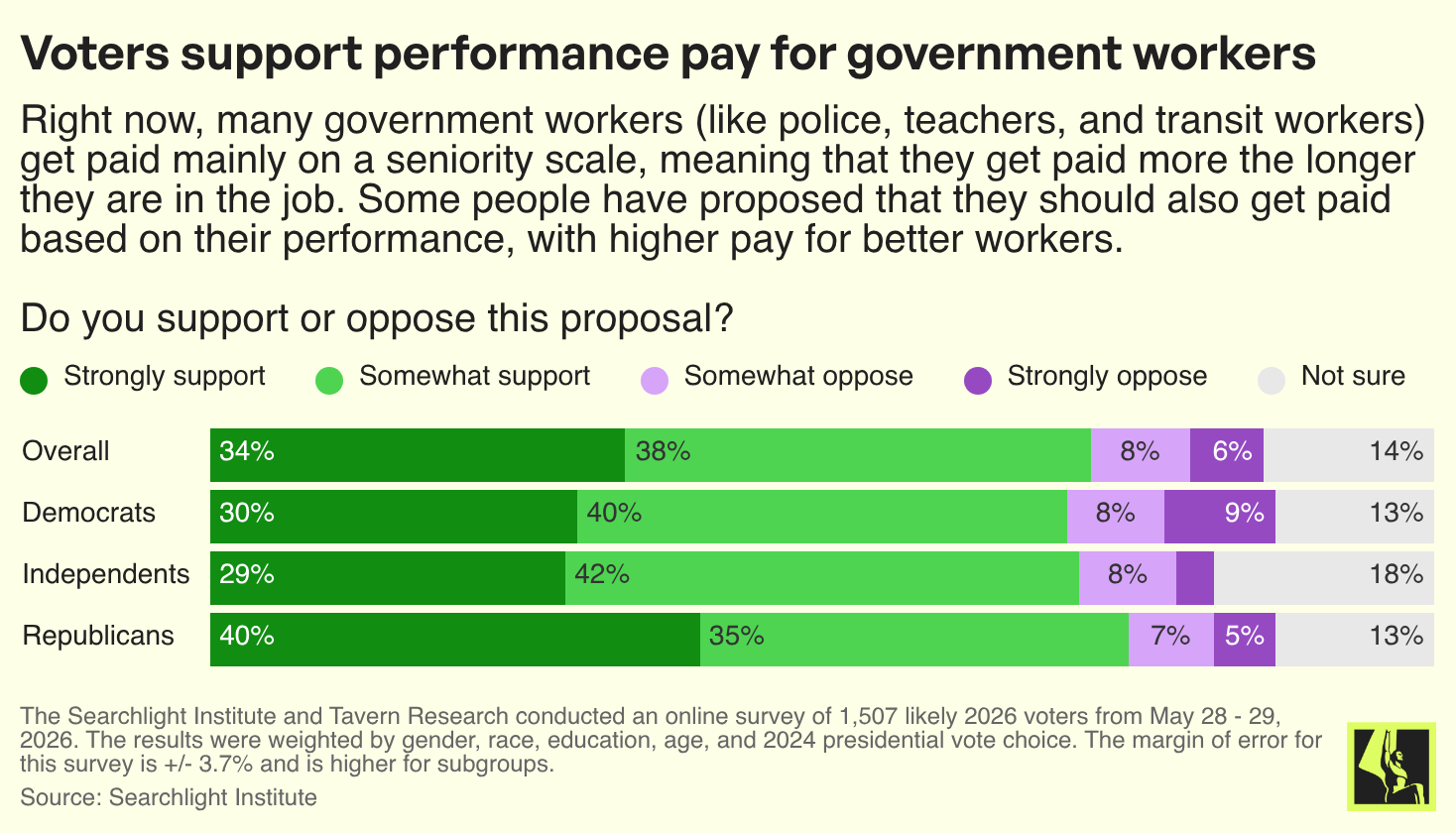
Take performance pay for public workers. Paying for performance might entail, among other things, giving a bonus to highly effective teachers based on classroom observations and principal evaluations. The biggest teachers’ union in the country, the American Federation of Teachers, hates the idea.
A whopping 72% of voters, however, supported performance-based pay. Just 14% were opposed, and another 14% were unsure.
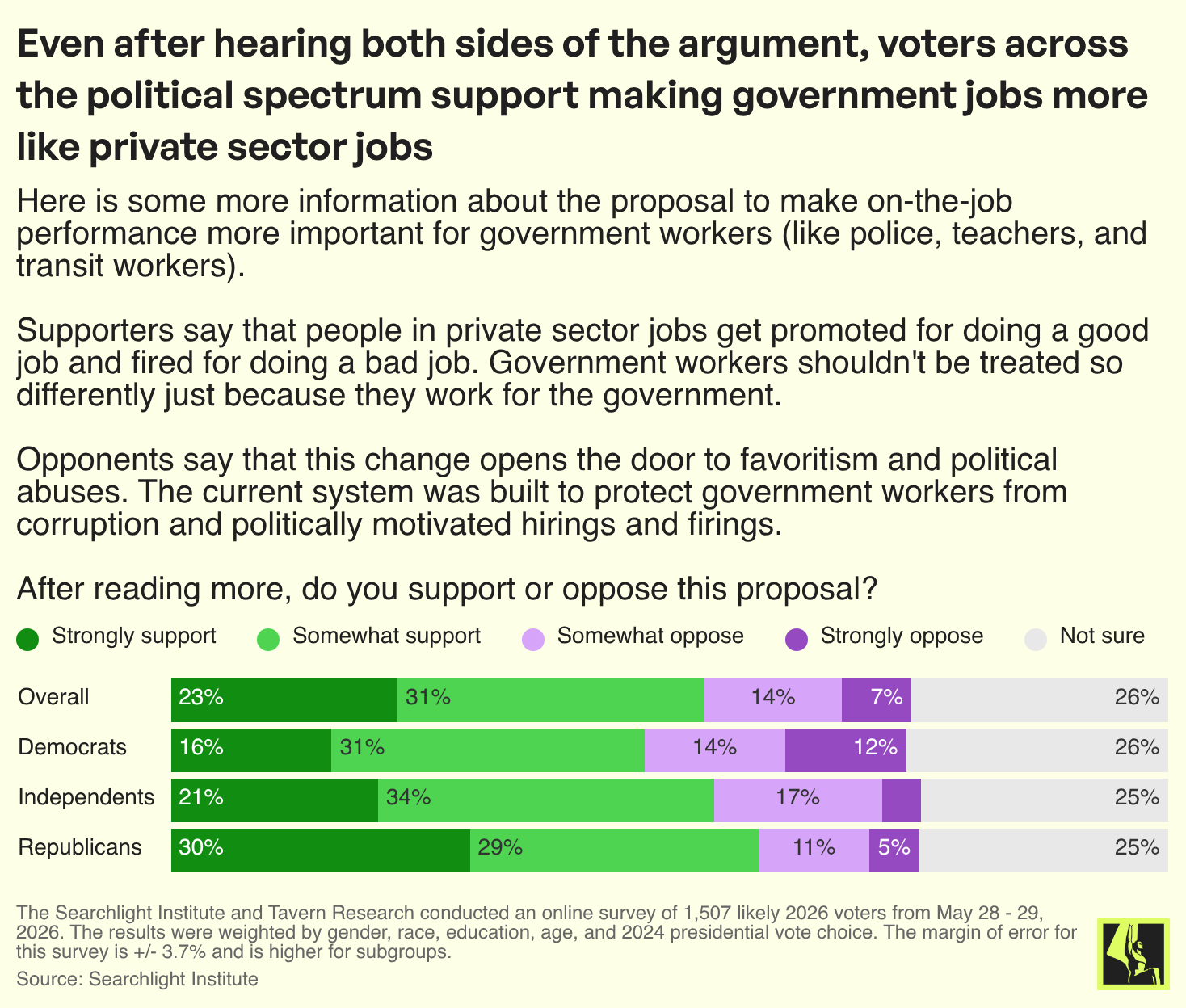
We also asked respondents whether they supported the principle that government workers shouldn’t be treated differently from private-sector workers “just because they work for the government.” More than half (54%) agreed.
We then showed respondents arguments both supporting and opposing this principle. Even then, about two-thirds of respondents (64%) said that it should be at least as easy to fire government workers as it is to fire private-sector employees. Only 1 in 5 (20%) thought it should be harder. But public sector unions consistently push for policies that make it very hard to fire bad cops or teachers.
That’s an especially striking result because even reform-oriented Democrats usually accept the need for some added due-process protections for government workers. Yet the voters—including most Democrats—want no part of it.
The kicker was a question asking which of the following “comes closest to your view”:
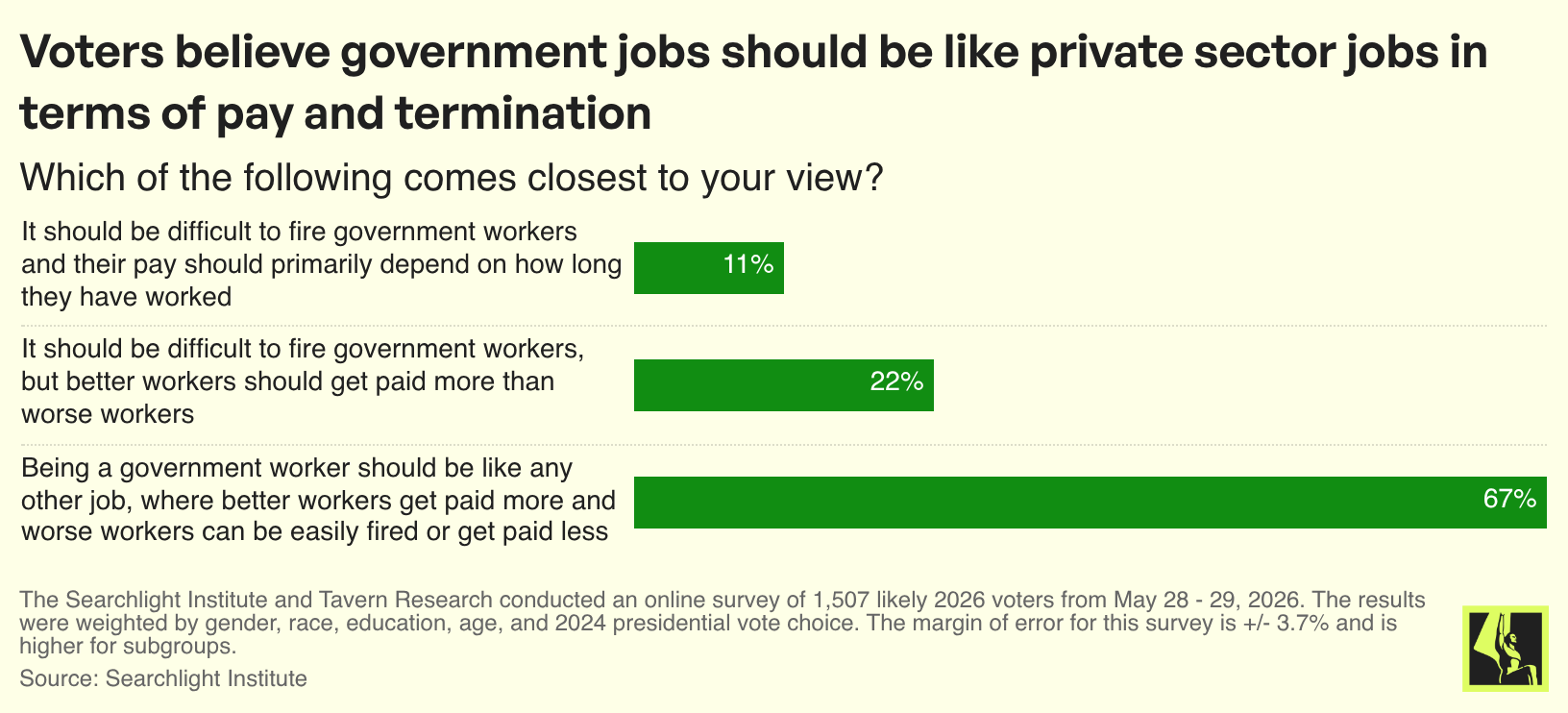
More than two-thirds of respondents picked the third option, which maximizes accountability for public sector workers. Just 11% picked the first option, which minimizes it.
These survey results, which you can find here, deepen the findings of a recent study from David Broockman and Josh Kalla about how Democrats can improve their electoral prospects. Across 29 topics, the authors found that the third-best issue for winning over voters was teacher accountability. (Ending affirmative action was first.) It’s a better issue for Democrats, the authors found, than more high-profile topics like moderating on transgender kids in sports or immigration.
Results like these should be a wake-up call for Democrats. As David Schleicher and I have argued, “[i]t is an extraordinary fact about the 2024 election that the areas that turned most aggressively toward President Trump were those cities and states that have long been Democratic bastions.” Voters don’t believe Democrats when they say they care about excellent schools, safe streets, and reliable transit. Voters don’t believe it because it’s not true. If Democrats did care, they wouldn’t keep cutting deals with unions that make it difficult or impossible to provide those services.
A better approach is possible. The governors we named earlier are following the lead of President Obama, who made a political virtue out of standing up to the teachers’ unions and insisting on good outcomes for kids. Democrats today are too timid to do the same, but these lopsided survey results should give them some confidence. Insisting on accountability in the provision of public services is good policy and good politics.

There are a number of misconceptions this article proclaims as factual and then wrongly generalizes to all government service. For example, there are many different types of public sector jobs. City, county, state, and federal public service cannot be approached as some sort of uniform grouping that can be dealt with as a whole. A police officer position for a 500 person town is much different than a rocket scientist position for NASA. Thus, the statement, "public sector unions regularly push for clumsy work rules and badly designed pay packages that make it harder to supply efficient and effective government services," is a ridiculous extrapolation and has no foundation whatsoever.
A job for a city or county is much closer to the private sector in hiring and firing practices than a state or federal job. Federal employees cannot go on strike like city or county workers, and federal unions are limited to collective bargaining efforts. And so the statement, "public sector unions consistently push for policies that make it very hard to fire bad cops or teachers," has no relationship to state or federal jobs or unions. The author seems to be concerned with improving education, but only focuses on teacher accountability. Again, this issue is much more complex. If the goal is a better pool of teaching talent, then raising teacher pay is mandatory. If you have a waiting list of prospective teachers, then accountability is a simple matter and you will be assured of quality educators. But teachers are in fact only a small cog in the education machine and they follow the direction established by their school districts. They don't set the curriculum, decide on the text books, or even have sole authority to fail students. Anyone who has taught in an inner city high school will attest to the fact that the zoo-like environment encountered is often not conducive to learning. The causes for such dysfunction go way beyond teacher quality. There is a reason why many of these classrooms have panic buttons, something I'm guessing the author never encountered in academia.
The author also seems to be concerned that federal workers not be treated any differently than private sector workers. Again, generalizing to all federal workers is an oversimplification and does everyone who directly or indirectly receives a benefit from the government a disservice. The reasons why federal workers chose to work for the federal government vary. Certainly some did so simply to have a 9 to 5 job. However, many federal career professionals will tell you that they actually believe in the quaint notion of public service, just as those who enter the armed service do. They struck a bargain with the government: A chance to make a difference in the world in exchange for less than average pay and a reasonable expectation of job security across administrations. In fact the federal government has had difficulty in attracting scientists, programmers, engineers, lawyers and other workers with high education and skill requirements and must pay these workers a differential in order to attract them. But not even dedicated public servants can tolerate the chaos caused by doge and a government that ignores its own laws and regulations. One has only to look at the number of lawyers who have left DOJ to see the results. These career professionals do not make widgets—they work to improve the lives of all of us. A few more years of this and the right will be very close to its goal of dismantling our government in favor of its preferred oligarchical alternative.
The lesson here is that Dems should not adopt knee-jerk reactions to oversimplified and in fact misleading polling just to score political points. We must somehow get beyond the endless application of bandaids to compund fractures, and really try to get at the fundamental reasons for societal failures. Be honest with America, admit that real reform is going to take a long concerted effort.
This is a terrible poll. I'm sorry, but what happens if you rephrase the question: "It should be as difficult to fire people in the private sector as in the public sector?" Or "Should it be legal to fire people in the private sector without cause, or for bad cause?"
The implicit message is that government workers shouldn't be treated _better_ than private sectors. I agree. I think that private sector employees deserve the same protections (by and large, I agree that some packages are "clumsy") as in the public sector. If you reframed the question you'd almost certainly get different answers.