

Jane Flegal is a Senior Fellow at Searchlight. Previously, she served in the Biden administration as Senior Director for Industrial Emissions. Pavan Venkatakrishnan is a fellow at the Searchlight Institute. Previously, he served as a policy advisor at the Foundation for American Innovation
After years of negotiations and scuttled deals, a bipartisan group of senators just released a sweeping bill that will reform America’s onerous permitting system. A regulatory overhaul has been needed for decades, but we’re in a new era of unprecedented electricity demand. Reforming the regulatory regime that approves transmission lines and utility-scale energy projects is the only way to meet that growth.
There will be opposition, including from those who are wary of striking a deal with the Trump administration and fossil fuel interests. We’re sympathetic to those concerns. But that does not dampen our enthusiasm and complete support for this permitting reform package, which is the most substantive and important piece of energy legislation in years.
If you care about decarbonizing the economy or reshoring American manufacturing, or cutting bills for ratepayers, then you should support this bill. No agreement is perfect, but there’s something in this permitting reform agreement that will, on net, benefit everybody.
And there isn’t a better deal out there.
What’s in the bill
The Bipartisan American Affordability and Jobs Act (BAAJA) is 400+ pages long, and it covers everything from establishing limited and unified federal review processes to robust protections for ratepayers.
Let’s start with one of our favorite parts of the bill: permitting certainty. One of the main reasons why some climate advocates are skeptical about this agreement is that the administration is currently unilaterally blocking onshore and offshore wind projects. In turn, this has created uncertainty in the wind development sector, which is understandably nervous about spending capital that will be tied up in years-long legal disputes.
Building on bipartisan, bicameral legislation introduced earlier this Congress, this permitting agreement solves that exact problem. It introduces a series of deadlines that apply to all classes of federal permits, and if the government unreasonably delays an authorization or improperly rescinds it after issuance, developers can be reimbursed. This will make it far more difficult for this administration and future administrations to successfully use the permitting system as a means of targeting otherwise lawful and environmentally sound projects. Moreover, bill negotiators have gotten Trump to approve several dozen wind projects he had previously blocked.
Let’s move on to transmission. Right now, a single interregional transmission line generally takes around 10 years to build. Given the transmission capacity we need to build in the coming decades, this is just not sustainable. This agreement fixes that problem on several fronts. First, it substantially reforms environmental statutes in ways that will speed project development (described in further detail below). It also creates a federal backstop that kicks in when states obstruct the construction of interregional transmission lines that would alleviate congestion and improve grid reliability. And it requires neighboring regions to coordinate on new transmission projects. In short, it contains the exact kinds of reforms transmission experts and climate advocates have been calling for.
Again, it’s a big bill stuffed with other good reforms, including regulations stating that data centers must pay for the full cost of their electricity and disclose their power usage to the Energy Information Administration. But it’s important to make the case for why the climate community should support this bill.
Reforming environmental statutes is good for clean energy
This permitting reform agreement will make it easier to build clean energy and fossil fuel projects. But it will disproportionately benefit the sort of energy infrastructure that will be needed to decarbonize the economy.
The primary reason is land. Solar and wind require roughly twenty to two hundred times more permitted land area than natural gas. Transmission lines are roughly two to three times wider than gas pipeline corridors. This means that clean energy projects are subject to more permitting exposure, and consequently more rigorous permitting timelines.
Surveys have shown that the vast majority of transmission and solar developers find federal permitting more “onerous” than state and local permitting. And there’s plenty of on-the-ground evidence to back this up: while the federal government currently owns roughly 21% of land in the continental US, it hosts only 3% of the country’s clean energy capacity.
This is because federal land triggers more substantial permitting reviews. Well-intentioned laws, most notably the National Environmental Policy Act (NEPA), as well as the National Historic Preservation Act (NHPA) and the Endangered Species Act (ESA), have all been used to obstruct and delay critical energy projects. This problem is set to get worse in the coming years. Of the 26,000 miles of transmission lines currently being planned, roughly 14,000 will be subject to the most burdensome levels of NEPA review.
This permitting reform bill looks to ease these issues in a number of ways. It narrows the definition of major federal action, limiting the number of projects that trigger NEPA review in the first place; it restricts the statute of limitations for NEPA, NHPA, and ESA lawsuits from six years to 150 days; it requires would-be plaintiffs to participate in the NEPA and NHPA permitting process before bringing a lawsuit, and it ensures that purely procedural violations no longer trigger the pause or outright abandonment of energy projects.
Importantly, if that law still violates the Clean Air Act, Clean Water Act, Endangered Species Act, or the Administrative Procedure Act, project-stopping remedies remain available. In other words, these reforms would preserve substantive environmental protections, but limit the ability of project opponents to use paperwork errors to block critical infrastructure.
Additionally, the bill reforms Sec. 401 of the Clean Water Act to prevent pretextual denial of linear infrastructure projects, extends the availability of nationwide permits for transmission, and reduces the scope of review under the National Historic Preservation Act—all of these are likely to disproportionately benefit clean energy over the long term.
Early modeling backs up the idea that this package will carry outsized benefits for clean energy. A new report from the Center for Climate and Energy Solutions and Greenlight Insights projects that the deal will reduce emissions, on net, by 9% over the next decade.
Yes, there are trade-offs with the fossil fuel industry. But that’s a given in any permitting reform agreement that can get 60 votes in the US Senate. But this bill is overwhelmingly likely to reduce emissions while also bringing about a host of reliability and affordability benefits.
We need energy abundance
The biggest word in American politics these days is “affordability.” And this permitting agreement will help address the massive rate increases that have driven up the cost of electricity bills for households across the country.
The reason is simple: permitting reform will dramatically increase our energy supply, easing the shortages that have exploded costs. After twenty years of flat electricity demand, total US electricity consumption is expected to increase by 35% to 50% by 2040. Data centers are driving this growth, but it’s also manufacturing and the mass electrification of the American economy.
The best and most sustainable path to protecting ratepayers is flooding our grid with clean energy, and the only way to do that is to make it easier to build new clean energy. We know supply-side measures work. During the 20th century, electricity demand grew four times, while inflation-adjusted energy prices fell by 20%. The reason is that we increased our electricity generation.
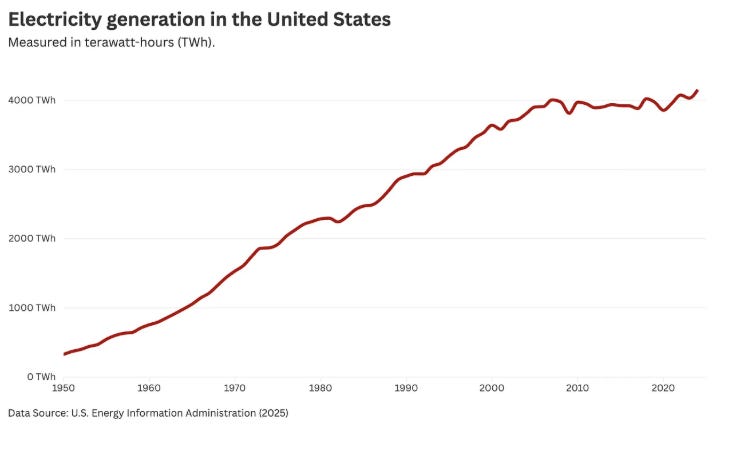
Sure, there’s some utility in policies that will increase energy efficiency, but supply is just a far more important tool for lowering energy costs and fighting climate change. We need to see an electricity generation boom comparable to what we accomplished in the 20th century, and we need it to happen in a much shorter time frame.
Moreover, many industrial technologies such as battery manufacturing, domestic aluminum and steel production, and transportation—all key ingredients of a successful energy transition—will require substantially more electricity generation. Many models predicting energy growth don’t even factor in this sort of electricity demand, even though it will be needed for future decarbonization.
Again, permitting reform is a prerequisite for building the energy necessary for all of this. If we do not cut down on the time it takes to site a transmission line, construct a utility-scale solar project, or get approval for a wind farm, then costs will go up, and the rate at which we decarbonize our economy will slow.
It’s time to pass permitting reform. This is a win for everybody.

