

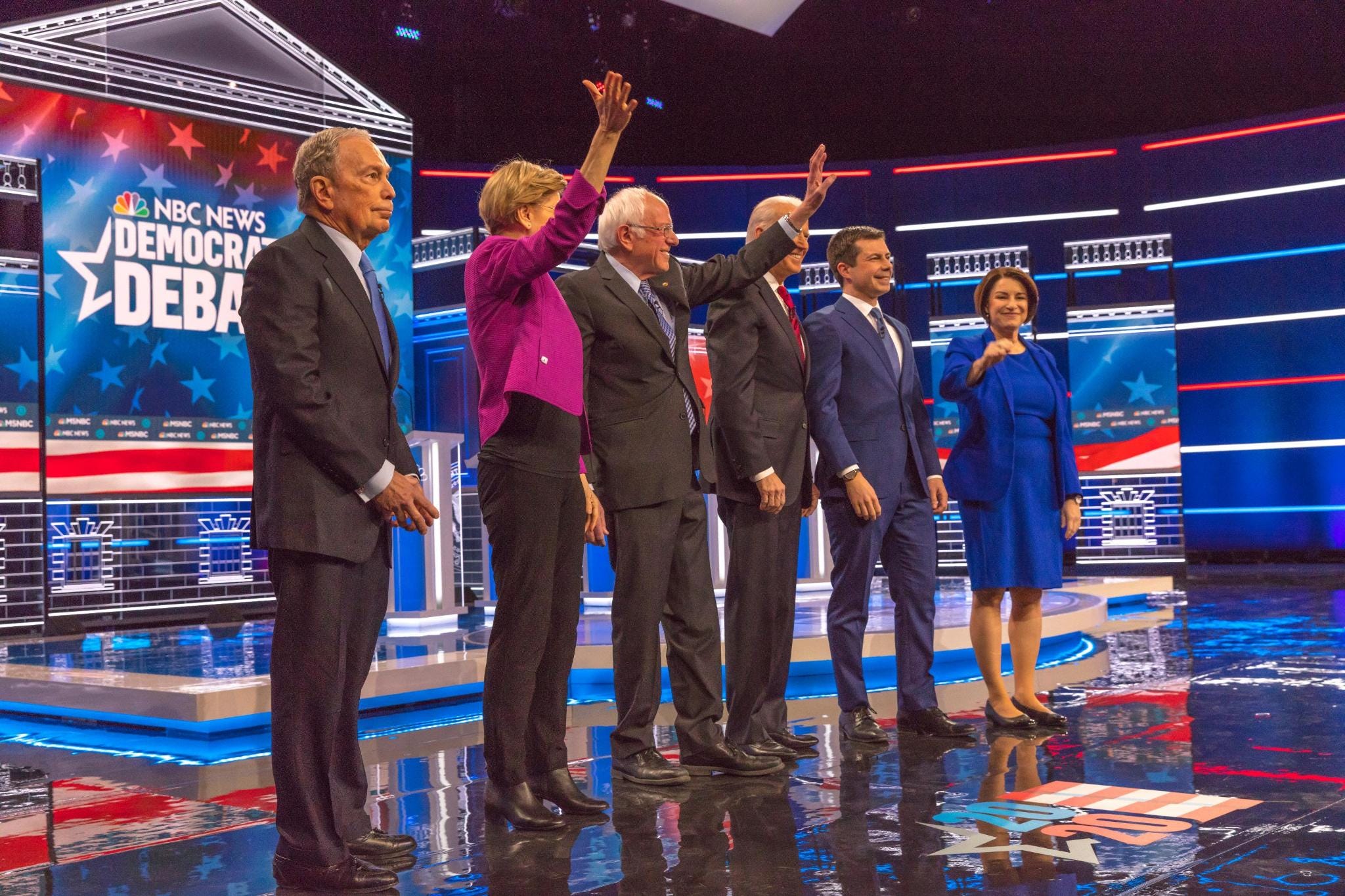
Picture it. It’s one year from today. MSNOW has just opened the first Democratic primary presidential debate. Ten candidates stand before a bespectacled Rachel Maddow.
The first question: “Candidates, raise your hand if you support single-payer health care that would eliminate all private health insurance.”
Over the next 30 minutes, would-be commanders in chief spar over health care policy minutiae that make even the wonkiest among us groan. The typical voter watching at home, the sort of person who actually benefits from better health care policy, is unable to follow the conversation. And the Democratic brand is widely seen as muddled, fractious, and completely out of touch.
If any of this sounds familiar, that’s because Democrats spent almost every single presidential debate in the 2020 cycle going through this same routine.
It doesn’t have to be this way. Democrats can break through their longstanding health care feuds. For the sake of the party and for the sake of actually improving people’s lives, they must find a compromise.
How I realized the health care debate is broken
Like so many things in Democratic politics right now, the health care policy debate is frozen between two intractable factions: the single payer absolutists (as best exemplified by Senator Bernie Sanders’ Medicare for All legislation) and those who want to continue extending ACA subsidies without offering a real vision for what comes next for American health care.
The M4A enthusiasts cast the opposition as either unambitious or shills beholden to the health care lobby. Those who favor single-payer alternatives often accuse the other faction of sloganeering and promoting half-baked ideas without backing them up with substance.
I have admittedly straddled both factions. During the 2020 primary, I was an avid supporter of M4A, but what shifted my perspective was watching the policy contortions Senator Elizabeth Warren made to ensure that her single-payer system could be implemented without raising taxes on the middle class. As numerous non-partisan think tanks have pointed out, broad-based tax increases would, of course, be needed. The idea is that people might end up paying less for coverage because their premiums will go down. But the political problem Warren attempted to contort herself out of, which has become even worse today, is that Americans do not want to pay higher taxes.
The contentious health care debates became even more pointless when the slim Democratic trifecta ultimately decided not to move on even the most moderate health care reform plans from the primary, and instead expanded tax credits that made ACA plans more affordable. My conclusion was that single-payer was a worthy goal that should be pursued with more incremental changes—such as a non-profit public option.
Over the past few years, I’ve come to believe that a single-payer Medicare for All system isn’t the right approach to bringing universal health care to this country. We are too large, too diverse, and hold too many ingrained ideas and expectations about the provision of health care for this type of system to ever be workable. But being against single-payer Medicare for All doesn’t mean I don’t share the important end goal of a truly universal system of health care coverage.
I have no great love for the private insurance industry and find issues like the cost of insulin to be morally abhorrent. If I were to start from scratch, I would prefer the German system, which has an employer element as well as a universal mandate that would be an ideal model for the U.S. But we’re not starting from scratch, and this isn’t some political science experiment. These are real people’s lives. We are living in a political reality where most Americans are skeptical of the government’s capacity to do most things right. And recent Searchlight polling has found that this also applies to the federal government’s ability to administer health care.
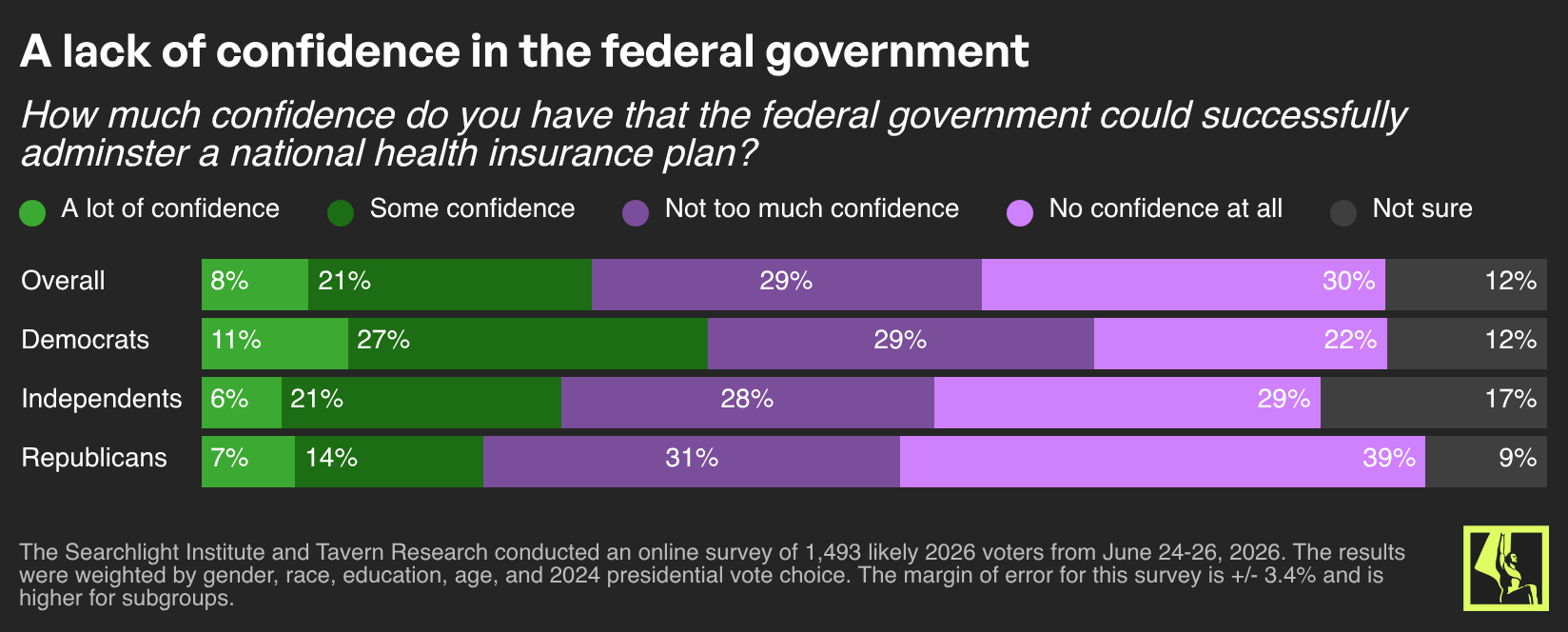
Beyond this question of trust, dogmatic single-payer advocates also tend to wave away the genuine concerns voters have about the broad-based taxes needed to finance the system, higher wait times, and access to physicians. And these are not unreasonable concerns; other countries with single-payer systems struggle with these exact problems all the time.
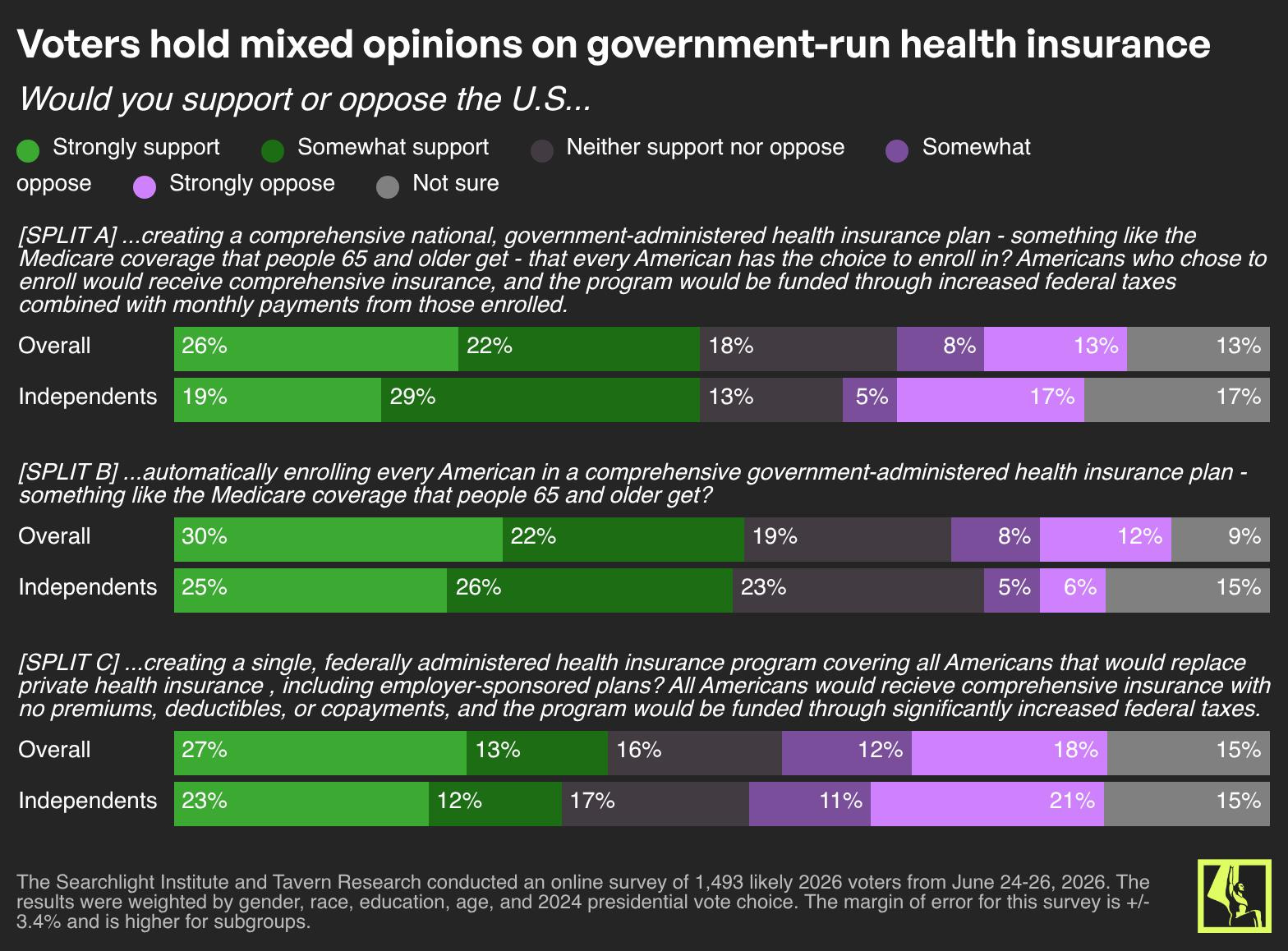
If you’re a M4A dead-ender, the rejoinder to all this is relatively simple: the policy polls incredibly well even after voters hear about the increased taxes. Our friends at Data for Progress found this in research they conducted at the end of last year. We found similar results in a polling collaboration we did with the progressive new media outlet Zeteo. But one big caveat: as you got more descriptive about what single-payer Medicare for All system would entail, when you explained that it would replace private health insurance, the proposal lost popularity.
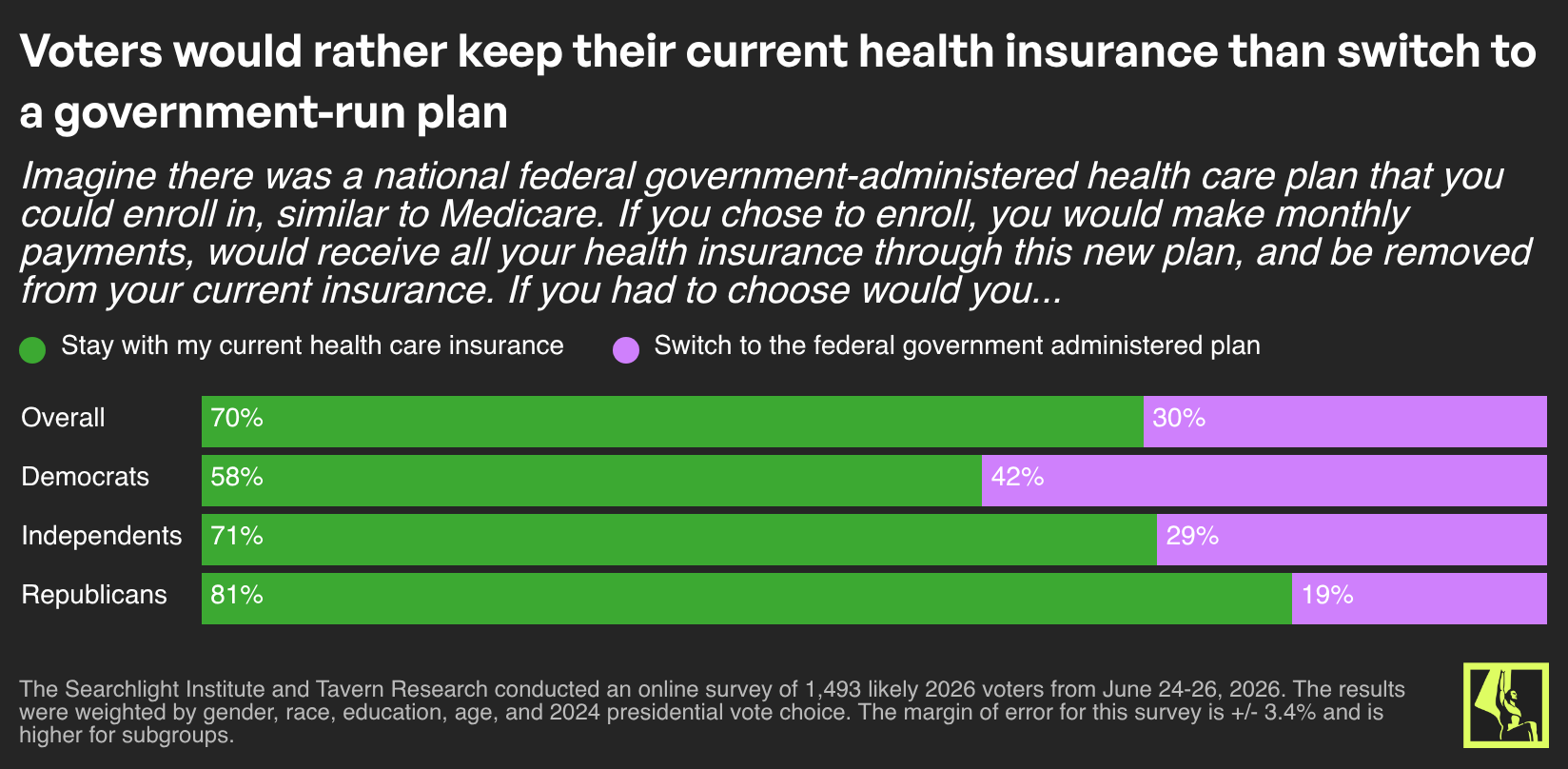
The most jarring finding from that same research was the overwhelming number of Americans who would simply prefer to keep their health insurance rather than receive it from the federal government.
I believe our debates should reckon with the complexity of attempting to make any sweeping policy change. As this polling makes clear, this is not a straightforward environment to make policy.
For people who believe in universal health care, the goal shouldn’t be to bash each other over the head with competing proposals. The goal must be to convince a skeptical populace that the government is, in fact, capable of providing such an intimate service well. And providing a public option is a great way to secure that trust.
This leads me to the false choice at the center of this debate: building on the demonstrable success of the Affordable Care Act or sweeping the system away and starting anew. Absolutists on both sides miss the point. Health care policy in this country should always have both a practical element and an aspirational one. One can advocate for pragmatic steps, while also building toward a single-payer system if the public eventually comes around to it.
We also forget that dramatic public policy change can lead to electoral backlash. President Obama’s “if you like your plan, you can keep it” line was used as a political cudgel against Democrats in the 2010 and 2014 midterms to disastrous effect because it turned out not to be totally accurate.
The ACA itself—reform pilloried as “half measures” by many detractors—did not enter positive approval territory until Republicans tried to take it away. This happened after an extended period where the idea of more government involvement in health care enjoyed robust support. It’s not too hard to imagine a theoretical 2030 midterm gone bad because a lofty policy goal actually fell flat once the rubber met the road. It is a fate that Democrats would do well to avoid, especially because the consequences could be the return of MAGA Republicans.
A better way to debate
Both factions should start with a bit of honesty and humility. For M4A hardliners, that means accepting that private insurance—regardless of how you might feel morally—is always going to have a role to play in the provision of health care in this country (as it already does with many administrative functions of Medicare). It’s also important to admit that a single-payer system is incompatible with the widely shared pledge inside the party not to raise taxes on Americans making under $400,000 per year.
For those opposed to single-payer, I propose we retire the frankly annoying retort of “How are we going to pay for it?” In a moment where tens of billions of dollars are being spent on military exploits abroad and cutting wealthy people’s taxes at home, that sort of rhetoric isn’t going to fly with an electorate that is angry at the establishment and hungry for change in the health care system.
Earlier this year, Searchlight began releasing some health care policies that can help unify this debate. David Bowen, our senior health care fellow, will have more to say about this soon. But we believe it is comprehensive, cost-effective, and responsive to public opinion. There’s a robust public option, free primary care, and a plan to break up health care monopolies.
The response from M4A enthusiasts like Michigan Senate candidate Abdul El-Sayed was, predictably, that the plan wasn’t Medicare for All and thus should be dismissed as a needless half measure. I’m all for having robust debates about health care, but I am frankly sick and tired of this Medicare for All dogmatism. And as I’ve tried to argue here, if you are not reckoning with the nuances of public opinion, then you are not contributing helpfully to this debate. The stakes are improving people’s lives, not winning a factional war.
For inspiration, look to Alexandria Ocasio-Cortez, no slouch on the single-payer absolutist front, who recognized the utility in accepting a public option and breaking up health care monopolies as an important step. That’s a fair response, and evidence that aspirational health care goals do not need to be in tension with practical health care reforms. There’s room for debate.
It is likely that, come 2029, a Democratic governing trifecta will have the opportunity to make a real advancement on health policy again. Between now and then, Democrats should build and campaign on health care policies they can explain succinctly and actually pass once given the opportunity. Health care has always been the party’s best issue; there’s no reason Democrats should diminish their advantage by advocating for maximalist policy ideas that, when fully explained, do not hold majority support among the public.
The path forward to a healthier health care debate is to listen to the Medicare for All wing, but tune out the ideologues who ignore the realities of public opinion. This will preserve the aspiration and hope that Medicare for All advocates hold dear, while also coalescing around something that can tangibly improve people’s lives. The alternative is a tired and elitist debate that fails to actually deliver material change to anyone. And we’re all sick of that.
Reading this and generally agreeing with it, I nonetheless have three major responses:
1. It reminds me of my deep dislike of Bernie Sanders. Separate from my policy and sloganeering disagreements, which are many, he is just a harmfully dishonest guy. He and members of his 2020 campaign have said, on the record, multiple times, that they all knew M4A was a pipe dream, unrealistic as proposed, and never going to happen. That that doesn’t stop him and his faction from attacking anyone who doesn’t fully endorse the same plan; which again, HE HIMSELF HAS SAID WAS IMPOSSIBLE is just such horseshit and everyone needs to know about it regardless of how they feel about M4A as a plan.
2. I disagree pretty strongly with your framing of the “a better way to debate” section. Maybe you’re right that the public watching a debate or whatever would be annoyed by a “how are you going to pay for it” response to M4A. But that doesn’t change that it’s objectively a fair question with an answer that is relevant for the public!
Yes, it’s true that we are spending a ton of money on a war in Iran that is entirely stupid. It’s ALSO true that last year Medicare was more expensive than the military. If someone is proposing taking a ~trillion dollar per year program and tripling its size while expanding its benefits…you’re damn right the pay-for matters!
And that goes doubly for anyone saying they won’t raise taxes on anyone below the 96th percentile of income because that person is simply lying to your face.
Yeah, maybe this is all too wonky and the average person’s eyes will glaze over. But my bold take is that people don’t love taxes and people don’t like being lied to by candidates. And if you are dogmatic about M4A, you’re either raising taxes on a ton of people or you’re lying to…a ton of people.
3. You claim for the electorate is, “hungry for change in the health care system.” Which *feels* true. People do seem unhappy about healthcare. But you not in this very same article 70% of people would rather keep their current healthcare than switch to a government run plan. So…are they actually that hungry for change if the context for that change means more government healthcare? Seems like…no.
Let's start by paying for Medicare/ACA that we haveby replacing the wage tax with a VAT.