

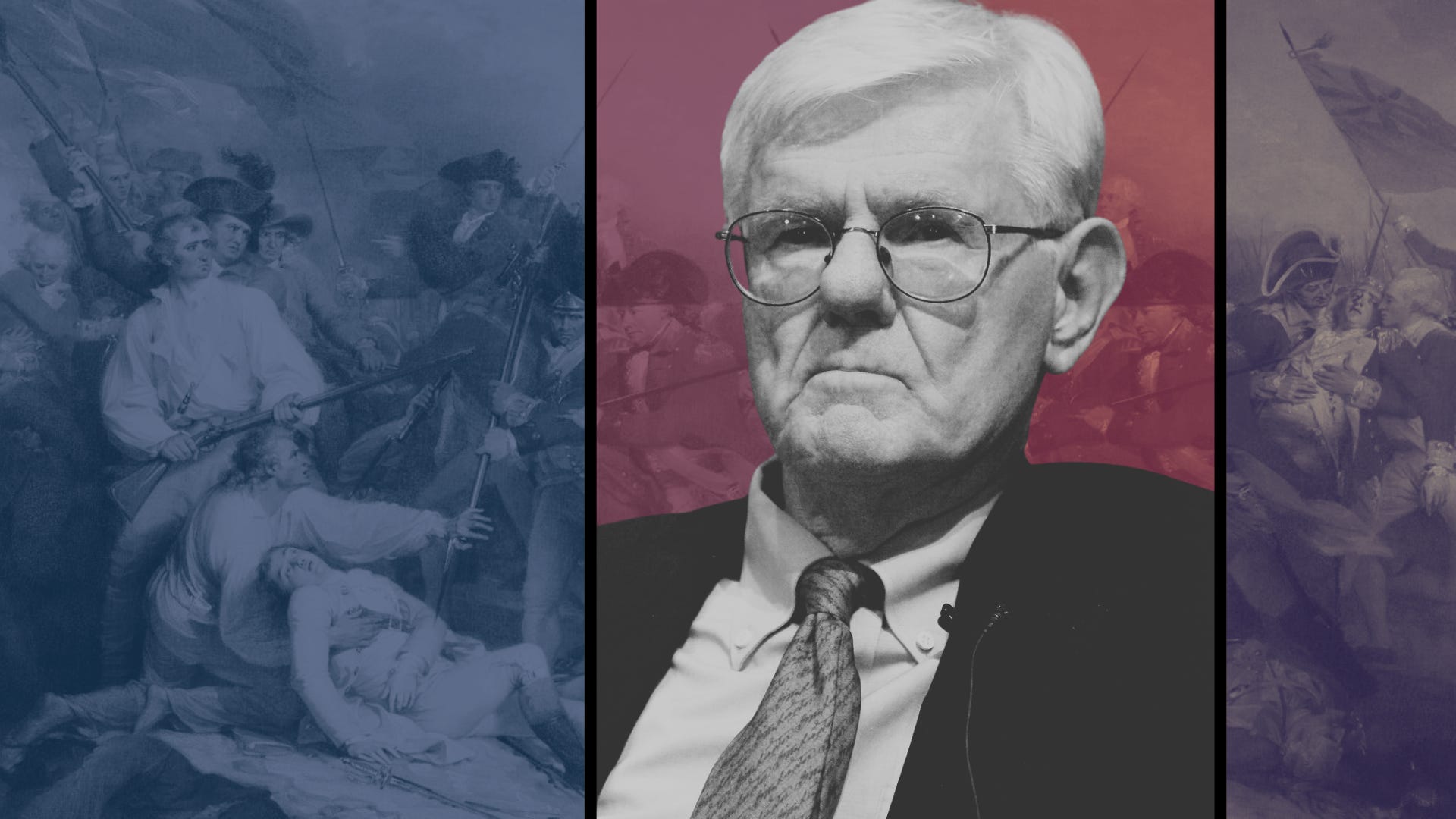
Gordon Wood died at 92 this weekend, less than a month short of the nation’s 250th anniversary. Among the nation’s most preeminent historians—perhaps the most respected expert on the country’s birth—he deserves to be remembered not least for what his scholarship tells us about the present day.
Gordon’s Pulitzer Prize-winning The Radicalism of the American Revolution detailed in ways that are too often lost in the contemporary debate why exactly our society should be considered “exceptional”—not, to note, that it’s explicitly better than others, or that its history is unblemished, but rather that’s it is different. We are a people without a single origin story. We’re not predominately from the same stock, we don’t worship using the same liturgy, and our ancestors did not speak a single language.
Rather, the governing institutions we will celebrate next month reflect a distinct element in our common heritage: We chose to live, or now choose to live, with one another absent the categorical bonds that define other societies. Who could have predicted that a society loosed from what might otherwise tether us together would, two and a half centuries later, claim a mantle as the oldest democracy on the globe?
In one of our most memorable conversations, Gordon mentioned something I’ll never forget. He noted that historians frequently highlight how John Adams and Thomas Jefferson, sometimes friends and frequent rivals, happened to die on the same day—July 4, 1826, the nation’s 50th anniversary. That coincidence has become a part of our national lore, evidence perhaps that the hand of God played a role in arranging the date.
What few knew—what Gordon revealed to me—was that both men, icons of the Founding Generation, both took their last breath feeling despondent about the fate of the nation. They were convinced that the American experiment was coming to naught—that the balance they had each worked to achieve between effective government and popular sovereignty was doomed. And of course, the cynicism was well placed: The nation would break apart just a few decades later in a war that would famously be described, amid the carnage, as a “new birth of freedom.”
Perhaps the most dispiriting element of Gordon’s untimely passing is that, ironically or not, we’re in a moment of similar despondency, particularly among those of us who are MAGA detractors. The eminent professor leaves us at a moment when many just presume that the American experiment is caught in a potentially permanent doom loop—that we need to “save our democracy,” even if many worry it’s beyond redemption. And perhaps it is.
But there are two things about that. First, as Gordon revealed to me all those years ago, this isn’t the first time we’ve been so cynical—and those of us worried about the future today can hardly claim to understand this moment as well as Adams and Jefferson would have claimed to understand theirs. For all we may seem to be on the precipice of disaster, America has survived seeming catastrophe before. That is perhaps the (accidental) genius of our society and government.
Second, a point which Gordon both embodied and illustrated last year while being honored with a lifetime achievement award at the American Enterprise Institute gala in Washington, our nation remains full of heterodox thinkers who are perpetually challenging orthodoxy and proposing new approaches to seemingly intractable problems.
Speaking before the denizens of America’s conservative movement at a time when a Republican administration had embraced out-and-out xenophobia, Gordon took the opportunity to extoll the virtues of immigration. However one parses the various streams of the conservative movement, there were more than a handful of Trump supporters in that room, and Gordon nevertheless received a standing ovation. That took what many of us might label “chutzpah.” And it may well have changed some very influential minds.
I’m as sad to realize today that I won’t have another conversation with Gordon as I was thrilled when, more than a decade ago, he responded to my email out of the blue asking whether I could pick his brain over lunch here in Providence.
He was a generous man, an iconic scholar, an important voice, and a reminder both in word and deed of what makes America great: a working-class kid who went on to shed light on our common story that might otherwise have been lost in the shadows of history.
His books, lectures, and articles were about things that happened a long time ago, but his wisdom speaks to our present moment. Upon his death and the nation’s 250th anniversary, we should be careful to appreciate what he taught us.