

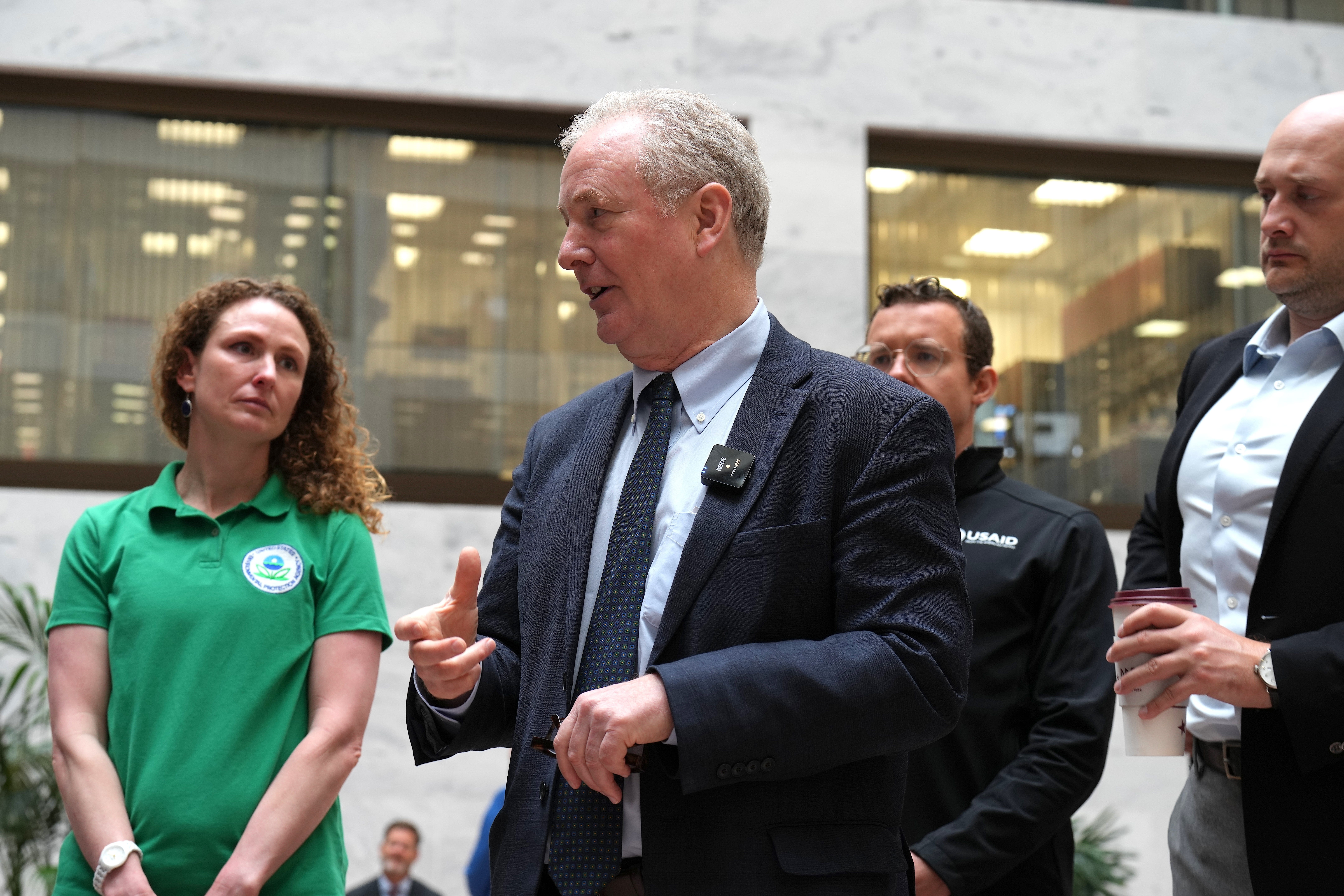
On Thursday, The Washington Post reported that Senator Chris Van Hollen will soon announce his proposal to effectively exempt half of all working Americans from paying the federal income tax — those earning at or below $46,000 a year if filing individually, or $92,000 if married and filing jointly.
Seemingly pitched as a response to Donald Trump’s own ‘No Tax on Tips’ campaign, Van Hollen’s ‘Middle-Class Tax Relief Act’ is a well-intentioned, yet misaligned proposal that could erode our fiscal foundations and ultimately backfire on Democrats on the national stage.
The policy helps fewer Americans than one would think. While an average family of four earning $95,000 is projected to save an additional $6,000, a typical family of four earning $25,000 could receive $0 (relative to current law). Around 3 in 10 tax filers already do not pay federal income tax once applying credits and deductions.
Other filers with low federal income tax levels would see comparatively small returns as well. What has been pitched as a boost of support would fall short of expectations for many. It would be a misuse of revenue and political capital, when there are better reforms that can support families of all shapes and sizes.
Van Hollen intends to cover the cost of this tax cut by introducing a new millionaire surtax that would raise “roughly $1.5 trillion over the next ten years.” If federal policymakers chose to levy the surtax, the collected revenue should be directed towards addressing problems head on — whether it would be to support smoother job transitions, reduce child poverty, or reverse Donald Trump’s cuts to Medicaid and food assistance. Instead, this proposal accepts the premise that taxes are the main challenge for working Americans to overcome.

There is a better path forward. Democrats should not engage in a race-to-the-bottom with Republicans on taxes. The pursuit of tax carve-outs will not only leave the system in a more precarious place, but stoke resentment about who pays their fair share.
The wealthy and big corporations must pay more. But working and middle-class Americans should pay their share too, no matter how small. Instead of running away from contributory tax policy, Democrats should hold up a broad tax base as the essential foundation for a more resilient government.
The Searchlight Institute is hiring! We seek an editor to scale Searchlight's written and editorial content — playing a direct hand in refining the big ideas that are shaping the future of public policy and action. Learn more and apply on our website.
This is what we're up against.
I asked Claude how much more revenue we could raise via income taxes if we made the tax code Laffer-optimal, and what that would entail. IIRC, the top marginal rate would go up into the high 40-something percent range, the cap gains tax would go up a point or two, and many deductions would have phaseouts at higher incomes. And, yes, taxes would go up on most Americans.
This would raise about an additional $400-600B a year.
Unfortunately, the annual deficit is pushing $2T, and that additional revenue would only cover about a fifth to a third of it, and we still haven't paid a penny of the national debt off at all.
Many of my GOP friends blanch at the idea of raising taxes at all, and many of my Dem friends blanch at the idea of cutting any spending.
I suppose we could look at additional revenue sources like a VAT, but those do have macroeconomic effects that need to be considered. Wealth taxes are probably a nonstarter; there's just not that much there, there are macroeconomic effects there as well, and the more extreme versions of those kinds of taxes you can only do once.
I think this is going to go on until we have a crisis that forces everyone's hand to do the unpopular things.
💯 Let’s not proffer tax proposals as if they are somehow independent of our economic, social, and national security objectives.