

You’re not done talking about New York, so we’re not either. There’s plenty more in our poll that we didn’t get to on election night.
Policy Expectations
One of the most common questions asked of Mayor-elect Zohran Mamdani in the days following his victory has been “can he actually get it done?” Winning is hard, but governing is harder, and Mamdani has laid out ambitious goals for his mayoral administration and the whole of New York.
In our initial analysis, we found that New York City voters were generally more supportive of policies than they were likely to believe the policy would really happen. What about Mamdani voters? Did they believe he could accomplish his policies?
The answer is “kind of.” Majorities of Mamdani voters believed it was at least somewhat likely that his signature policies will be implemented. However, under a quarter were willing to say they would become reality. You could read this as pragmatism about the slowness of city government, or as an understanding that campaign promises are more gestures toward a governing posture than guarantees of policy execution, depending on your ideological leanings.
One fascinating thing is that Mamdani voters seemed to believe that an increase in the NYPD headcount (an Eric Adams policy adopted by Andrew Cuomo) is just about as likely to happen as the Mamdani public grocery store policy. In the days immediately before the election, when we fielded this survey, there was a great deal of news about Mamdani’s decision to keep Jessica Tisch in her role as police commissioner if he won. It’s possible that the perceived likelihood of a police headcount increase was in reaction to that news. It probably wasn’t a hedge from voters thinking Cuomo had a chance to win, given how likely Mamdani voters were to believe in their candidate’s chances.

We also directly asked voters some questions about what they prioritized in a mayor: someone with realistic proposals that could actually be implemented, or someone with an aspirational policy vision, even if it was overtly ambitious. Mamdani voters were far, far more likely to say they preferred a candidate whose policies set a clear direction for the city, rather than one focused on realism. Nearly the exact opposite result was true for Cuomo voters.

Of course, the causality here is hard. It’s possible that Mamdani voters, understanding that their candidate was often criticized as having unrealistic proposals, selected ambition over realism explicitly because that was the Mamdani-aligned position. It’s also possible that it was their preference for such ambition that brought them to Mamdani in the first place. We can’t break those two things apart with the data we have here.
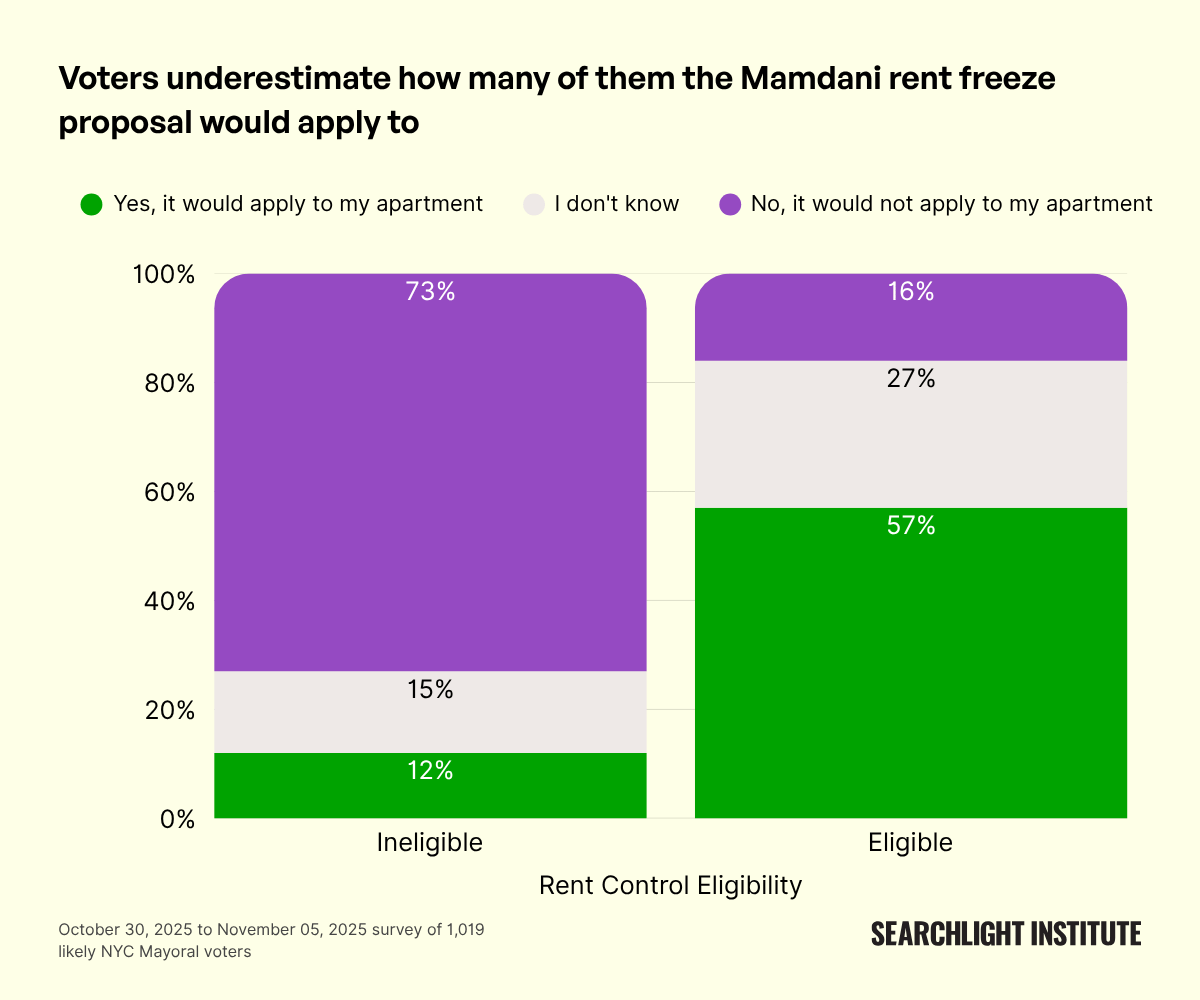
One suggestive bit of evidence that this is pragmatism and not cynicism comes from a question we asked about Mamdani’s rent freeze policy. We wanted to quickly check if people understood whom a rent freeze would apply to. As currently scoped, it applies only to New Yorkers in rent controlled or subsidized units.
The results were promising: Just 12% of ineligible renters believed the policy applies to them. If anything, voters were underrating the scope of Mamdani’s rent freeze, with nearly 40% of renters in subsidized units not certain it would cover them. Personally, this is the opposite of what I expected to find. I was absolutely expecting that a fuzzy understanding of the rent freeze would lead more people to think it included them, but that’s not what the data shows.
News Source
Another angle by which we analyzed our results was through news consumption habits. Our theory was that you’d find differences in perceptions of the race, and the core issues, depending on where people mostly consumed information about it — including traditional media like TV news and newspapers, and digital media sources like YouTube and TikTok.
Those differences are kind of present, but generally small. The biggest one was one crime, where 49% of national TV news viewers said it was a top issue for them, versus just 29% of TikTok news consumers. This is most likely due to age, so make of it what you will. People getting their news from TikTok were also more likely to say that affordable prices or affordable housing were top issues for them, compared to the average of all voters (our analysis of keywords in Mamdani’s content found that his content was extremely on message).
Spite voting?
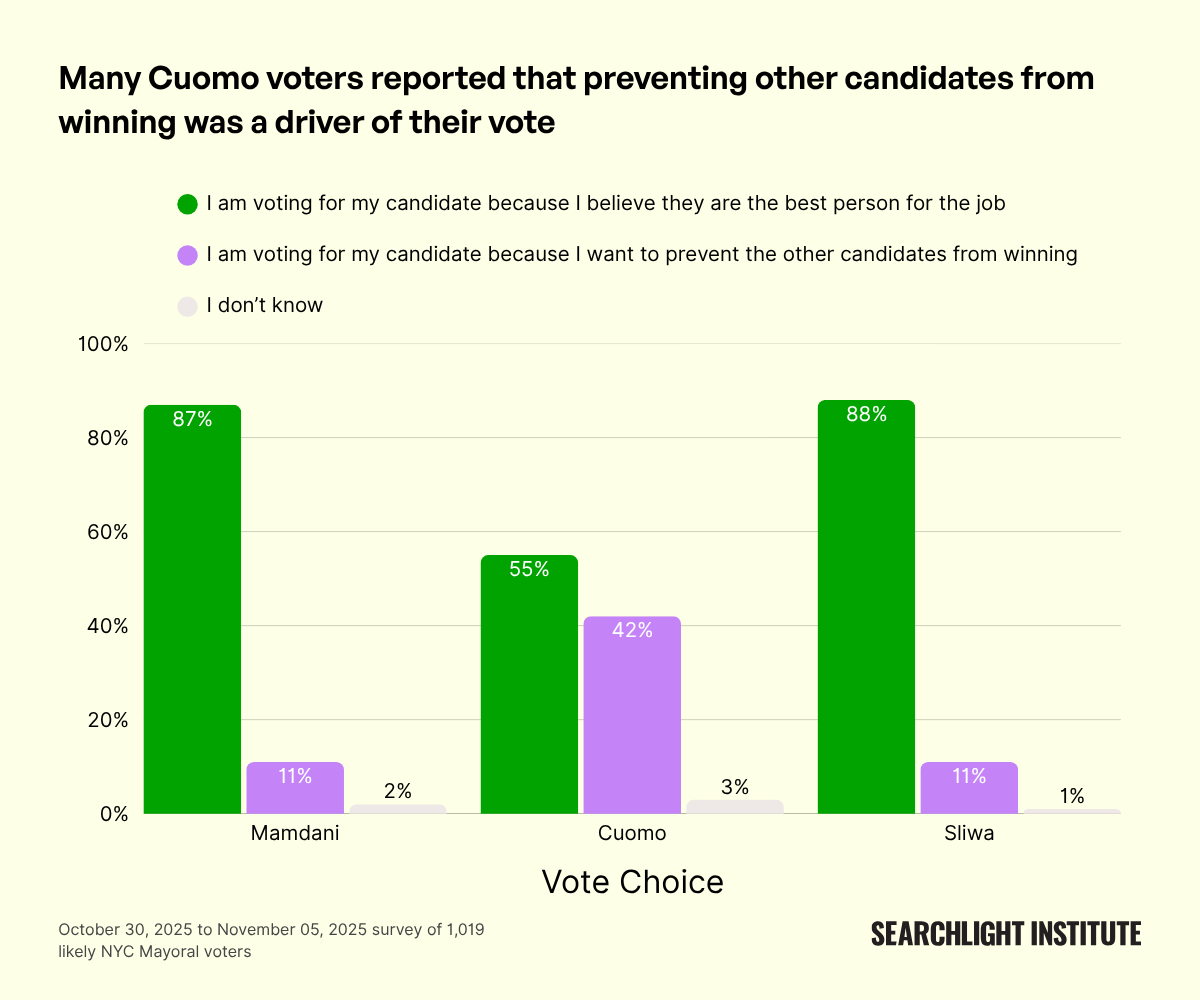
In an effort to understand what was going on in voters’ heads, we asked if their vote choice was driven by a belief that their choice was the best candidate, or by a desire to prevent someone else from winning. It seemed clear from the coverage and framing, especially around Cuomo, that some voters were going to be voting to prevent a certain candidate’s victory. I wasn’t really sure if they would see this as an embarrassing thing they wouldn’t want to tell a pollster about, or if it was a straightforward motivation for them.
However, New Yorkers are nothing if not brutally honest: 42% of Cuomo voters said they voted for him because they wanted to prevent the other candidates from winning, compared to only 11% of both Mamdani and Curtis Sliwa voters. This is perhaps not surprising given the dynamics of the race and the hard partisans who voted for both Mamdani and Sliwa.
Policies Are Important
It’s not all about vibes, though: 65% of Mamdani voters, and 70% of Cuomo voters, said they were voting for their candidate primarily because of their policy positions, and not their personal character and qualities. Cuomo voters seem to have been slightly more policy-driven, but even supporters of the undeniably charismatic Mamdani were primarily policy-focused. Of course, both things can be important, but when forced to choose, it’s policy all the way.
We asked voters where they disagreed with their chosen candidate, understanding this was likely a high-difficulty question for them and unlikely to produce super precise answers. (Asking voters where they disagree requires them to understand the candidate’s position, have a strongly held position of their own, and be able to compare these two across a range of issues. This is a lot to ask of people who don’t spend all their time thinking about politics, although I’m sure it would be very easy for readers of this post.) The answer for Mamdani voters, at least, was not much, as 65% selected no options for what they disagreed on. The most common single point of disagreement was Israel-Gaza, with just under 7% of his voters saying they disagreed. There wasn’t much disagreement with Cuomo from his voters, either, with the most selected issue (immigration) barely cracking 10% of voters disagreeing with him on it. Despite the complex dynamics of the race, voters seem to have picked the candidate who had policy the most in line with their beliefs, and felt that alignment to be pretty darn close.
Conclusion
We saw in our media analysis that Mamdani paired a laser-like focus on affordability with ambitious policy proposals across housing, child care, and transit. His voters seemed to have appreciated his willingness to shake things up, and really believed in the direction he wants to take the city. His charisma certainly served him well, but ultimately, it seems to have been the policies really driving vote choice. Cuomo voters liked his policies, but many saw their vote as preventing a Mamdani or Sliwa victory. We’ll see in the next few years if Mamdani’s policy accomplishments validate voters’ sense that most of his signature policies were only modestly likely to happen — even if widely supported.

It is already apparent that he will smile at Jews while tacitly OKing his anti-Zionist mob to terrorize us, use his power and platform to delegitimize the Jewish state, and implement or attempt to implement his BDS economic terrorism.