

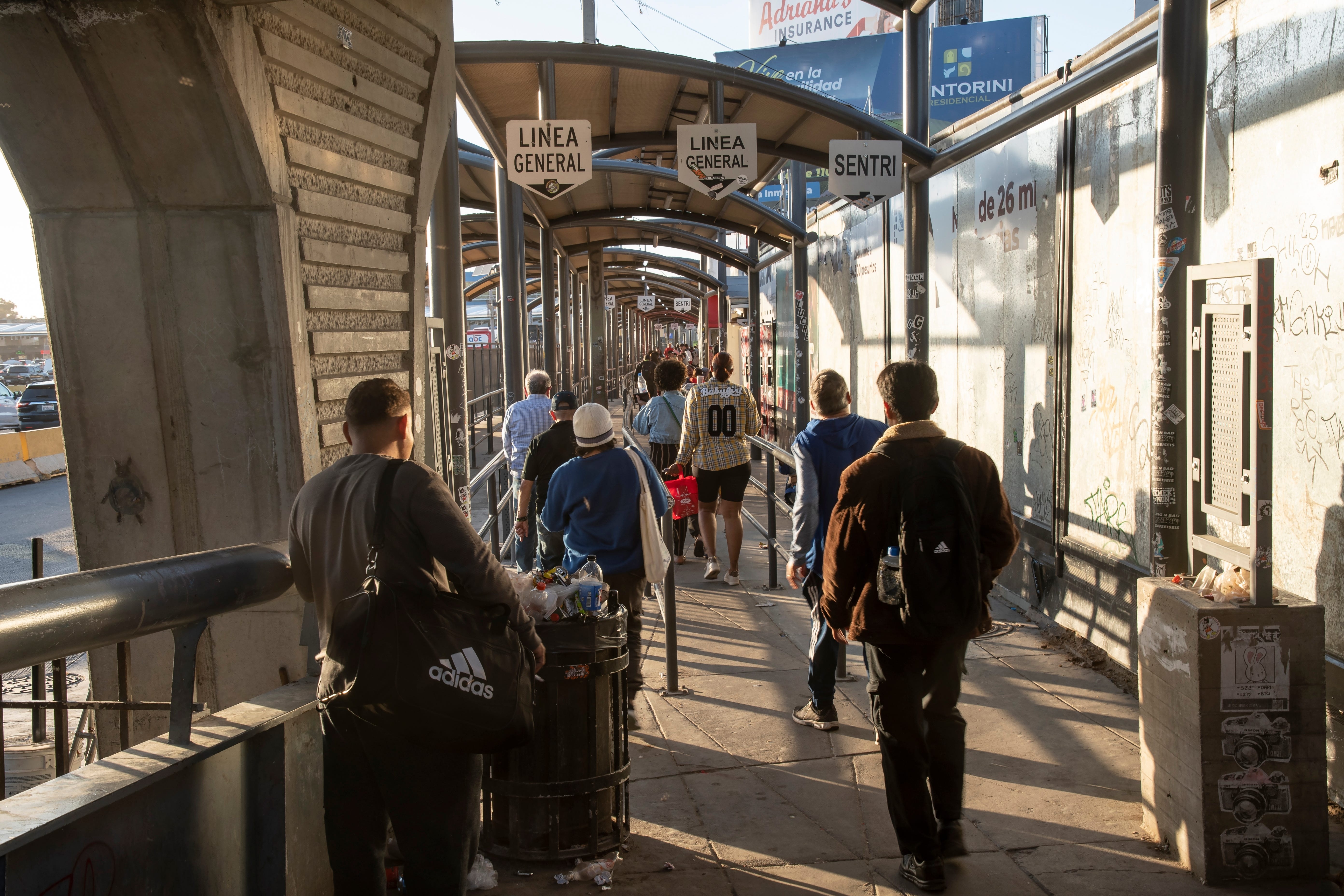
Today’s article is from Blas Nuñez-Neto, a Searchlight Senior Fellow and former Biden administration assistant secretary for border and immigration policy at the Department of Homeland Security, and Daniel Delgado, a Searchlight Senior Fellow and former deputy assistant secretary for immigration policy at the Department of Homeland Security.
Today, the Supreme Court announced its decision in Mullin v. Al Otro Lado, a little-known case that has enormous ramifications for our ability to manage land border crossings and facilitate lawful trade and travel. In this decision, the Court clarified that someone has not “arrived” in the United States until they have physically crossed the border. This will allow border officials to ensure they have the resources necessary to process undocumented people — people who do not have a valid visa or other travel authorization — at our ports of entry before they allow them to cross the international boundary and “arrive” in the United States. In fact, this is no different than what routinely happens at airports, where we only allow people to fly to the United States who are authorized to travel here, and the number of flights that are allowed to land are directly tied to the resources we have to process them.
Today’s decision affirms the importance of being able to manage our land border in an orderly and safe manner. While some may be quick to call the court’s decision another “win” for the Trump administration, it is actually a victory for commonsense immigration policy. Anyone who wants to avoid the chaotic scenes we saw periodically at the border under the Biden administration needs to be clear-eyed about this, and not oppose it merely on the grounds that Trump was in favor of it.
The policies that sparked this lawsuit actually began under the Obama Administration (when one of us was working in the U.S. Customs and Border Protection’s (CBP) front office). While President Obama did, in fact, allow a certain number of migrants to be processed each day regardless of whether they had documentation, President Trump instead exploited the use of metering to essentially shut down access to ports of entry for people seeking asylum.
Despite this, as we know firsthand from our experience serving as senior border officials with the Department of Homeland Security, the ability to meter the number of arrivals at land border ports of entry is an important tool that ensures those critical crossings operate safely and efficiently. We want to explain why today’s decision matters, and more importantly, why it won’t fix our broken immigration system.
Where “metering” came from and why it matters
In 2016, we experienced a surge of undocumented Haitian nationals seeking to cross the border at the San Ysidro port of entry in southern California. These Haitians had left Haiti after the devastating earthquake of 2010 to work in Brazil and Chile, where they had been welcomed. But as the economic situation in those countries began to deteriorate, thousands of migrants made their way north towards the United States to claim asylum at our southern border near San Diego. After a few weeks, CBP was overwhelmed.
Under our current immigration laws, people who are inside the United States, or who have “arrived” at a port of entry, must be allowed to claim asylum. But processing people without a valid visa or authorization to come to the United States takes several hours per person, and our ports of entry are simply not designed to hold the number of people that arrive during surges like these. To respond to this influx, CBP was forced to redeploy personnel and convert conference rooms, and even the Port Director’s office, into temporary holding spaces. Wait times for normal border crossing activity, such as lawful trade and intra-country travel, ballooned.
The situation was completely untenable.
As a result, CBP put officers at the international boundary — the line that separates the United States and Mexico—to review people’s documents. Only those undocumented individuals that CBP had the capacity to process safely were allowed to cross the boundary and present themselves for inspection. Those who were turned back had to wait in Mexico until CBP was able to process them into the United States at a designated port of entry. This practice came to be known as “metering.”
In response, in 2017, the immigrant advocacy group Al Otro Lado (AOL) filed a lawsuit on behalf of 13 asylum seekers against the Department of Homeland Security. They alleged that the practice of “metering” was a violation of international law and migrants’ rights to due process.
If AOL had succeeded in this case, CBP would have no recourse at the land border to manage our ports of entry during times of crisis at the border. The court’s decision correctly affirms the government’s right to manage its borders using tools that promote orderly processes — especially as the frequency of illegal crossings surges and CBP resources grow more strained.
The problems at the border go far beyond metering
It’s important to remember that metering does nothing to address the root cause of border crises like these: Our broken immigration and asylum system takes far too long to decide cases and has effectively become the most generous labor pathway into the country. This continues to drive migration to the southern border regardless of conditions abroad.
Because asylum cases take years to resolve — evidenced by a growing backlog of over 3.2 million immigration court cases — migrants are incentivized to make frivolous claims, delaying legitimate ones and undermining border enforcement. Despite these concerns, none of the major comprehensive immigration reform efforts over the past 30 years would have directly addressed the asylum system. This means that even if these bipartisan efforts to craft legislation based on enhancing border security and providing a pathway to citizenship for those who are here illegally had become law, surges at the southern border almost certainly would have continued.
Policymakers in Congress need to understand this fact. And they need to know why.
Over the past 15 years, we’ve seen firsthand how border staffing and infrastructure have not kept pace with increases in legal trade and travel. This puts immense strain on our border processing and, at times, leads to extended wait times at border crossings. This reality then becomes exacerbated by the periodic surges in illegal immigration, which have occurred under Presidents of both political parties.
Our current immigration laws make it too difficult to deliver timely and effective consequences to those who cross illegally — a critical tenet of any functioning immigration system — and Congress has continually failed to address this slow-motion crisis. This reality has sparked these recurring surges in migration and led a succession of Presidents to attempt overhauls of our immigration system by executive fiat.
This has, at times, forced CBP to shift limited resources away from other critical missions. For example, in response to record high levels of illegal crossings in December 2023, CBP curtailed or suspended operations at numerous points of entry along the southern border — including the suspension of vehicular, rail, and pedestrian traffic in some places — causing a significant disruption to lawful trade and travel into the United States.
It’s time to fix the root of the problem
Ensuring that our ports of entry can function safely should not be a partisan or controversial issue. Before people retreat into their partisan corners to reflexively praise or criticize today’s Supreme Court decision, they should take a step back and ask themselves the simple question that lies at the heart of this case: Does our obligation to allow people to claim asylum at ports of entry outweigh the imperative to ensure that the type of lawful activities that fuel our economy and connect border communities are not disrupted? The commonsense answer, which the Supreme Court affirmed today, is clearly no.
We believe liberals should take this opportunity to lead the conversation. After all, it was President Obama who spoke to the realities of a broken immigration system, and the critical need to secure our nation’s borders in his 2010 speech on comprehensive immigration reform. “Ultimately, our nation, like all nations, has the right and obligation to control its borders and set laws for residency and citizenship.” He continued, “Government has a threshold responsibility to secure our borders.”
As a country, we should welcome immigrants who come the right way — through the front-door, with a visa, even as we close the loopholes and backdoors in our laws that incentivize illegal immigration. If you’re curious about how exactly we can craft a border policy that builds a lawful immigration system that works for both the American public and migrants, read Blas’ policy report: No More Back Doors: Recapturing the Public’s Trust on Immigration.
A sovereign nation starts with a secure border, and to be effective, the government must be allowed to operate that border within its own capacity and without the threat of frivolous lawsuits that refuse to recognize the reality of what common-sense border management looks like.
Those who are serious about securing our nation’s borders and ensuring that lawful trade and travel are not adversely impacted by illegal immigration should welcome today’s court decision. It’s a win for common sense, not the Trump Administration. At the end of the day, until Congress finally does its job to update our woefully outdated and broken immigration system, we all will continue to suffer more losses than wins.


Totally agree with this article. All sovereign nations have the right and responsibility to manage immigration and this is a reasonable approach. I also appreciate the underlying sentiment: if Democrats oppose everything trump does, we lose credibility. In order to attract and retain a broad voter base, Democrats must be seen as reasonable and thoughtful. Along those lines, a parallel track to this issue is the prosecution of businesses who employ illegal immigrants.
A good border and immigration management system should have the following features:
1) The border should be sufficiently secure to stop most illegal crossings.
2) Penalties for illegal crossings should be sure and severe enough to discourage people from attempting to do so.
3) The immigration process should be no more (or less) onerous or time-consuming than necessary to keep out people who have a reasonable likelihood to do us harm (individually or collectively) or become dependent on the state.
4) The immigration process should be transparent.
5) Priority should be given to those who will be a net contributor to the country, via a scoring system.
6) Volume of immigrants should be managed such that it does not disrupt the lives of those already in the country by depressing the job market, straining public services, etc. This should be data-driven and subject to market fluctuations, with the assumption that immigrants are coming to stay unless given a temporary status, such as seasonal workers.
7) Businesses should not be able to exploit the immigration system as a way to get labor at below-market prices.
8) Unless it directly conflicts with any of the above, there should be no preference to immigrants from one country over another, unless certain countries have a demonstrated history of immigrants that have difficulty integrating into American society and conforming to the American vision of universal human rights and the responsibilities of citizens.