

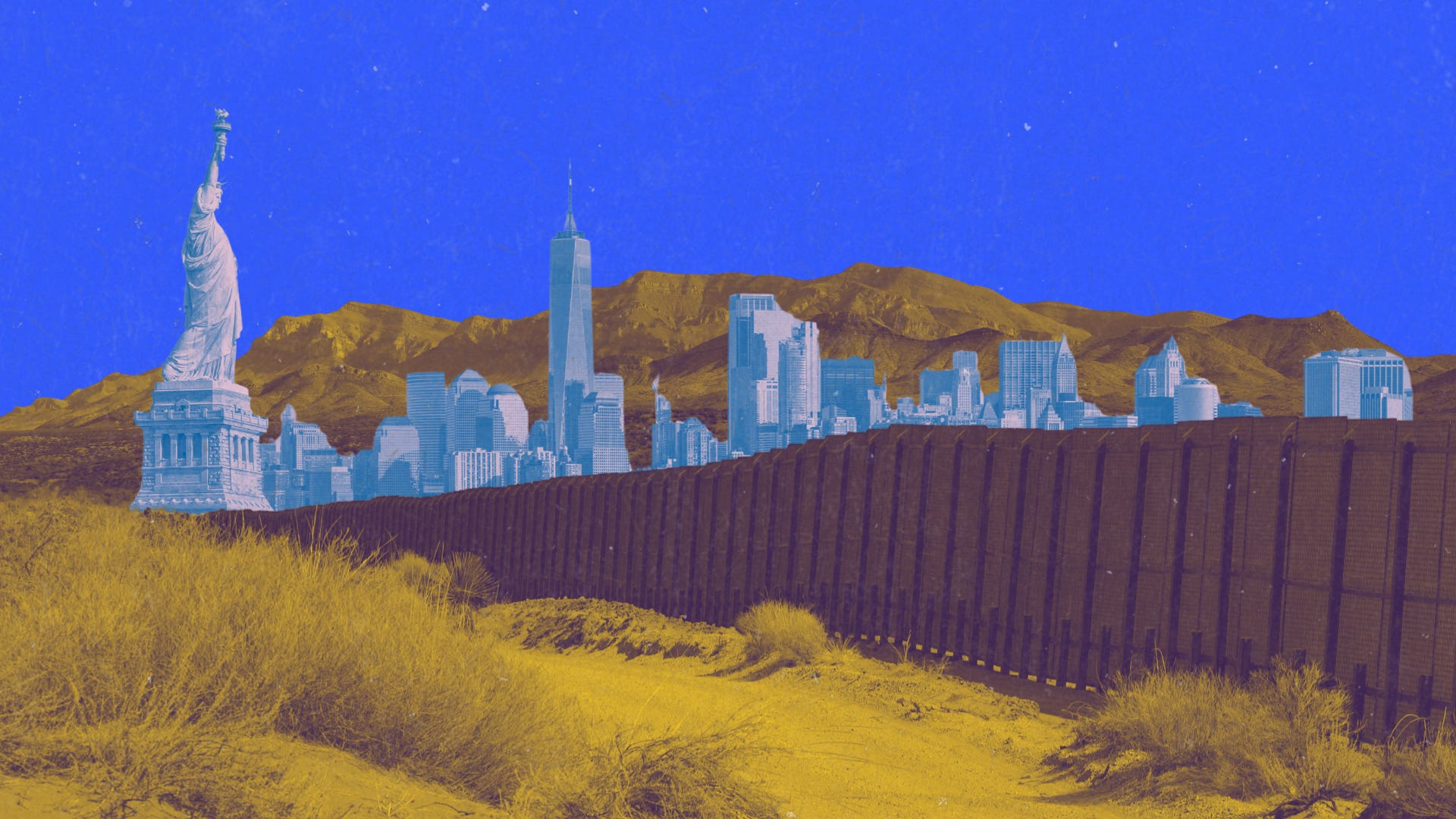
Mayor Zohran Mamdani’s mayoral tenure has started on a good note. His generational political talents on the campaign trail have translated into genuinely strong mayoral leadership. He has smartly touted good governance policies like fixing potholes and forged a working relationship with the governor to secure funding for universal 2-K. Mamdani has also achieved buy-in from more moderate skeptics by releasing a smart housing policy and supporting a plan to increase headcount at the NYPD. The mayor is clearly aware that the best form of politics, even in deep blue cities, involves taking on a heterodox set of issues.
Mamdani also hasn’t had to deal with some of the problems that can bedevil big-city mayors. There’s no ‘migrant crisis’, major crime is falling from pandemic-era highs (although less than in other major cities), and the vibe in the city is, well, immaculate. Between the Knicks’ championship and the World Cup, New York City is ready to party. And there’s no one better to oversee that party than their young, hyper-charismatic mayor.
The urban Left that backed Mamdani from the beginning is set to take a victory lap. Before they begin, they should ask themselves this question: What if the fundamentals in New York City weren’t as strong? What if Mamdani governed under the weight of the Biden-era migrant crisis? It might be politically convenient to memory-hole the event that sunk mayoral approval ratings, cut city budgets, and helped hand Trump the White House. But as the Democratic Party looks to define its immigration agenda, it is something that can’t be forgotten.
There is a consensus among many national Democrats that the next administration needs to reform the immigration system and secure the border. Progressives have signaled their interest in achieving these policy goals too. But to ensure that another politically destabilizing crisis doesn’t happen again, the left-wing of the party needs to reflect on a still unresolved tension.
There is a conflict between the border policy advocated by Left groups at the federal level and the conditions that allow for Left mayors to thrive at the local level.
Trump’s interior enforcement strategy has been cruel, lawless, and unpopular (although not as much as one would hope). For that matter, the decision from governors like Greg Abbott to bus migrants across state lines for political purposes was also wrong. But Mamdani has doubtlessly benefited from the fact that migrant encounters at the southern border are at their lowest level in fifty years.
There’s a path forward here that doesn’t involve Trump’s inhumane immigration policy. That path also means the left needs to confront the excesses of their immigration activist groups, too, and implement the sort of policies that will prevent another migrant crisis.
Who the migrant crisis hurt the most
Last year, I reported on Brandon Johnson’s failed mayorship in Chicago. I wanted to figure out why the once insurgent left-wing mayor had seen his approval rating fall to 14 percent. After speaking with several city aldermen and policy experts in the city, I found that the migrant crisis was the most significant factor.
One of the most interesting stories I heard was that some of the low-income, majority-Black neighborhoods that voted for Johnson were also some of the most impacted by the migrant crisis. That’s because many of the migrant settlements popped up in their communities, and when they saw the City Council allocate large sums of money towards these newcomers, they were understandably upset. Progressive City Alderman Desmon Yancy expressed this exact sentiment when the Council passed a $70 million migrant aid bill: “When Black residents see the large financial investment being made to help support the migrants, they rightfully question when it will happen for them.”
Johnson certainly could have handled the crisis better. But other big-city mayors faced the same trade-off between increasing or even maintaining funding for city services and redirecting taxpayer dollars towards migrant settlement. In Denver, the city was forced to spend $180 million supporting tens of thousands of newcomers. For that to be fiscally sustainable, Mayor Mike Johnston reduced recreation center hours and enforced alternating weekly closures at DMV offices.
The progressive mayor repeatedly begged the Biden administration to deal with the border because the crisis made the job of governing Denver significantly harder.
New York City is the most glaring example. During the city’s migrant crisis, Mayor Adams cut billions in funding for everything from summer camp programs and libraries to trash pickup.
As one might expect, low-income New Yorkers were the ones who bore the brunt of these budget cuts. When the city reduced hours and cut Fridays for “Summer Rising” — a summer program focused on reducing learning loss and providing free meals to students, 30,000 low-income families suffered. When there is less funding to empty trash cans, neighborhoods like the South Bronx get dirtier, and richer neighborhoods can pay to stay clean.
This isn’t to say these mayors shouldn’t have redirected money to migrants. It was a genuine humanitarian crisis, and these people needed shelter, food, and healthcare. The problem is that when a city like New York is forced to pay 3 billion dollars a year on migrants, it creates an inherently zero-sum situation where the city is unable to maintain services for its citizens. Nobody should be surprised when the citizens who rely on city services get upset.
The month after the 2024 election, I chatted with a progressive city councilwoman from Queens about the borough’s rightward shift to Trump. I expressed shock, and she wasn’t surprised at all. Over the past two years, her office had fielded countless calls about migrant issues, and she expected Trump’s border message to resonate in her district.


Tax and spend progressivism needs an orderly border
It’s important to remember that the mayors who dealt with the migrant crises entered office with plans to increase funding for city services. Just like Mayor Mamdani, they see the government as the primary mechanism to redistribute wealth and create a more egalitarian society.
At the federal level, progressive immigration groups that advocated against the Biden administration’s (fatefully, late) decision to restrict asylum claims are guided by a similar moral impulse. They see the plight of the migrants, even those fleeing for strictly economic reasons, as something that must be rectified by the United States, a much wealthier country.
The problem, of course, is that these immigrant groups are not accountable to the voting public. And as much as some on the left want to exclusively blame increased migrant flows on issues like American imperialism, that’s not going to solve the sort of border crisis that happened under the Biden administration. That’s not going to satisfy the working mom in Queens who can’t drop her kid off at a city-funded summer camp because it’s closed on Fridays.
There are real political ramifications to this. It wasn’t just New York City where the migrant crisis moved voters towards Trump; a study from the USC Price School of Public Policy found that counties that received migrant buses from Texas saw Trump’s vote share increase by three points compared to the 2020 election. Trump nearly swept every Texas border county in the 2024 election, doubling his previous electoral performance. These counties are overwhelmingly Latino.
I don’t want to overstate the role immigration played in swaying voters; cost-of-living was still the primary factor. It’s also worth noting that the mayors who presided over the migrant crisis, including Mayor Brandon Johnson, saw their approval ratings rebound somewhat after the issue abated.
But there is still an important and unresolved tension between progressive immigration policy and progressive economic policy. The Left used to be more cognizant of this. Remember when Bernie Sanders railed against open borders? If the Left wants to become a more formidable electoral force and show they can actually govern, they’re going to need to return to the era when they embraced more heterodoxy on immigration.
Fixing asylum is a policy necessity and a political winner
President Biden did not campaign on a plan to massively increase migrants into the country. Nor did his administration develop a plan to allow substantially more migrants. It was the result of the administration moving to the left on asylum policy, regional push factors, and a functionally broken immigration system that hasn’t been properly updated in decades.
That means the next Democratic administration needs to enter office with a plan to prevent another migrant crisis from happening. Sitting back and hoping one doesn’t materialize is a strategy that invites political doom.
When most people think about Democrats’ plans to fix immigration, they think about Comprehensive Immigration Reform. Blas Nuñez-Neto, a Searchlight Senior Fellow and former Biden administration Assistant Secretary for Border and Immigration Policy at the Department of Homeland Security, makes an important point:
None of the major comprehensive immigration reform efforts over the past 30 years would have directly addressed the asylum system—which means that, even if they had been enacted, surges at the southern border almost certainly would have continued.
More than a pathway to citizenship or enhanced border security, fixing the asylum system is the primary way to rebuild the public’s trust on immigration. I’d encourage anyone reading to check out Nuñez-Neto’s full immigration plan, which he released for Searchlight, but I want to briefly highlight the reforms on asylum.
People who cross illegally between ports of entry should generally not be eligible for asylum, unless there is an extraordinarily compelling reason—such as their life being in imminent danger.
Create an orderly process that starts abroad for individuals who are fleeing persecution or torture to claim asylum safely at a port of entry.
Increase the screening standard used during credible fear interviews at the border to ensure economic migrants are identified early in the process.
Repurpose existing federal funding to create asylum processing facilities where everybody encountered at the border goes through this expedited process and is not just released into the country.
Some of these policies are contentious in certain more left-leaning parts of the party. But I’d like them to really reflect on that tension I began my piece with. A mayor like Zohran Mamdani can not increase funding on city services or govern with durable political support if he’s dealing with a migrant crisis. For that matter, no progressive Democratic president could govern popularly while allowing such chaos to reign at the border.
Every wing of the Democratic Party needs to remember the political catastrophe that doomed the Biden administration and start discussing actual solutions to ensure that it doesn’t happen again.
I was a bit surprised to read that the fake asylum thing is 15+ years old; I thought this was a strategy that had really come into its own in the late 2010s or early 2020s.
Curious what your thoughts are about creating more pathways for legal migrant laborers, i.e. those who are entitled to enter for part of an agricultural season but then have to return home.
It also seems like making it easier for normal people to come here the right way, without waiting for years or to win a lottery, would give us better visibility into who's coming in and would grow our population and talent pool in a way which would enable us to concentrate our economic capabilities even more effectively.
I think that the author is wrong about the relevant folks' priorities. Push comes to shove, they would prefer economic ruin to closing the border, because it is a classic sacred-profane conflict, where people are very averse to trading off the former for the latter.
But the advice still makes practical sense.