

Ashley All is a communications and political strategist with more than 20 years of experience working – and winning – in some of the most challenging places in the country. She’s led communication teams for numerous campaigns in red states, including for attorney general, governor, Congress, and U.S. Senate. And she served as Governor Laura Kelly’s first communications director.
There is an old saying that newspaper icon, author, and Progressive leader William Allen White had about his state: “When anything is going to happen in this country, it happens first in Kansas.”
The quote reminds us that trends often start in unexpected places. Sometimes it’s a good thing, like when Kansas was the first state in the nation to successfully defend abortion rights after the fall of Roe v. Wade in 2022.
But sometimes it’s a warning. A little over a decade ago, Kansas faced a much worse first: the “Brownback Experiment.” As a communications and political strategist working to elect Democrats in my home state, I had a front-row seat as an ideological tax experiment pushed our state into a fiscal crisis. While I’m happy to say we’ve long been on the road to recovery, I think this fiasco and the political response to it hold important lessons for my fellow Americans today.
In recent years, Donald Trump and the Republican Party have engaged in a fiscal experiment of their own, cutting health care subsidies, reducing Medicaid eligibility, and increasing SNAP requirements. This all amounts to the greatest attack on the social safety net in decades; millions of people have already paid the price.
How will Americans respond in November? How can Democrats use this moment to make the case to skeptical voters that they should be trusted to govern?
This might surprise some of my fellow liberals in New York and California. But I think an important part of the answer can be found in Kansas.
The Brownback experiment
Coming out of the Great Recession, Kansas was the first state to adopt a sweeping tax experiment that slashed income taxes on businesses and the rich at the expense of working people. Then-Gov. Sam Brownback and his advisor Arthur Laffer claimed the plan would generate dramatic economic growth. In an interview on Morning Joe in 2012, Brownback boasted his “real live tax experiment” was the largest tax cut in Kansas history and would be a “shot of adrenaline to the heart of the Kansas economy.”
As it turns out, it was much more like a sedative. In the years that followed, Kansas underperformed the national economy and lagged behind its neighboring states in economic growth. State revenue plummeted, and our budget was turned upside down. To make up for nearly a billion dollars in lost revenue, Republicans hiked the sales tax on food and other necessities, raised property taxes, and slashed public schools, health care, and other services. Middle and low-income working families bore the brunt of these changes as the cost of living skyrocketed.
For almost five years, Kansans lived with the consequences of Brownback’s tax experiment. Our economy limped along, and our citizens struggled, while the rest of the nation saw economic recovery. To keep the state budget in the black, Republicans made massive cuts to public schools, causing larger class sizes, fewer teachers, four-day weeks, and school closures. Brownback diverted money intended for Kansas highways to pay the bills, leaving roads in disrepair, important infrastructure projects on hold, and construction jobs in limbo. Privatization and cuts to Medicaid led to rural hospital closures, billions in lost revenue, and more Kansans going without health care. In 2016, Kansas was on the brink of financial ruin.
In the fall of 2016, when Kansas joined the rest of the nation in electing Donald Trump, we were also kicking dozens of Brownback-aligned Republicans out of office.
Democrats connected the real-world consequences Kansans were experiencing to Brownback’s policies. This led to a significant shift in the makeup of the Kansas Legislature. It was still a Republican supermajority, but a responsible governing coalition emerged, made up of moderate Republicans and Democrats. That new coalition voted to reverse the tax plan in 2017 over Brownback’s veto—a striking accomplishment.
That coalition was courageous but short-lived. In early 2018, Brownback left office disgraced with an approval rating of just 26 percent. And to this day, his name is toxic. Memories are short in politics, but Kansans remember Brownback.
The lesson from a decade ago in Kansas is exceedingly relevant today: Kansas didn’t recover because one party or one faction suddenly won a sweeping victory. It recovered because Democrats and moderate Republicans built a governing coalition committed to reversing the Brownback experiment and putting our state back on sound fiscal footing.
Brownback goes national
Kansas is not America, and Brownback was not Trump. But those of us who lived through the Brownback experiment recognized the economic platform of the Trump presidency immediately.
In 2017, as Kansas was reversing course, Trump, Laffer, and their allies in Congress pushed through a sweeping tax law that substantially reduced corporate and individual taxes—especially for the wealthy. At the time, Brookings and other experts explicitly compared the approach to the Brownback tax plan.
Again, Kansas and the federal government are different, and the policies were not identical. But the underlying wager was the same: cut taxes for businesses and the rich, and let the benefits flow down to those on the lowest rungs of the ladder.
Trump doubled down on that wager in his second term with another large tax package. And, just as before, the Congressional Budget Office (CBO) projected that federal revenues would drop by roughly $4.5 trillion.
This time, Trump cut spending and benefits for middle-to-low-income Americans to offset some of the tax cuts. CBO estimated that cuts to Medicaid will reduce spending by roughly $1.2 trillion through 2035 and push about 13 million eligible Americans off of Medicaid, including children. The law also cut projected SNAP spending by about $211 billion, ending support for millions of eligible families.
To be clear, many of the law’s largest changes were conveniently timed for after the midterms, which means many of their effects will unfold in the coming years. But so far, the consequences have been devastating to families who are already struggling under the weight of inflation and high costs resulting from Trump’s chaotic tariffs, policies, and wars. Millions of Americans have been kicked off SNAP in the last year, and millions have already lost access to affordable health insurance options.
What Kansas can teach America
Now for a ray of hope. Kansas recovered from the Brownback experiment, and I believe America will be able to recover from Trump.
The latest polls show Trump with negative net job approval in 41 states and the District of Columbia, including Kansas — a state he carried comfortably in 2016, 2020, and 2024. Americans of all political stripes may be turning on Trump as Kansans turned on Brownback.
But Democrats can’t just ride the wave of GOP backlash; they’ll need to govern and build a coalition that can actually pass legislation that substantively improves the lives of voters. Here too, Kansas can serve as a model.
By the time Kansans elected Laura Kelly governor in 2018, Democrats and moderate Republicans found enough common ground to reverse Brownback’s tax policy. These legislators saw the world differently in countless ways, but they shared a simple goal: fix the state budget and make life more affordable for families.
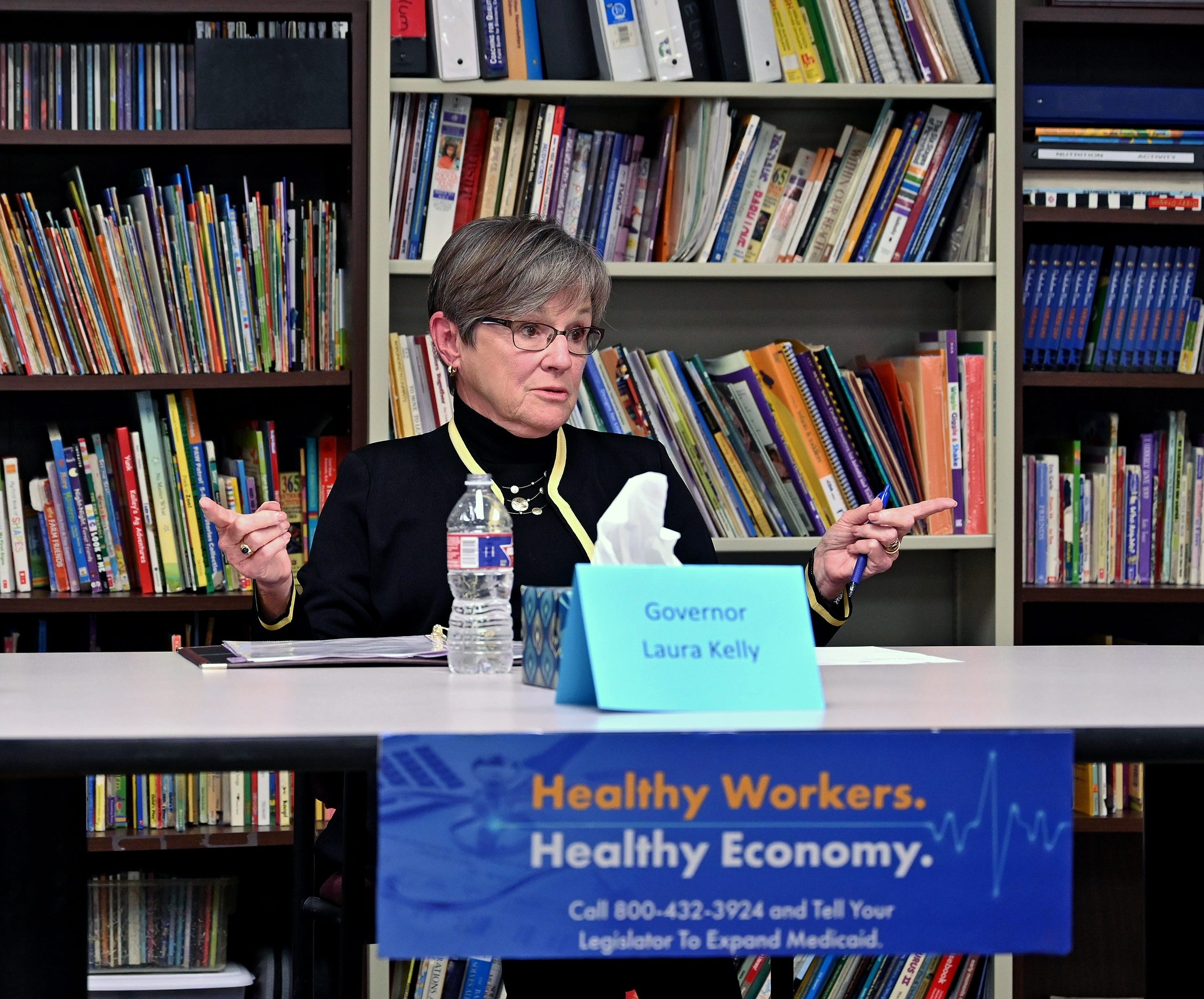
Kelly inherited the next part of the job. I served as communications director in the early days of her administration, and saw firsthand how difficult repair could be. The state government had spent years under enormous fiscal pressure. Rebuilding it was a long, laborious process. And it became even more challenging when the coalition began to crumble in the next election cycle as Republicans became less interested in fixing problems, and more invested in reflexive partisanship.
Over eight years, Kelly emphasized investments in schools and infrastructure, economic development, fiscal stability, and, eventually, eliminating the state sales tax on groceries. She set achievable priorities, acknowledged that recovery would take time, restored fiscal responsibility, and steadily rebuilt confidence in state government. At times, this was challenging with a GOP supermajority in the state legislature. She often had to use her veto pen to hold the line and prevent Republican leaders from moving Kansas backward and undercutting our recovery.
Importantly, Kansas Democrats did not respond to one ideological experiment with another. We focused on the issues that impact families every day: sales tax on food, class sizes, and roads. Gov. Kelly “governed from the middle” throughout the recovery—even when it caused tension with her own party. Her pragmatic, commonsense personality demonstrated how to be successful in a complex state. It also helped begin to rebuild trust in the Democratic Party.
With the foundation built in the last decade, Kansas might be on the verge of electing a Democrat to the US Senate for the first time in 94 years. That’s what people miss about Adam Hamilton’s Senate campaign: it’s not just because he’s running on the right issues and engaging Kansans around shared values. He’s also following a successful Democratic blueprint for winning in Kansas.
The blueprint is simple: make government work, focus on the problems families face, and build a coalition willing to solve them. In Kansas, that meant Democrats and moderate Republicans working together to put the state back on track.
A national governing coalition will almost certainly look different. There is no large bloc of moderate Republicans in Washington capable of playing precisely the role they played in Kansas. It might have to occur within the Democratic Party alone, the tent stretched wide enough to include fiscal moderates and DSA leftists.
That doesn’t mean everyone in a governing coalition must agree on everything. The Kansas coalition certainly did not. Nor does coalition government require abandoning strongly held principles. It requires agreement on enough of the fundamental tasks and priorities to move forward. Americans have made it clear what those priorities should be: lower costs, fair taxes, and a competent government.
The 2026 cycle could be a historic first step for Democrats to build this coalition. And if the conditions emerge once again in 2028, then the hard part will come: showing voters that a Democratic coalition of all ideological stripes can govern together.
To those who doubt this is possible, I say, remember William Allen White’s wisdom: “When anything is going to happen in this country, it happens first in Kansas.”

An excellent article with an absolutely clear and well-documented evidence that debunks Reaganomics and supply-side economic theory. So why has this, in effect, case study not been drilled into voters heads since trump 1.0 until we're absolutely sick of it? The answer is a failure in vision, communications, and leadership at the DNC.