

Want to know what undecided voters are thinking about? Ask a (reputable) pollster. Want to know what campaigns want them to think about? Watch some ads.
At the tail end of a midterm cycle dominated by cost of living, Democratic attacks are converging on a closing message about corruption. By my rough count, there are dozens of ads dinging dirty-dealing Republicans airing all across the expansive Senate map.
Here are just a few examples. In Ohio, Jon Husted has been attacked for accepting outright bribes from an energy utility. Ashley Hinson in Iowa and Mike Rogers in Michigan are being hit for selling out to big pharma donors. In Mississippi, Cindy Hyde-Smith has been called out for “pocketing money from special interests,” while kicking voters off Medicaid.
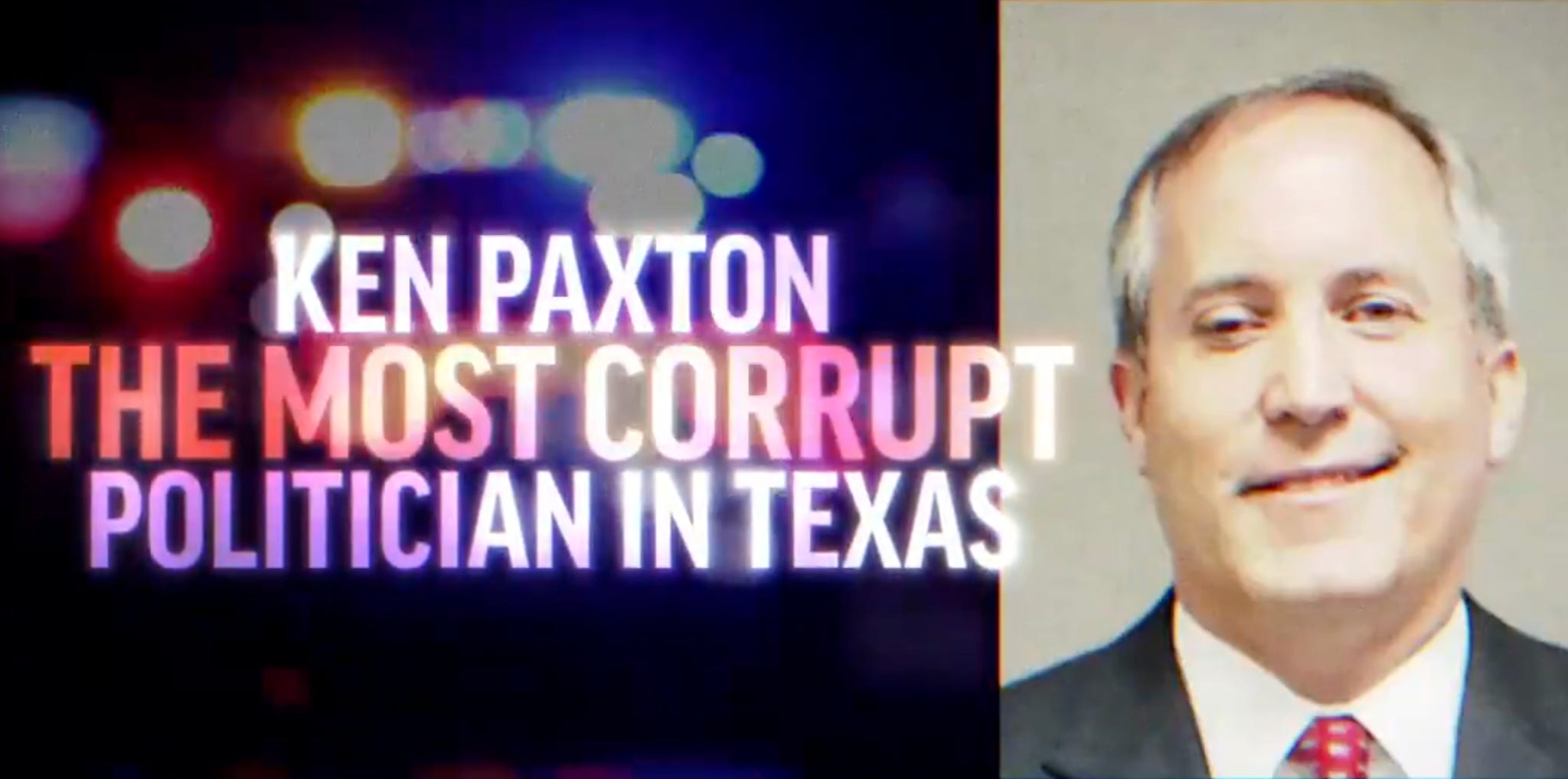
The most obvious case is Ken Paxton, who even a good number of Texas Republicans think is corrupt. We also shouldn’t overlook Susan Collins, who has been credibly accused of rewriting federal contracting rules to benefit her husband.
While I haven’t waded into ad buys in frontline House races, the Wall Street Journal recently reported that Democrats have spent a whopping $182 million on ads focused on corruption in the fight to control Congress. I also have to acknowledge the spectre of Jeffrey Epstein and his associates, whose financial connections to various Republicans loom large ahead of Election Day.
Clearly, Democratic campaigns are confident that corruption will be an effective cudgel as they look to close out the most competitive races in the country. Based on recent polling, they’re making a good bet. A recent FOX survey found that 88% of likely voters reported being extremely or very concerned about corruption.
Now, FOX’s findings don’t suggest that corruption is the issue that voters are most troubled by; that’s obviously the cost of living. But Democrats are savvily tying pocketbook issues to corruption in their messaging. And Searchlight’s research suggests that it’ll work.
While “corruption” and “affordability” are usually polled separately, we found that voters see them as linked: If corruption is addressed, then elected officials will focus on what actually matters to the people, such as cost of living. It’s not hard to understand why they feel that way. They’ve seen the same intractable issues get worse and worse over the years, while a paralyzed Congress is seemingly unable or unwilling to act on their behalf.
But here’s what Democrats need to understand: Searchlight polling shows that 71% of voters believe that any “Typical Politician” is corrupt. And that perception crosses party lines; 68% of voters think “Republicans” are corrupt and 61% say the same about “Democrats.”
This came up in corruption focus groups Searchlight conducted over the summer. Voters’ frustrations extended far past Trump and the construction site formerly known as the White House. The common refrain from the swing voters we talked to was that most elected officials in BOTH parties are corrupt and beholden to special interests or donors over their constituents.
Regarding presidential corruption, participants generally thought that Trump was “equally corrupt” as his predecessors. One man said, “I would say it was better hidden before, and Trump’s just more blatant about it.”
This should not be seen as an argument equating Trump’s corrupt conduct to Democrats. He’s treated federal dollars as an extractable resource, sold access to the highest levels of our government, and handed out more no-bid contracts to cronies than I can count. The steady drip of stories covering his outrageous corruption has started to burn in—almost two-thirds of Americans now believe that Trump is using the presidency to enrich himself.
But Democrats need to understand the very real perception voters have about how politics works, and they need to act on it.
This anti-corruption agenda can start with simple reforms. Searchlight president Adam Jentleson outlined some earlier this year: release a regular timesheet showing voters what you did with your day, commit to a minimum number of public town halls, and be willing to remove members who are suffering from mental decline. Rachel Bedard has an excellent idea for Congress to create an office of public physicians to regularly assess elected officials.
There’s a lot more to address, but these are all reforms that voters said would enhance their trust in our political system.
Democrats are right to run against corruption. But they can’t treat it as solely a campaign issue. They need to take voters at their word and do more to address corruption within our government should they take majorities in one or both chambers of Congress. Yes, that includes satisfying the urge to hold the Administration accountable, but it also means looking inward as well.