

Corruption is only becoming more of an issue as the public’s trust in government has steadily declined over the past few decades. Skepticism of politicians, government, and political office as a whole remains older than the rise of Donald Trump.
Look no further than the words of comedian George Carlin: “It’s a big club, and you ain’t in it.”
So who’s in the club?
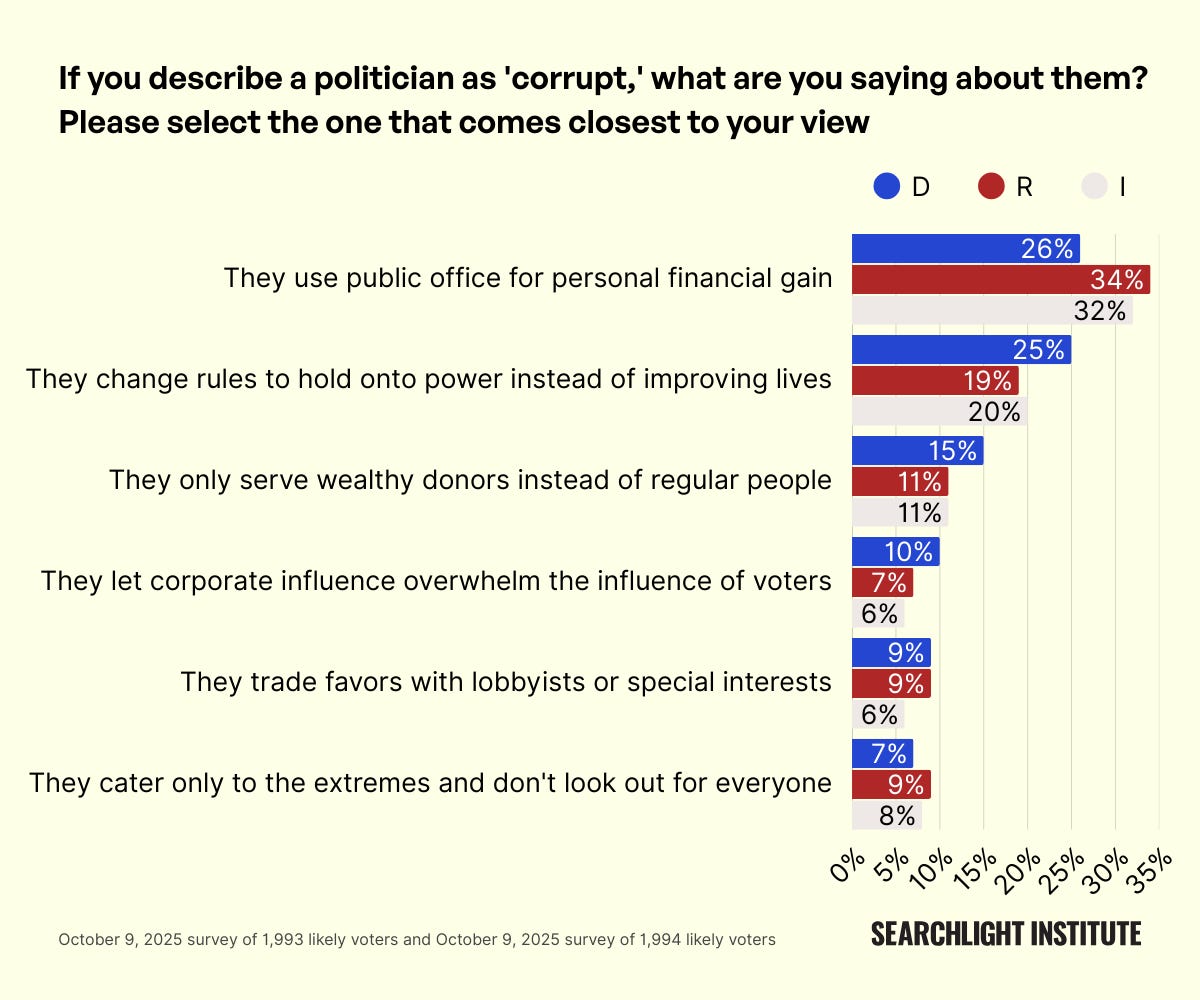
Searchlight’s latest polling finds that voters overwhelmingly see both the typical Republican and Democratic politician as corrupt. They also see corrupt politicians as those who exploit their office for private financial gain and put the interests of wealthy donors over constituents.
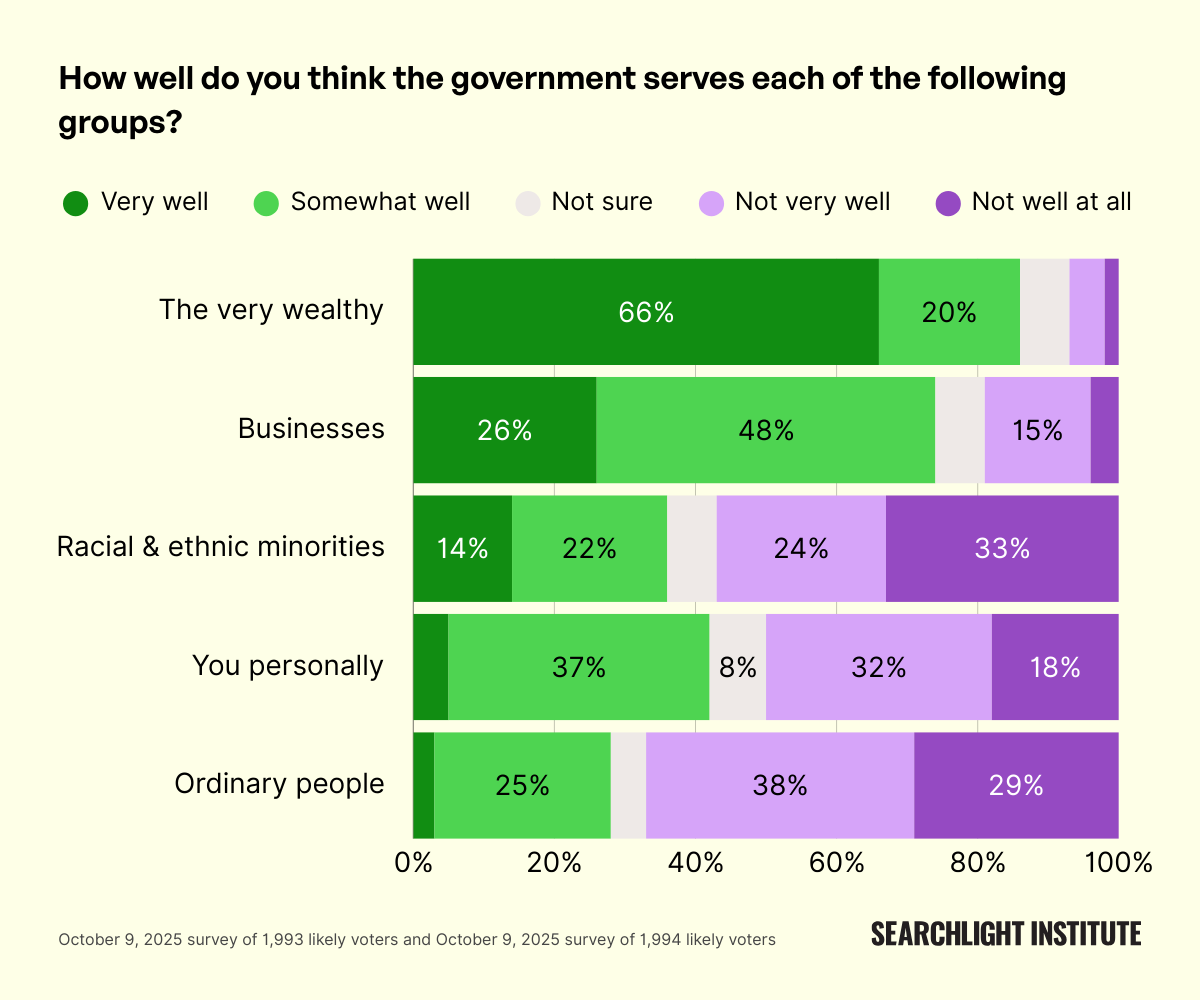
But it’s so much more than money. It’s about politicians ignoring ordinary people to protect themselves, their social groups, and the very wealthy. Voters truly do think there’s a big club — and they’re not in it.
Solving political corruption won’t happen with a snap of a finger or the signing of one bill. It will take a new approach to trust and transparency that reaches far beyond finances. We need to get money out of politics and make politicians reliant on the people they represent, but we also need to show those very people that politicians are held to an even higher standard.
The best way to do that is to pursue many reforms, not just one. Searchlight’s research into trust and transparency measures finds strong support for a variety of novel measures to counter corruption and low performance — from work hours tracking and term limits to mental acuity tests and annual town hall requirements.
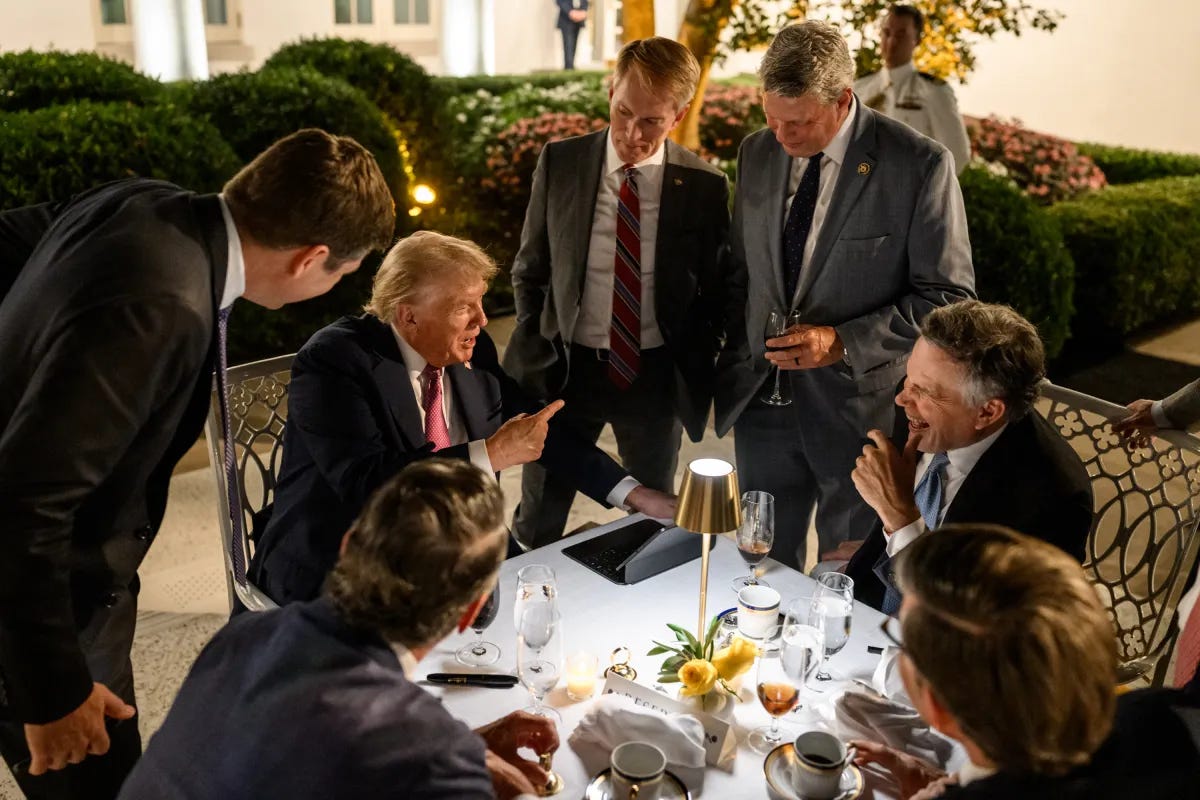
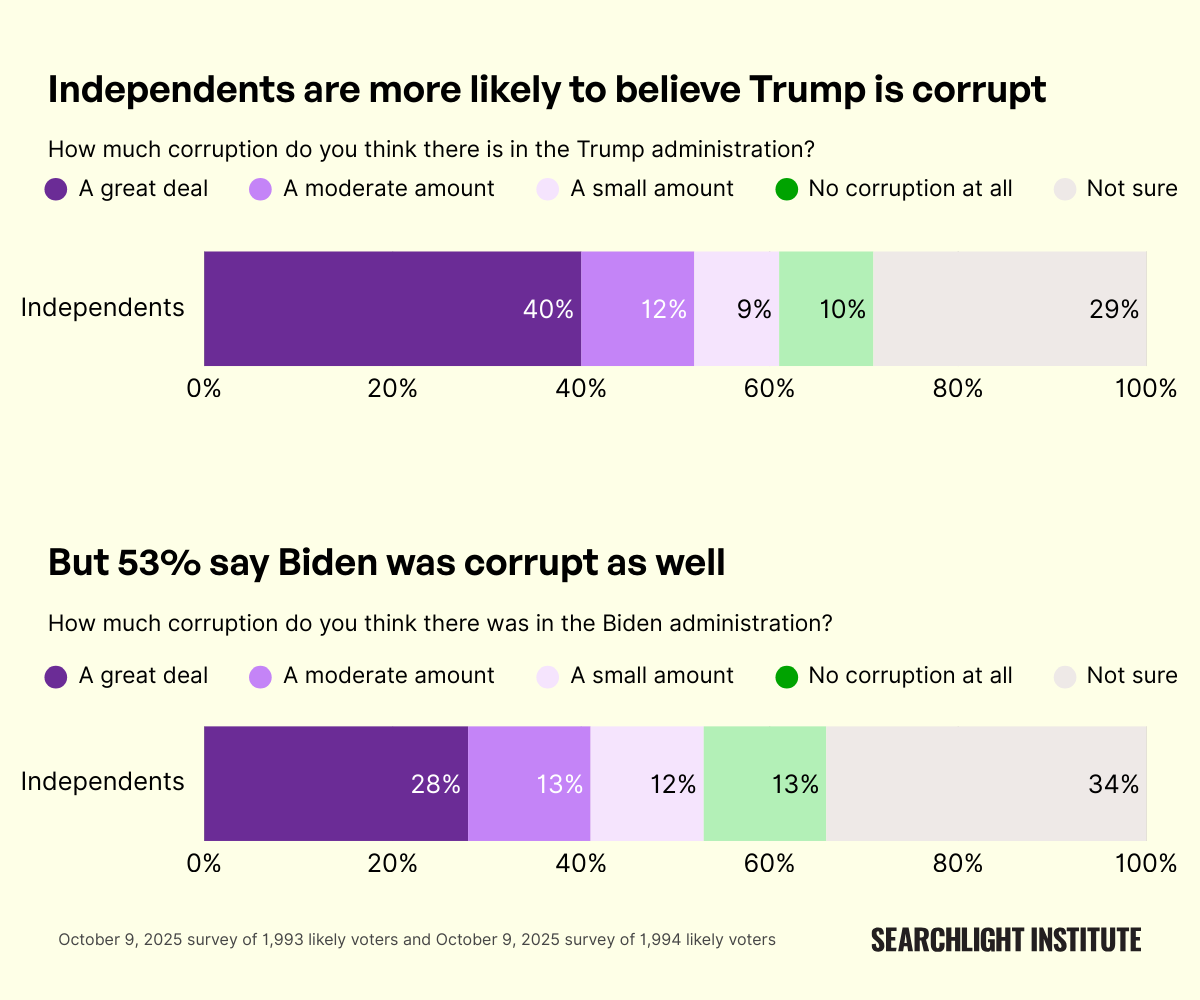
This is only a start. We have to dive deep into the perceptions and realities of American political culture and the many ways voters see corruption rearing its ugly head. Because even though Trump is dining with his donors and bulldozing parts of the White House for his ballroom, plenty of voters also see Joe Biden as corrupt — including a majority of Independents.
Why? Because voters really do hold a broad definition of political corruption and what it looks like — and they’re likely skeptical of any president or elected official in the first place. What’s more, concerns over how the Biden and Trump families stood to receive special privileges or personal private financial gains also added onto this subtle ‘equivalency’ we might see between both presidents on corruption.
Biden’s age and ability to serve could also be strong contributing factors for these perceptions. Voters would no doubt have less trust in Democrats if they were seen as shielding Biden from criticisms and concerns over both age and ability. But Trump isn’t immune to voters’ concerns about age and mental acuity either — the number one refrain I heard from people in my life ahead of the 2024 election (before Biden dropped out) was that they were both too old to be running for a job as demanding of the presidency.
The aim of realignment is to reshape political coalitions and create a movement built on ideas that can fuel an entire generation. It means addressing decades of voter skepticism of the government and the ways in which Americans distrust politicians to deliver concrete results while in power.
We can and must address longstanding concerns of corruption among voters by proposing concrete reforms that instill trust and transparency among politicians. Higher standards for performance and openness are strong avenues to start.
Anyone running for State or Federal office in 2026 who doesn’t make addressing corruption in American politics and with politicians a major part of their platform is either clueless or a direct beneficiary of the corruption. If I were running, this would probably be the second topic on my stump speech, right after the economy (affordability). While maybe not easily accomplished, I would put forward the following proposals, because what percentage of voters would really be opposed to these things? And I would dare any opponent to disagree with them. They’re very specific, but would be easy to understand for any voter:
Term Limits:
House - 4 terms; 8 years
Senate - 2 terms; 12 years
President - 2 terms; 8 years (current)
Supreme Court - 12 years
Stock Trading:
No buying or selling of any stocks/mutual funds, etc. while in office. None. Applies to the Supreme Court, too.
Gifts:
No gifts in excess of $100 to any office holder from any one individual or corporation. This includes meals.
No gifts/donations to a Presidential Library until after the incumbent is out of office.
Elections:
Redistricting allowed once every 10 years - no more.
Redistricting may not take political party affiliation, race or any other voter personal attribute into consideration, and must be done by an independent body. State elected officials may not be involved in redistricting.
Corporations may not donate to or help finance any campaign - period.
Only American citizens can donate to campaigns, and there needs to be a reasonable limit ($1000.00?). Bottom line - the wealthy cannot have any more influence on an election than the average American voter. This is complicated by the existence of software money/PACS, and something needs to be done with this, too.
This is a fascinating polling exercise, but it raises more questions than it answers. I wonder if Searchlight could manage to tease out the answers to a different but related question, namely: what traits would make the broad populace *really admire* a politician? We're getting an interesting glimpse of what people mean by corruption. What would make people come to the opposite conclusion, and discern VIRTUE?