

When I was the Executive Director of the progressive polling firm Data for Progress, I wrote and read hundreds of climate polling questions. So when I saw this report from UC Santa Barbara’s 2035 Initiative, titled “Politicians Shouldn’t Hide From Climate,” I was very familiar with the underlying argument.
It takes the correct premise that a majority of voters express concern about climate change as evidence that politicians must center it in their messaging agenda. Specifically, it shows that emphasizing climate change modestly helps politicians. As a result, Democratic messaging should “lead with affordability but keep climate on the agenda.”
I think it’s incredibly important for the climate advocacy community to not mislead itself with reports like this. Generic climate messages like this always test well, but that doesn’t mean they translate to real political benefits. That’s because climate change is not a salient issue among battleground voters, young voters, or the general electorate. Moreover, policies advanced by the climate movement, such as rules banning combustion engine vehicles and the complete phase-out of fossil fuels, are quite unpopular. There’s a reason why Democratic politicians of all factional stripes who are actually trying to win swing voters have stopped talking about climate.
To be clear, climate change is one of the most important issues of the 21st century; it was the animating reason for why I decided to pivot from my engineering undergraduate degree to a career in politics in the first place. That’s why I want us to advance the most effective political and policy solutions.
Solving climate change will require decarbonizing the global economy, which is happening faster than expected thanks to the plummeting cost of renewables and the landmark investments in clean energy spurred by the Inflation Reduction Act.
And there’s a lot more work to be done. As my Searchlight colleagues Jane Flegal and Pavan Venkatakrishnan argued in a recent op-ed in the Wall Street Journal, Democrats need to work with Republicans to pass permitting reform so we can build more clean energy infrastructure. Of course, we also need to invest in technologies to decarbonize heavy industry, transportation, and the food system. Meanwhile, the vast majority of future emissions are projected to come from developing countries.
If the goal is to form a congressional supermajority that will actually advance these climate policies, then politicians must prioritize the issues that are actually salient to voters in states like Ohio and Texas. It’s time the climate advocacy community came to terms with this. That means understanding why reports like this are misleading.
Climate crowds out other priorities
The biggest claim made in the 2035 Initiative poll is that politicians receive a modest bump in support if they prioritize climate in their messaging. To obtain this result, they ran a conjoint experiment. This meant respondents saw two candidate profiles, each randomly assigned “top priority,” “a priority,” or “not a priority” on climate and five other issues, then picked which candidate they’d vote for and rated each one’s favorability on a 0–10 scale.
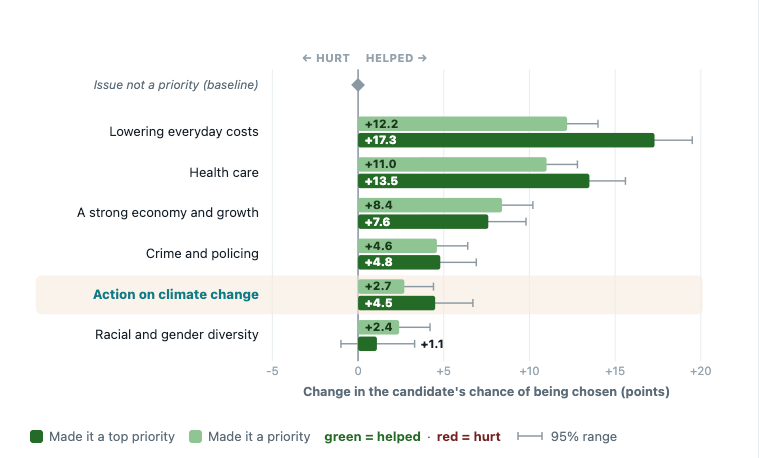
The amorphous issue of “action on climate change” — which does not account for unpopular climate policies — was the second least popular issue. Still, it did yield a modest increase in support, depending on whether it was listed as the top priority or a priority.
The problem is that this just doesn’t reflect how political campaigns work. Candidates get a short window to make an impression on voters, whether it’s a thirty-second TV ad or a piece of earned media that goes viral. Listing through five different issues doesn’t make a particularly good sound bite.
Think about Zohran Mamdani talking incessantly about affordability or Jon Ossoff bringing up Trump’s corruption every time a camera is shoved in his face. Politicians don’t know which moment will break through, so they have to constantly stay on message to define themselves.
The point of this research is to advise campaigns, so imagine you’re a Democratic politician running for Senate in a state like Michigan or North Carolina. You know that a majority of your voters profess some level of concern about climate change, but it’s an incredibly low-salience issue, and as a Democrat, it’s a topic you’re already strongly associated with. You also know that your path to winning relies on convincing voters who supported Donald Trump and are generally skeptical of politicians in your party.
This poll tells you that making climate change a top priority could increase your level of support by 4.5 points. But a top priority is, by definition, singular. And issues like affordability and health care increase your level of support by roughly three to four times the amount — both of which are areas where Democrats have a significant trust advantage heading into November.
That means you have a choice: center your message around one of the four more popular issues, or include climate change to appease a much smaller portion of the voter base that is already inclined to vote for you. I think the choice is quite clear, which is why Senate candidates like the more moderate Roy Cooper and even the leftist Abdul El-Sayed are not mentioning climate in their campaign messaging.
This report acknowledges that there are more motivating issues, so it suggests that politicians should lead with affordability, but keep climate policies, like clean energy, in their messaging. This would result in a 2.7-point increase in support, which is comparable to a message that leads with affordability and includes a commitment to racial and gender diversity.
I’m skeptical that this suggestion is helpful because it’s not clear that voters are even convinced clean energy will help with affordability. A new polling project from Heatmap and Embold Research shows that a majority of voters who are “persuadable” to care about climate change think that claims about clean energy’s affordability are exaggerated. This finding is even backed by this report, which acknowledges that only 37% of voters think clean energy is a “cost-saver.”
If I’m a politician, why would I muddle my message by including something that at best helps me among people who are already going to vote for me, and at worst, is going to sow doubt among the people who I want to persuade?
Climate politics in the real-world
For all of the handwringing that climate advocates have expressed about the abundance movement over the past few years, a finding I was pleasantly surprised to see published in this report is that voters want to build more of, well, everything.
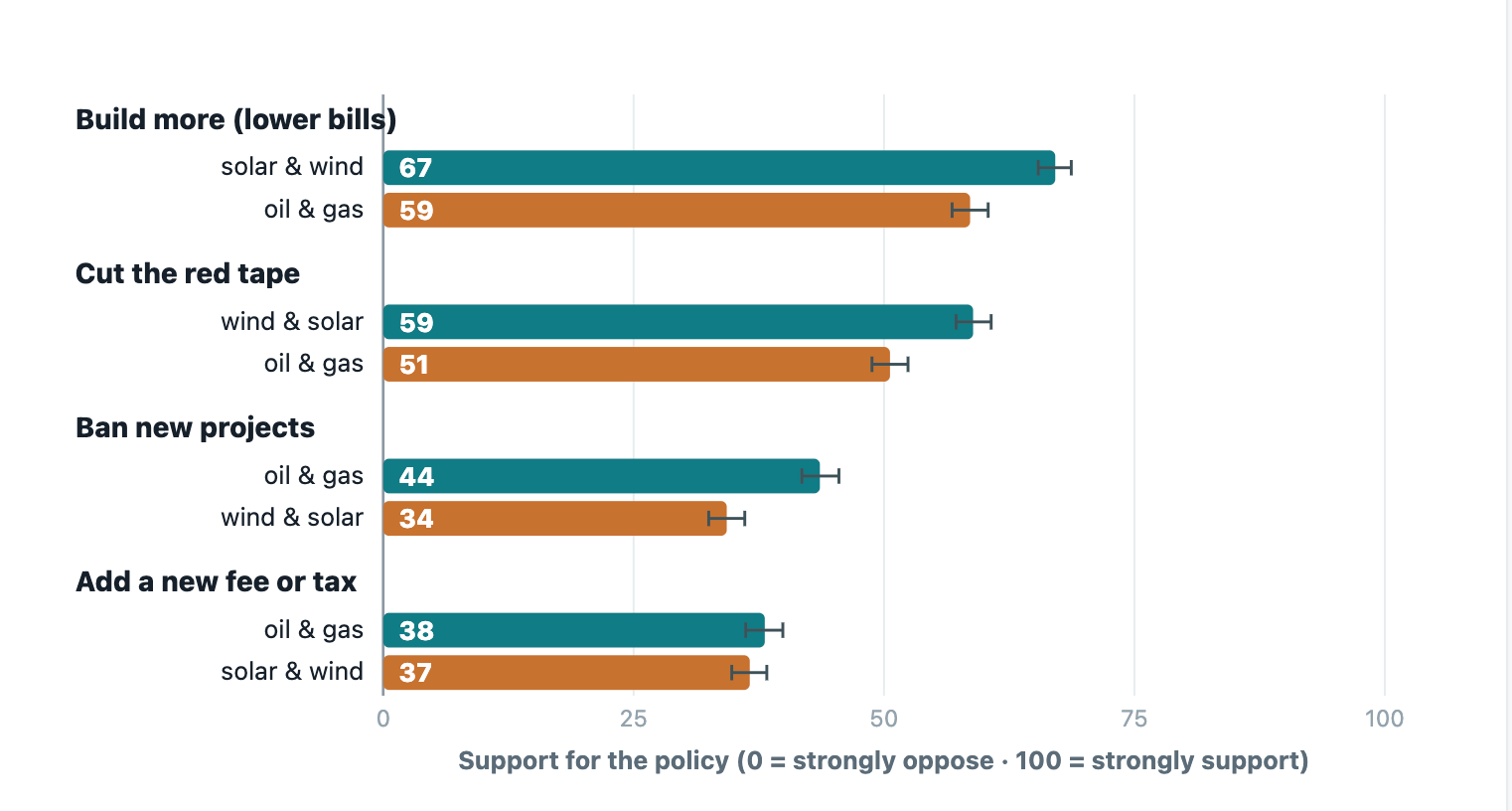
I think this is more important than ambiguous polling about action on climate because it reveals the actual preferences of voters. From pushing the Biden administration to ban new fossil fuel extraction on public land to lobbying lawmakers to vote against the current federal bipartisan permitting reform bill, the climate movement has defined itself in opposition to fossil fuel projects, even if it doesn’t lead to a net increase in emissions.
But that just isn’t what the public believes. A majority of voters do profess concern about climate change; it’s just a low-salience issue, and they don’t want to incur a cost to pay for it. That’s why fees and taxes on fossil fuels are so unpopular. That is why natural gas is incredibly popular. And that explains why in the very blue state of California, voters overwhelmingly favor climate action, but oppose climate policies like the executive order banning the sale of gasoline-powered vehicles by 2035.
I know this report doesn’t advocate for unpopular climate policies; to the contrary, it presents clear evidence that repudiates the long-held argument from the climate movement that blocking fossil fuel projects should be prioritized over issues like affordability. But I do think if you’re asking for politicians to center climate politics in their messaging, it’s worth interrogating the actual climate policies that are most associated with the movement, even as more advocates — to their credit — are steadily embracing growth-oriented policies.
The broader point here is to look beyond these polling experiments and understand how successful politicians navigate climate politics in the real-world.
By all accounts, the Left is insurgent and more politically popular than ever inside the Democratic Party. Many of its standard-bearers have dropped climate from their political rhetoric. Zohran Mamdani’s mayoral campaign is correctly regarded as having one of the best political messages in recent memory, and it was entirely focused on affordability. As Heatmap reported last year, “The self-described ‘ecosocialist’ had ‘muted climate politics.’ Listen to Bernie Sanders and AOC on the stump; their message is “oligarchy,” not “climate.”
You can solve climate change without making everything about climate change
I understand that the climate community is worried about losing traction in Democratic policy debates. But that doesn’t mean the climate policy agenda will be sidelined in a future Democratic Congress. In fact, some of the greatest climate victories in American history were spearheaded by politicians who didn’t centralize the issue in their political messaging.
Barack Obama didn’t feature much climate messaging in either of his two presidential campaigns, and he still negotiated the Paris Climate Accords. Joe Manchin, a reviled figure among the climate left, was the final vote for the IRA — even though it dropped his approval rating in West Virginia by double digits.
Of course, we’re no longer in the Paris Accords, and portions of the IRA have been gutted by the Trump administration, which points to the fact that durable climate action can only be accomplished by winning and maintaining governing majorities. That will require Democrats to win fossil fuel-friendly states like Texas and Iowa. If James Talarico and Josh Turek win their Senate races, there’s simply no reason to think they won’t support climate policies in a future Democratic reconciliation bill.
And it’s important to understand what climate policies we need today. A recent report from the MIT Center for Energy and Environmental Policy Research found that 74% of new clean energy capacity has still been preserved even after the IRA subsidies were repealed. Renewables are now market-competitive, and the primary roadblock, as the report notes, is “Alleviating supply-side barriers — primarily through permitting reform and transmission buildout.”
Combine this with the fact that climate change is a global problem that will primarily be solved by inventing and scaling new decarbonization technologies for global export, and it’s clear that Democrats can use their next congressional majority to pass climate policy that is both high-impact and politically durable.
Make America the global hub for clean energy innovation. Reverse Trump’s pro-industry oil and gas regulations. Pass a federal permitting reform bill — which is something that will still likely require Republican votes and should be done today in order to create the regulatory pro-clean energy environment Democrats need in 2028.
The best part of each of these policies is that they can be accomplished without significant spending or policy trade-offs. One can imagine a Democratic Congress passing sweeping health care reform, while more clean energy floods the grid because of a permitting deal.
Asking Democrats running in swing races — whose election depends on winning skeptical Trump voters — to focus on climate in their messaging makes any future climate policy less possible. It’s time the climate advocacy community realized that.
This is a very good article. Exactly what I think. Super important issue, but not politically salient in a way that the climate activists would like.