


Eliot Wertheimer is an intern at Searchlight. He is a rising sophomore at Tufts University.
If my 10-year-old self knew how few people cared about gun violence in 2026, he’d be furious.
I was in fifth grade when I went to Portland, Maine’s March For Our Lives protest. A few years later, I walked out of history class and marched to Susan Collins’ office after the Uvalde shooting.
I called for “banning all guns” and voting out the members of Congress who didn’t share my maximalist positions. I knew this was an extreme approach, but after witnessing such horrible shootings at schools much like my own, I believed such action needed to be taken.
The peak of the gun control movement happened in 2018, when 200,000 people marched down Pennsylvania Avenue. The March For Our Lives protest called to force lawmakers to back restrictive gun control laws, and with public opinion seemingly on our side, legislative progress seemed possible.
Since then, however, momentum has fallen. Gun control was one of the least salient issues in the 2024 election. This election cycle, even though ghost guns are surging and gun-inflicted suicides are increasing, it’s hard to find a single candidate talking about gun control.
But just because gun control has fallen out of the public eye, it doesn’t mean that a future Congress can’t take action.
In a recent polling survey, Searchlight asked voters how they feel about gun control and whether Democrats and Republicans can find any common ground on common-sense legislation.
While gun control is not a particularly salient issue, it’s not all bad news. Our polling found that 69% of Americans, including 54% of Republicans and 64% of Independents, believe it should be harder to buy a gun. Even a majority of gun owners (56%) agree with this statement.
Capitalizing on this support means reckoning with the nuances of public opinion.
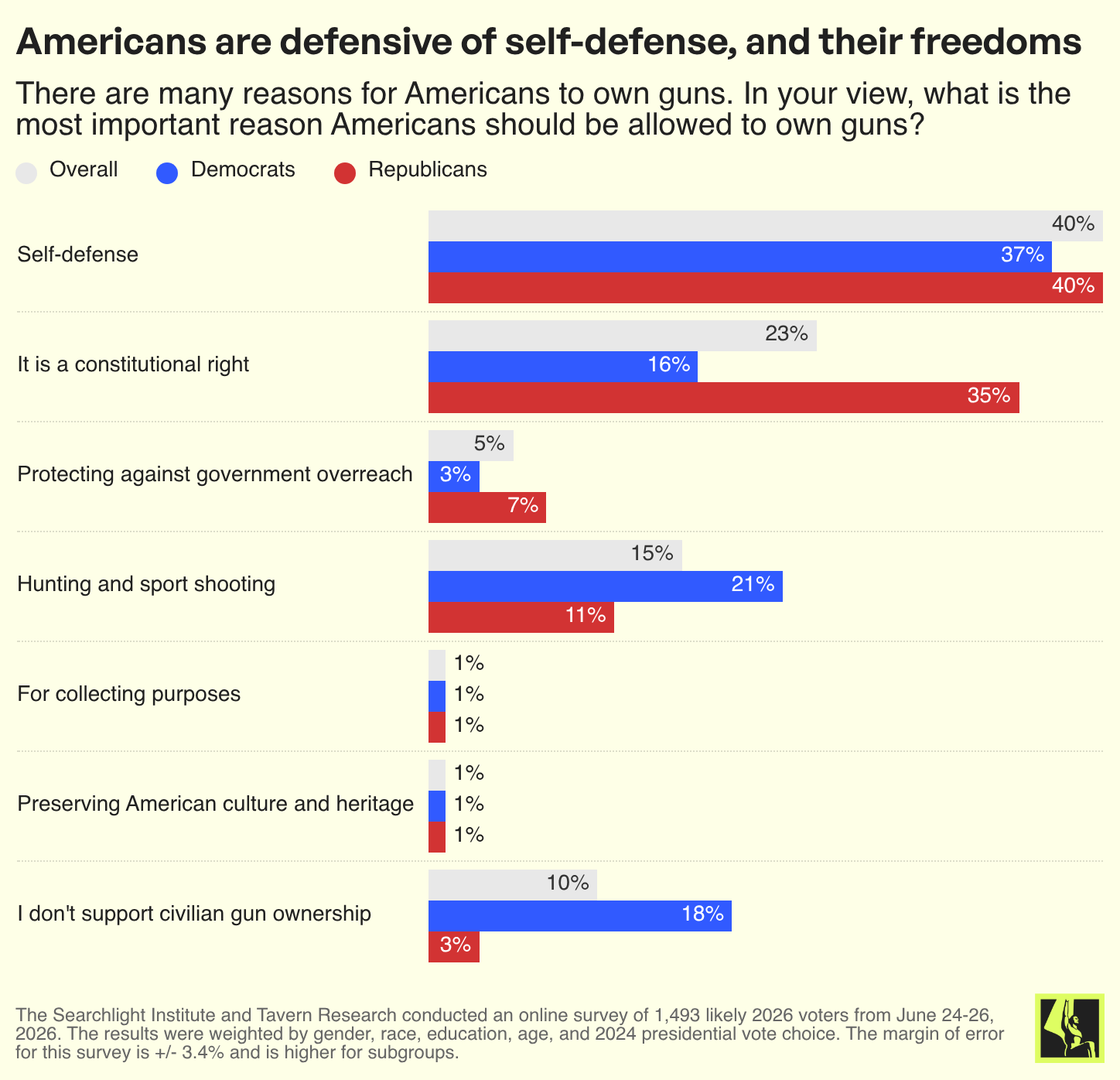
When asked to list the single-biggest reason why Americans should own guns, the overwhelming majority of respondents listed self-defense, constitutional rights, and hunting. Only 10% of respondents did not support civilian gun ownership. That’s a fact gun control activists need to reckon with, but that doesn’t mean we can’t pass gun control legislation in the future.
It’s time to revamp our movement
For too long, the left has been quick to jump on mass shootings as justification for sweeping reforms few Americans support. In doing this, we squander the political opportunity these horrible shootings create and polarize an issue that should command broad-based support.
Perhaps the most infamous example of unpopular and impractical gun control proposals came when Beto O’Rourke said: “Hell yes, we’re going to take your AR-15.”
I remember hearing that answer and trying to convince my mom to vote for him. She was dismissive, saying “No, Eliot, he has no chance of winning.” As we think about the best measures for addressing gun violence, we need less seventh-grade-Eliot attitude and more Eliot’s mom-attitude.
That being said, the movement has reached some policy success. In 2022, Congress passed the Bipartisan Safer Communities Act, which expanded background checks, school safety programs, and mental health services. Unfortunately, much of its funding has been slashed by the Trump administration.
But the operative word here is bipartisan. We will need buy-in from some Republicans, Independents, and gun owners if we’re going to pass any more meaningful legislation. And to ensure this legislation is durable, we will need to emphasize a new set of policies and messaging that avoids alienating those with cultural values far different from my own.
There is still a path towards common-sense gun reform
Our polling found broad support for a series of large-scale reforms: enacting tough-on-crime public safety programs, requiring the safe storage of guns, and repealing the law giving broad immunity to gun manufacturers.
Together, these policies reflect an agenda capable of uniting Americans around effective gun violence prevention policies.
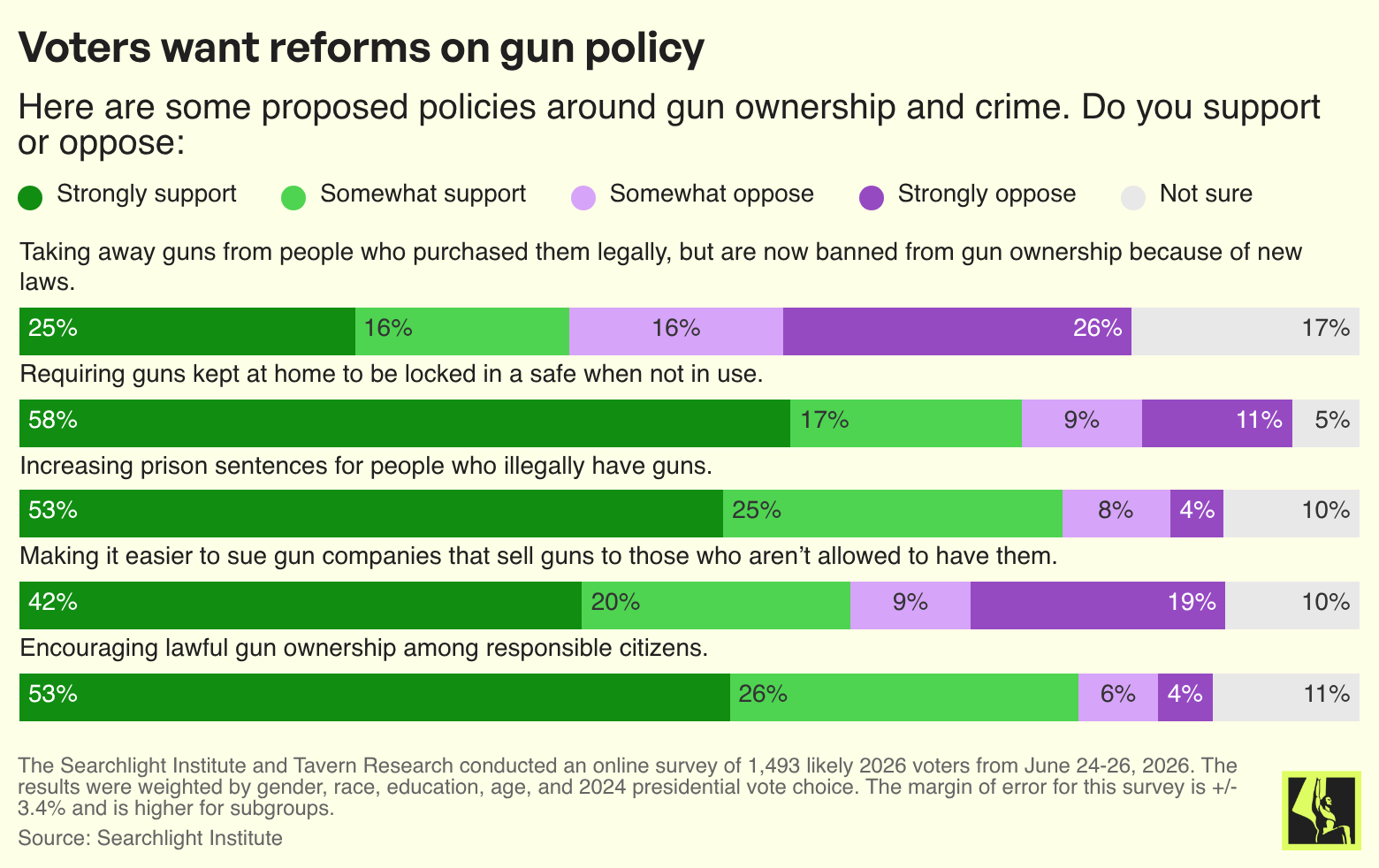
Of these policy reforms, increasing prison sentences for people who illegally have guns was the most strongly supported, with backing from 77% of voters, including 81% of Democrats, 78% of Republicans, and 71% of Independents.
This gets at one of the core ideological conflicts inside the gun control movement. We want to deter gun violence, but because we live under the progressive tent, we’re wary of tough-on-crime policies. This polling shows that harsher punishments for illegal gun owners actually command wide support across the political spectrum. While severe punishments are not the most effective way to deter homicides, it does point to the fact that voters are open to more enforcement. When district attorneys refuse to prosecute illegal guns, they’re on the wrong side of the public, and they’re making their community less safe.
The next most strongly supported policy is requiring guns kept at home to be locked in a safe, which 74% of voters — including 89% of Democrats, 64% of Republicans, 68% of Independents, and even 51% of gun owners — strongly or somewhat support.
Easy access to a gun in the house triples the likelihood of suicide and doubles the likelihood of homicide and fatal accidents. Requiring these guns to be locked in a safe not only reduces this threat, but toes the line between infringing on a constitutional right millions of Americans care about and keeping guns out of the hands of those who shouldn’t have them.
Across the country, 26 states have enacted some sort of Child Access Prevention (CAP) law that holds parents criminally accountable if a child accesses a gun because it wasn’t stored properly. These laws have been found to decrease suicide rates by 14%, and those that require guns to be stored unloaded in safes have an even greater effect.
The final strongly supported policy is making it easier to sue gun companies that sell guns to those who aren’t allowed to have them, which a supermajority of voters — including a slight plurality of Republicans — strongly or somewhat support.
The Protection of Legal Commerce in Arms Act (PLCAA) was passed in 2005, and it gave unique, broad immunity to gun manufacturers. The result has been a chilling effect on all lawsuits aimed at the gun manufacturers. Repealing this law would not significantly reduce gun homicides, but it would force gun manufacturers to face more accountability when their guns malfunction or are knowingly distributed to people who use them for mass shootings.
Building a big tent for gun control
Finally, it is essential that all measures to limit gun violence and improve public safety are underpinned by a protection of legal and safe gun ownership.
The least popular policy in our polling was taking away guns from those who purchased one legally, but are no longer allowed to own one because of new laws. Combine this with the polling result showing 10% of Americans do not support civilian gun ownership, and it’s clear that public opinion here is not in favor of the most maximalist gun control positions.
While the issue’s low national importance is at times pointed to as the reason for the lack of legislative progress, the messaging surrounding it is also to blame. In that same poll, we found that traditional pro-gun control arguments weakened support for stricter gun reform by 14 points. Two separate partisan interpretations of these facts decreased support by 20 and 21 points, respectively.
Ultimately, any form of federal gun control will need to pass through the Senate, which means it will need the support of senators who represent culturally conservative states with strong cultures of gun ownership.
A member of Congress from New York City can appease seventh-grade Eliot’s views on guns, but Senate candidates in Montana, North Dakota, and Nebraska (all states that had Democratic senators during Democrats’ 2009 supermajority) will likely not. They should listen to their constituents’ actual views on guns and champion the policies supported by a supermajority of Americans.
Though this heterodox strategy would not have appealed to me 10 years ago, embracing a big tent on gun issues avoids fueling the backlash that has hindered our movement’s progress — and puts us back on a path towards winning.

"We want to deter gun violence, but because we live under the progressive tent, we’re wary of tough-on-crime policies." Excellent point. There’s a cognitive dissonance on the Left between wanting tougher gun laws and then seeing what actually enforcing those gun laws is going to look like.
The idea that owning guns is primarily for self defense is a relatively new one promoted by the NRA and gun loving politicians. For most of our history, guns were not a cultural battle zone.
Unfortunately, after working on gun control for 26 years, I see no possible change unless the Supreme Court turns left.
The real focus for the movement should be suicide by gun. Mass shootings grab headlines but the reality is they are few and far between and impact very few Americans (directly). Until the gun control movement moves to that focus, little will change.