

So far, artificial intelligence seems to be having limited effects on the labor market. Despite the occasional viral headline announcing AI-driven job cuts, we are not seeing a big increase in unemployment or layoffs. While there are some weak signals in the market (notably the decrease in hires), there’s little support showing this is due to companies no longer demanding labor.
At the same time, we should recognize that this might not always be the case. It’s possible that a few years from now we will see dramatic shocks to the labor market. Policymakers should be preparing for these shocks now, so that appropriate policies to respond are already in place.
One of the most popular policies for mitigating the employment effects of AI also appears to be the simplest – we could just have the government create more jobs by directly hiring people. Polling by Blue Rose Research shows that 54% of Americans would support the government creating jobs directly, sometimes referred to as a “Job Guarantee.” Conversely, only 17% are in favor of direct income support without an attached job.
The US government previously used public employment programs similar to a Job Guarantee to help solve mass unemployment during the Great Depression. Agencies like the Works Progress Administration and Civilian Conservation Corps loom large in American history and serve as a reminder that a robust government can materially improve people’s lives with a paycheck and the dignity of work.
However, I want to be clear-eyed here and note that the existing literature shows we should be skeptical of a Job Guarantee working at scale today. While there are certainly great positive economic effects of high employment levels, I worry that we sometimes lose track of why jobs are good for people. A job doesn’t provide purpose, meaning, or skills in a vacuum. It provides those qualities in the context of that specific job being something employers demand.
A job created solely for the purpose of employing someone will not necessarily provide skills that will be useful elsewhere in the labor market. Moreover, employment will only feel valuable to people if they believe that their job is providing a valuable service. While there are cases where public works demand public employment, “make-work” jobs will not have the same functionality as jobs that exist to provide a specific service.
I have some ideas for how policymakers can think creatively about how to deal with a future of possible AI-induced unemployment. But as an economist who studies unemployment and job training programs for a living, I want to first start with a technical look at existing labor market interventions and an awareness of how effective these programs truly are.
Let’s begin our preparation for the potential AI jobs apocalypse by looking at the Congressional Budget Office’s 1976 typology for labor market interventions. It’s important to first understand how a federal jobs guarantee compares to other government programs.
Skill development programs try to enhance the skills of employees through a combination of classes or on-the-job training.
Work experience programs try to give an introduction to the workforce for people without previous employment, such as younger workers. Unlike on-the-job training, the goal is not to develop skills for a specific job, but to give job seekers experience working in general.
Employability development programs help people search for appropriate jobs. This includes job search assistance, resume help, and creating job boards to help workers and firms find each other.
Public sector employment programs hire the unemployed directly. These programs create new jobs expressly for the purpose of decreasing the number of people who are unemployed. These programs are typically aimed at adults with previous work experience.
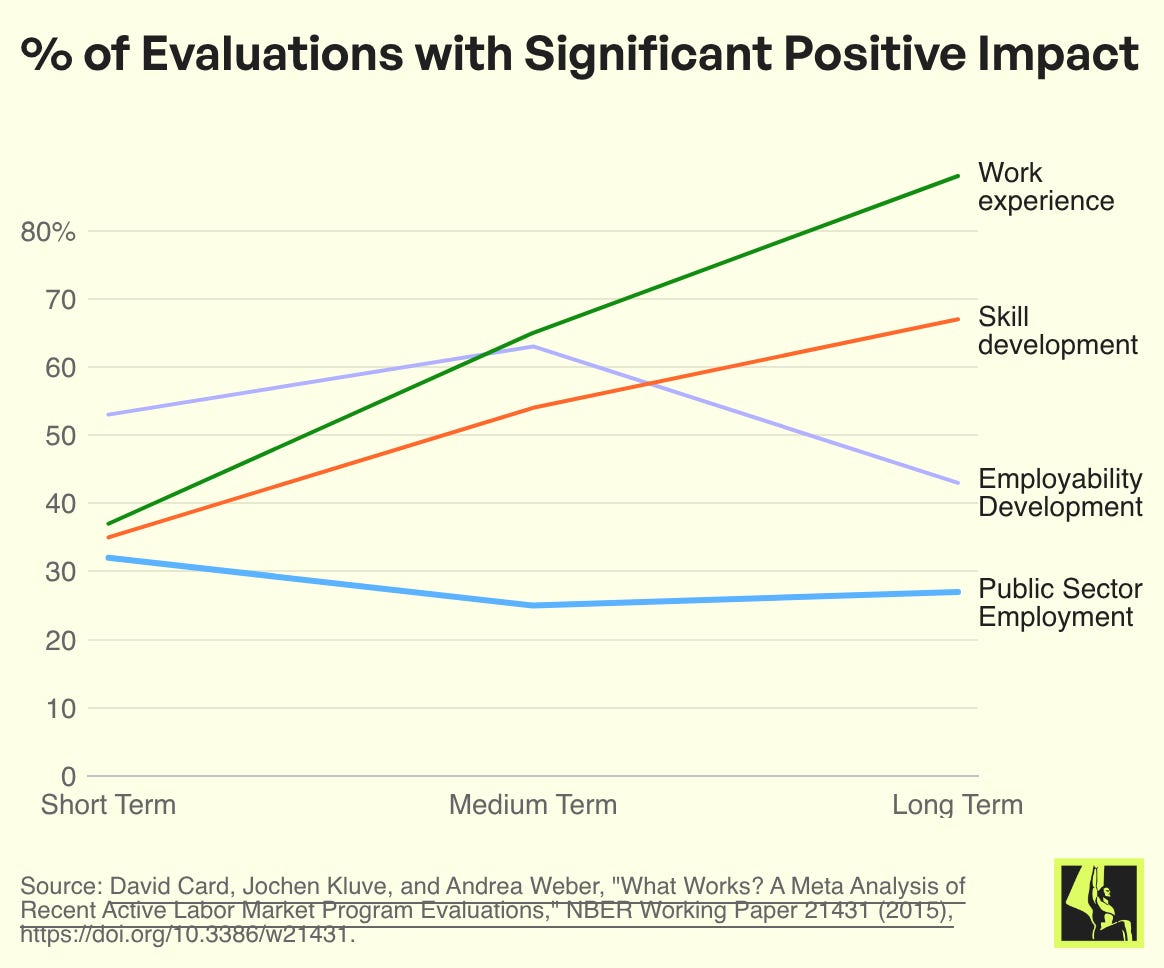
So how well do these programs work compared to other labor market interventions? To examine this, we can look at a meta-analysis across over 200 evaluations of workforce programs.1 The results show that evaluations of “skill development” and “work experience” programs tend to find weak results in the short run and strong results in the long run.2 “Employability development” programs, such as job search assistance, find strong results in the short run, and weaker long run results.
But “Public sector employment” – the programs a “Job Guarantee” would scale up – consistently find weaker results than the other three frameworks, in the short, medium, and long run.
Why is public sector employment ineffective? In part, because it crowds out other activities that the worker could be doing. A person who loses their job and receives unemployment insurance can spend their time looking for suitable jobs, developing skills to match what employers are looking for, and applying for positions. A person working in a public sector employment program has less time to do these things. Moreover, because the job was created for the purpose of providing employment, it might not provide the worker with skills that other employers will demand.
This doesn’t suggest that a Job Guarantee can’t be part of the package of programs intended to help workers with AI shocks. Perhaps a more expansive Job Guarantee will have fundamentally different effects than narrow public sector employment programs. Alternatively, maybe policymakers simply need more experience designing these programs and working to make them better. Proposals to pilot a Jobs Guarantee in a specific area, such as Senator Cory Booker and Representative Bonnie Watson Coleman’s Federal Jobs Guarantee Development Act, could help work out any bugs.
But we should also be focusing on scaling up effective programs and making them work even better. For example, a randomized trial of Year Up (a program that combines training and job placement) found that it increased wages by over $8,000 a year up to 7 years after the program ended. Scaling this program, or reworking it to focus on AI-related job destruction, could substantially help people adjust to any shocks. There are also useful tax reforms that could be enacted. The Earned Income Tax Credit (EITC) program is effectively a work subsidy – increasing the take-home pay of workers and making them cheaper for employers – and has substantially increased employment. Scaling the EITC up, such as Marco Rubio’s 2014 proposal to transform the EITC into a wage subsidy, could build on this success and keep people employed. Reforms that allow for more predictable unemployment taxes can also encourage greater hiring rates.3
Novel programs – including Job Guarantees – that are designed around the unique challenges of AI can supplement existing programs. But the core of our AI labor policy has to be programs and incentives that have been demonstrated to work. Policymakers across the political spectrum are right to be concerned about the prospect of future AI job displacement. It’s time they acted on that concern, and the public’s growing angst, to start developing solutions for it.
For the purposes of this paper, the “short run” is within a year of the program ending, “medium run” is approximately two years after the program ends, and “long run” is three or more years after the program was completed.
Because different studies use different outcome variables (for example, employment levels, wages, or time on unemployment benefits), the meta-analysis reports the results across all findings. Many studies include effects on employment such that it can be analyzed separately. The findings on the effects of an intervention on employment in isolation are similar to the effects across all variables.

I can't imagine that any type of guaranteed federal job program would work when one of the the republican party's main objectives since Reagan has been to shrink the federal workforce. Apparently, the author was asleep during doge's carnage run through the federal government. One of the fundamental problems with AI, is of course, a complete lack of regulation, from the building of data centers (and the complete lack of transparency regarding them), to the outrageous power their creators now wield. All of this is a direct result of unfettered capitalism at the expense of the average person. Thus, the strategy for dealing with AI is for the government to first establish its right to regulate AI. Trying to envision a solution for the inevitable end result—a reduction in the workforce—is a reactionary position that, like so many bandaid approaches to problems the federal government has tried to address, does not treat the fundamental underlying cause of the problem. Once the government claims its right to regulate AI for the good of the people to whom it owes its only allegiance, then we can begin to address this issue.
Dude I didn’t realize you were affiliated with Searchlight - I should have said ‘hi’ when I was chilling with Adam and Matt Lavkey in the office a month or so ago!