

Today’s article is from Blas Nuñez-Neto, a Searchlight Senior Fellow and former Biden administration assistant secretary for border and immigration policy at the Department of Homeland Security, and Daniel Delgado, a Searchlight Senior Fellow and former deputy assistant secretary for immigration policy at the Department of Homeland Security.
Last week, hikers in Texas’ Big Bend National Park were surprised to find a new invasive species: Bulldozers.
The Trump administration had begun clearing parts of the unspoiled wilderness to make way for what CBP coined “limited” barriers as part of President Trump’s plan to build a “Big Beautiful Wall” across our southern border.
But the plan is seemingly short-lived. After a rare round of bipartisan political finger-pointing, CBP announced on Monday it was temporarily pausing construction to review the project.
This Big Bend border project is part of DHS Secretary Markwayne Mullin’s broader push to use almost $50 billion of its overall $165 billion slush fund, courtesy of the One Big Beautiful Bill, to build a wall across the entire southwest border before President Trump leaves office. This would fulfill a long-standing promise that then-candidate Trump made during the 2016 presidential campaign.
President Trump’s signature “build the wall” slogan has functioned as a signal to immigration-skeptical voters that Trump was the only candidate who took their concerns seriously. And consequently, it pushed Democratic candidates—including President Biden in 2020—to reflexively oppose building any walls at the border. During the Biden administration, this led DHS to tie itself into knots trying to justify why it was leaving large gaps in the existing border wall in place even as the materials that were purchased to close those gaps rusted nearby. And while this was certainly not the biggest border issue during the Biden administration, a number of migrants exploited those breaches to cross illegally.
The border wall debate is both one of the dumbest policy debates in American politics and a perfect encapsulation of how extremes on both sides prioritize performative immigration politics over common-sense policymaking. As with most immigration issues, the best solution is one that charts a pragmatic middle path.
Walls Are Not a Magic Bullet
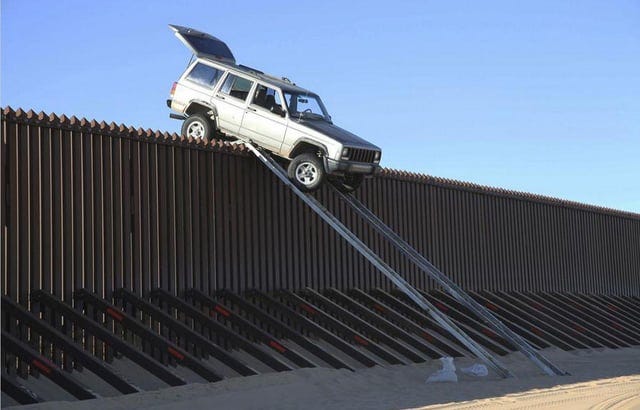
The two of us have spent more than three decades cumulatively working on border security and immigration issues, from inside and outside the federal government. One of us even authored the first comprehensive Congressional report on U.S. border barriers in 2006. So let us bring you in on a little secret: Border walls do work, but not in the way the president seems to believe. They don’t stop people from crossing illegally. They do, however, slow people down and give Border Patrol agents more time to make an arrest before illegal immigrants escape into the interior. They also channel migrants into more predictable areas where Border Patrol is better equipped to engage.
Building border walls makes operational sense in parts of the border where the Border Patrol has a limited amount of time to arrest someone before they disappear into a city or are picked up by smugglers. That is why DHS has been building walls in urban, suburban, and exurban parts of the border since the early 1990s, under presidents of both political parties.
But in the remote wilderness that covers vast tracts along our border, dominated by rugged mountain ranges and desolate deserts, it can take days of walking before someone who crosses illegally reaches a town or a road. This is even more pronounced in areas like Big Bend, which is nicknamed El Despoblado, or the Uninhabited, and it accounts for nearly a quarter of the U.S.-Mexico border. In fact, some parts of the border are so remote that Border Patrol agents are often airlifted in to set up camp. It doesn’t make much operational sense to build expensive walls or barriers in those remote areas when nature has already done the job for us. These wilderness areas are so remote and hard to navigate that hundreds of migrants die each year trying to make the trek to the nearest sign of civilization. That’s a human tragedy that a smarter immigration policy would aim to fix.
But there are other factors to consider too. Smugglers and migrants tunnel under, climb over, and cut through the border wall every day. Just like any man-made structure subject to the elements and tampering, agents need to constantly monitor and repair the walls and barriers erected along the border. This is much easier to do in areas where there are nearby Border Patrol stations that can quickly respond to such incidents and make the necessary repairs. And that work is far easier to do in the urban, suburban, and exurban parts of the border.
Hitting you in the wall(et)
Of course, President Trump doesn’t just want to build a wall across the nearly 2,000 miles that make up our border with Mexico; he also wants to paint it black. The president apparently believes that doing so will make the wall so hot that it will be “untouchable” for migrants and dissuade them from trying to climb it. As experts have noted, though, any increase in surface temperature would be negligible, and definitely not worth the estimated $500 million to $3 billion price tag.
Of course, this administration’s track record with painting things does not exactly inspire confidence that the costs will be contained or that the paint will be effective.
This would all be funny if it wasn’t such an epic misuse of taxpayer funds. Unsurprisingly, Trump’s DHS has not been transparent about these projects and their costs. The One Big Beautiful Bill secured $46.5 billion to construct 700 miles of new wall along the border. Much of it will likely go to building a wall in places where we don’t actually need it and will require expensive ongoing repair forever.
During the first Trump administration, journalists identified more than 200 contract modifications to wall construction contracts that increased costs by billions without adding significantly to its length.
Cost overruns are already happening. A company that was awarded a $1.68 billion contract to build walls in New Mexico had a contract modification issued just three weeks later that added another $108 million to the contract. Needless to say, the contracts for building the wall are going to companies with ties to the White House.
Bending over backwards
That brings us back to Big Bend, where the administration’s waiver of environmental laws to build access roads and install barriers in an iconic national park has drawn bipartisan scrutiny. Is it operationally needed? One way to gauge that is whether there is a significant number of illegal crossings in the area. Just last year, Customs and Border Protection touted that the Border Patrol reported fewer than 10 encounters a day of people crossing the border illegally in the Big Bend sector, making it one of the quietest parts of the border.
Spending $1.7 billion and blasting an access road across iconic sections of a national park to stop 10 people a day from crossing the border illegally does not seem like the best use of taxpayer funding—particularly when other options that are cheaper and much less invasive are available, such as sophisticated surveillance towers that use AI to help identify illegal activity and vector in agents. Those brand-new access roads could also backfire and be used by migrants to move more quickly out of the park.
It really shouldn’t be this hard to have a rational conversation about border walls. We should definitely build and maintain walls along the border, but only where it makes sense operationally to deter and slow illegal crossings. In the more remote parts of the border where walls don’t make sense operationally, we should use the funds provided by Congress to invest in smart technology that brings our border into the 21st century and helps our Border Patrol better monitor and respond to illegal activity. Doing so would be a much better use of taxpayer funds than building and painting yet another monument to the president’s whims.


I like the article. Will admit it was the photo at the top that caught my eye. Got to admire their dedication to crossing the wall tbh lol.
They key issue for Dems is near the end of this piece: "We should definitely build and maintain walls along the border, but only where it makes sense operationally...." The border is one of those wedge issues that Dems must make go away.