

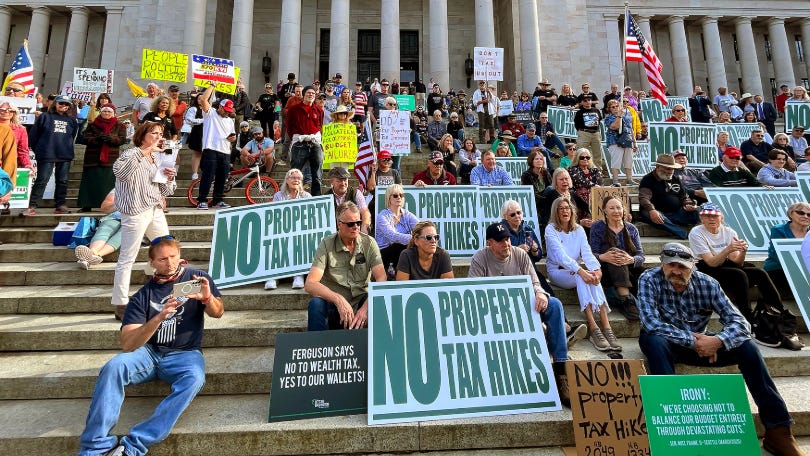
By now, you’ve probably read just about every piece of analysis about the 2026 midterms. But if you care about funding the sort of policies that were promised by the candidates who won those races — and you should — then it’s time to talk about how tax policy performed at the ballot box.
This election cycle, there were 29 state-level tax ballot measures across 16 states. Some proposed sweeping changes, while others were minor tweaks. Meanwhile, candidates across the country ran for office on a variety of tax reforms. These ranged from raising rates on billionaires to lowering tax burdens on the middle-class.
Lurking in the background was a widely proclaimed “tax revolt” — voters were reported to be dissatisfied with their tax obligations and some politicians campaigned on policies that would alleviate them. Now that the results are in, we have some more data to answer the question that lingered over this election cycle: Are we truly in the midst of a tax revolt?
Of the 29 tax referendums, five measures proposed tax increases while 24 would have reduced taxes or curbed the ability of the state to pass or increase taxes in the future. Of the 24 tax cutting or limiting referendums, 13 passed. On the tax-expanding side, three of the five measures were successful.
These results show that the direction of tax reforms is a jump ball. In all, the anti-tax stance (the passage of an anti-tax measure or the failure of a pro-tax measure) only prevailed on one more ballot measure than the pro-tax stance (the passage of a pro-tax measure or the failure of an anti-tax measure).
That’s why I’d call this a tax grumble, not a full-on revolt.
Where the tax revolt won
Of the 29 tax measures on the ballot, 15 had an anti-tax result:
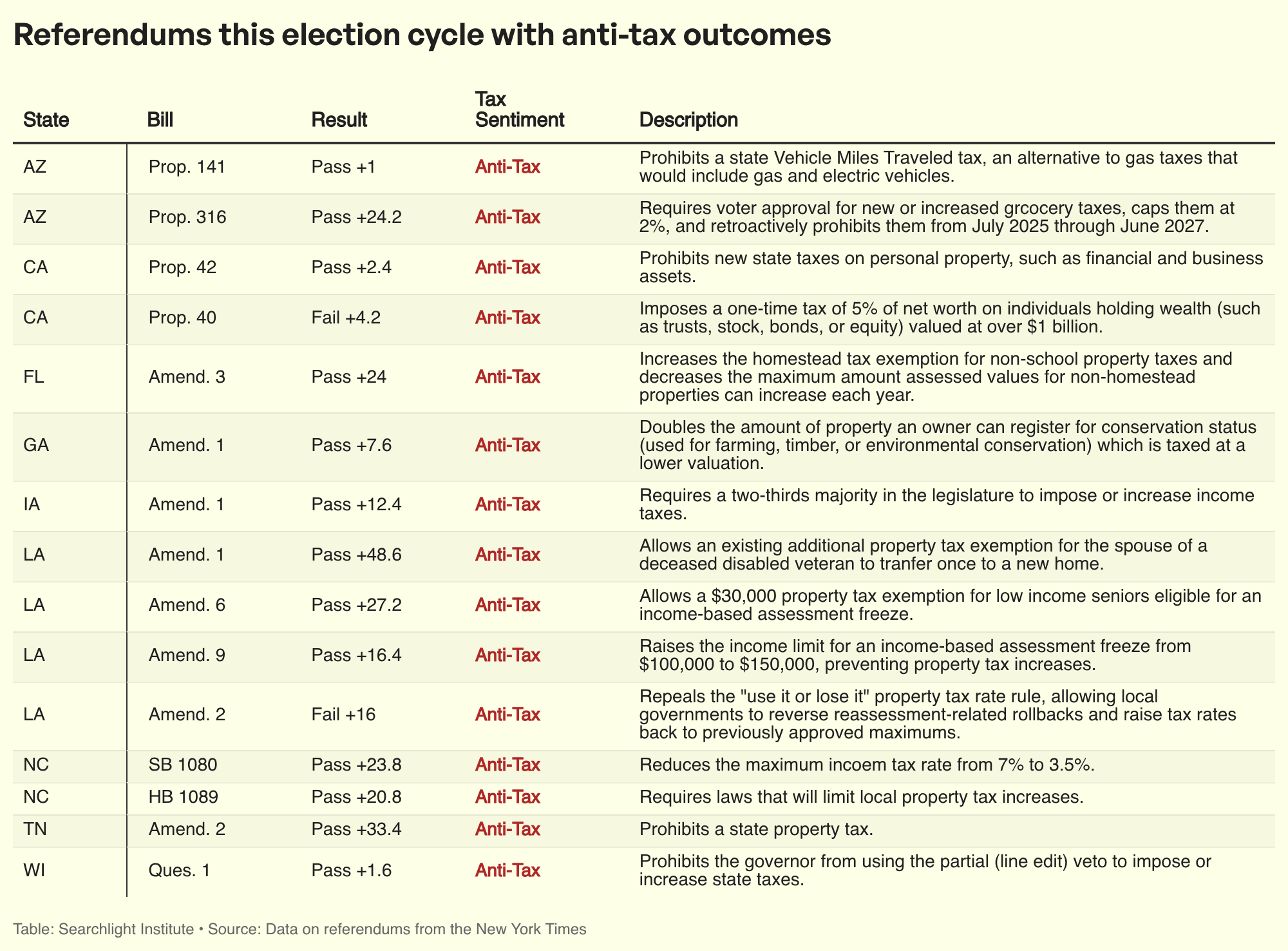
Of course, not all tax referendums are created equal. But as a policy wonk who really hates regressive taxes, I want to start with some of the big ones.
Florida’s Amendment 3 increased the property tax exemption from $25,000 to $150,000 in 2027, and to $250,000 in 2028, and decreased the maximum amount property taxes can increase annually.
As a consequence, public services will take a $12 billion blow in funding. This will impact everything from public education and infrastructure to public safety and disaster preparedness.
Property taxes account for three-quarters of Florida’s local tax revenue, so local governments will need to cut services or scrape together enough money for the basics. This could mean that taxes skyrocket on properties that are not eligible for the exemption (like apartment buildings with renters) or localities increase sales taxes, which are more regressive. Of course, Florida does not have a state income tax, so that’s another missing revenue source.
Florida was not alone. Property taxes were slashed or limited across the country — a “property tax revolt” nested within a more mixed electoral environment for taxes. In total, nine of the 13 property tax ballot measures ended in an anti-tax result. In the Atlantic, Annie Lowery described this as a form of “class and generational warfare.”
Let’s move to another major form of state and local revenue: income tax. North Carolina voted to cut its maximum income tax rate in half from 7% to 3.5%.
Dollar for dollar, income taxes tend to be progressive: even with a flat tax rate, as you earn more, you pay more. Capping the maximum tax rate impedes future reforms, such as graduated tax rates, which consequently limits the state’s flexibility to raise revenue in the future. So if North Carolina finds itself in a budget crunch, or needs to generate funds to recover from another natural disaster, they’ll need to increase state sales tax and property taxes, which are typically less progressive.
One should not forget about the politicians who campaigned on anti-tax populism. In Iowa and Nevada, candidates flipped seats while supporting policies such as no tax on tips, overtime, and Social Security — tax exemptions which have, so far, failed to stop the affordability crisis. In Texas, James Talarico advocated for a middle class tax cut, while Gina Hinojosa floated tax refunds and lower property taxes. In Georgia, Keisha Lance Bottoms campaigned on targeted income tax relief, proposing to remove certain groups from the tax base and increase broad exemptions.
These were just campaign promises and elected officials should be wary of actually implementing them, both because it will undermine their other progressive goals and because the political benefits are pretty overrated. A Politico poll released shortly before the election found that only 9% of voters said taxes were a top issue. Searchlight polling conducted earlier this year did find that voters thought they were paying too much in taxes. But when asked what would make them feel better about their tax burden, “paying less” was the second least popular answer — responses about tax fairness and transparency performed the best.
Democrats must remember that tax promises like these act as a Band-Aid over the bullet hole of affordability — a tax credit of a few hundred dollars on April 15 just doesn’t make up for higher grocery prices, expensive gasoline, crippling housing costs, or burdensome health care bills year-round. Worse, Democrats’ embrace of these tax ideas will just make it harder to pay for their social programs; it’s either tax slop or a bigger safety net — one cannot have it both ways.
Where the tax revolt lost
Not all voters wanted lower taxes. There were five “pro-tax” measures on the ballot, three of which passed. Nearly half of the “anti-tax” measures also failed — a result you wouldn’t see amid a true revolt.
In all, the pro-tax sentiment prevailed in 14 of the 29 tax ballot measures:
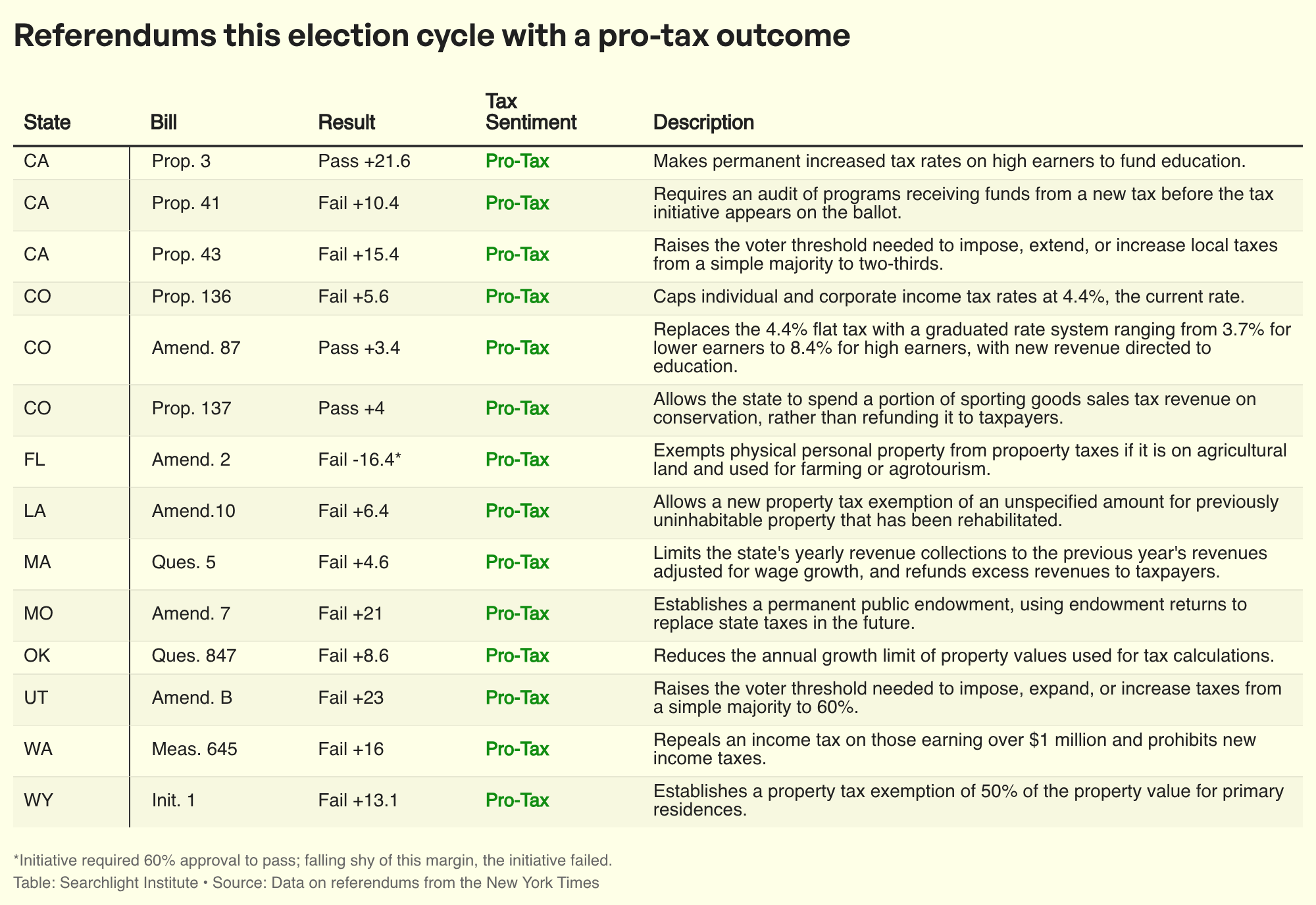
The most important pro-tax measures increased rates on the wealthy. Washington voted to maintain their income tax on households earning over $1 million, which will go into effect in 2028 (pending litigation) and uphold the state’s right to enact new income taxes across the board — this is important seeing as Washington does not currently have a state income tax.
Colorado voted to replace its flat income tax with a graduated tax system, allowing for increased rates on higher earners. On a city level, Chicago voted to enact a surtax on the wealthy — an individual 3% income tax on those earning more than $1 million annually. Overall, five of seven measures specific to income taxes resulted in a pro-tax outcome. This will make state income tax codes more progressive and light a sustainable path toward ‘taxing the rich.’
Voters didn’t just vote to raise taxes on the ultra-wealthy. In Colorado, an initiative to cap tax rates failed — which allows the state to enact a graduated tax system. Oklahoma voted down a question that would have decreased the growth limit for property tax assessments, meaning voters left the future open to higher property tax rates. On Amendment 87, Missouri voters rejected a proposal to replace income taxes with a sovereign wealth fund, even though it may have eliminated their own state tax bills. Voters in Massachusetts also rejected a reform that would limit state revenue collections and refund excess revenues to taxpayers.
So why did some taxes fail and others succeed? I found that the design of the tax often mattered far more than the politics of the state, and the best example of this is California.
The Golden State is famous (or infamous) for its high taxes. But Prop. 40, the wealth tax, failed, in part, because there were real questions over its functionality and legality — as well as historic opposition spending.
At the same time, Californians passed Prop. 3, which made an income tax on high earners permanent, as well as rejected Prop. 41 and Prop. 43, which would have made it harder for the state to pass new taxes. But then when it came to personal property taxes, Californians voted to restrict them.
Politicians have a choice
So call it a revolt or a grumble, the point remains: anti-tax politics is a real force. But it’s important to not overstate its importance, both at the state and national level. Despite being the ‘party of low taxes’ and riding the coattails of one of the biggest tax cuts since Reagan, Republicans lost nine Senate seats, six governorships, and more than 40 House seats this election cycle.
Searchlight polled voters in seven battleground states and only 2% of respondents mentioned taxes as a factor in their vote. And importantly, some of those voters were talking about raising taxes on the wealthy rather than lowering taxes for themselves. In every case, cutting taxes mattered far less than making daily goods and healthcare more affordable.
As Democrats craft their affordability agenda, they should look to balance tax reforms that generate revenue with those that help deliver immediate cost-of-living improvements. If they’re looking for more money, don’t be afraid to repeal some of Trump’s “no taxes” proposals. That money can be spent on much more progressive and impactful tax credits like the EITC and CTC that more Americans can broadly access.
Ultimately, Democrats have a choice — continue to expand the social safety net or engage in a race to the bottom with the GOP on taxes. The latter option is regressive and politically pointless.
